

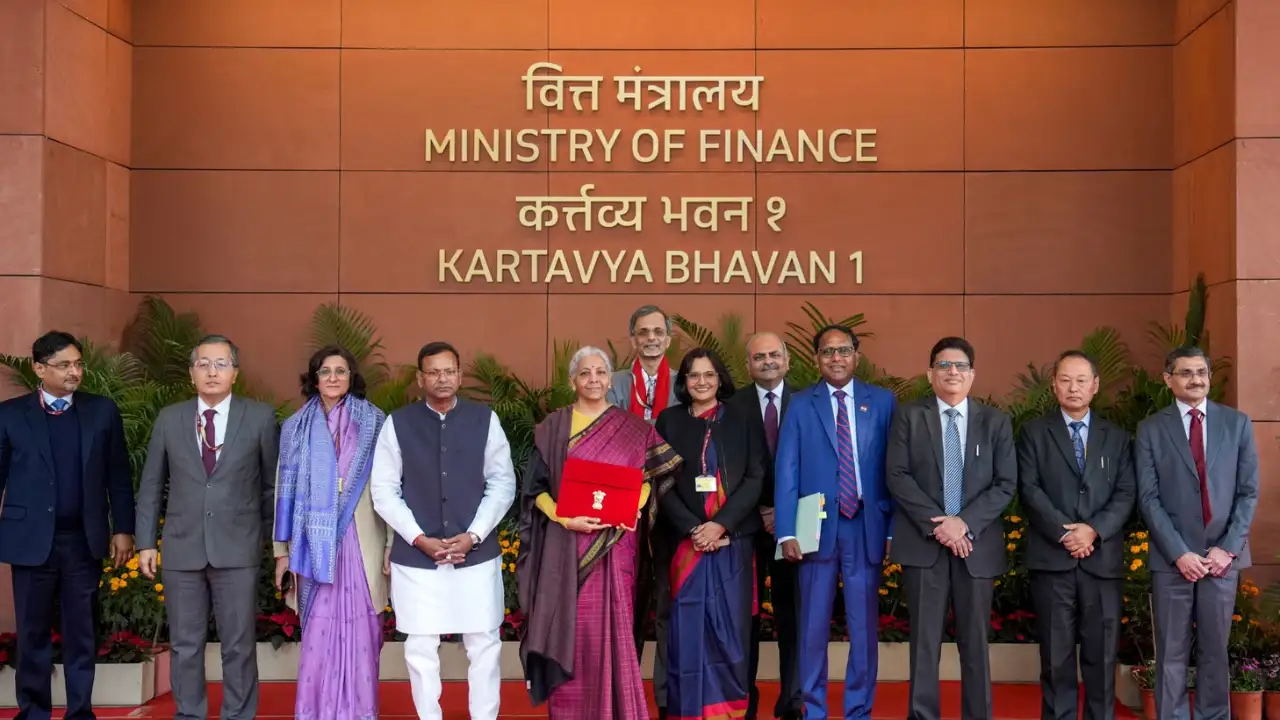

February 1, 2026: Finance Minister Nirmala Sitharaman presented the Union Budget for 2026–27 in the Lok Sabha, describing it as a continuation of reforms undertaken over the past 12 years. Delivered on the occasion of Magha Purnima and the birth anniversary of Guru Ravidas, the speech marked the first Budget prepared in Kartavya Bhawan. Sitharaman said India’s recent economic performance had been characterised by stability, fiscal discipline and moderate inflation, with growth averaging around 7 percent.
She outlined three guiding kartavya—accelerating economic growth, building the capacities of citizens, and ensuring inclusive access to resources. The Budget, she said, sought to balance domestic priorities with India’s integration into global markets amid disruptions to trade and supply chains.
Manufacturing Push Across Strategic Sectors
A major portion of the Budget focused on scaling up manufacturing in seven strategic and frontier sectors. Among the key announcements was Biopharma SHAKTI, a ₹10,000-crore programme spread over five years aimed at developing India as a global hub for biologics and biosimilars. The plan includes three new National Institutes of Pharmaceutical Education and Research, upgrades to seven existing institutes, and the creation of more than 1,000 accredited clinical trial sites.
Certified Cyber Crime Investigator Course Launched by Centre for Police Technology
The government also announced India Semiconductor Mission 2.0, expanding its scope to include equipment manufacturing, materials, and full-stack Indian intellectual property. The outlay for the Electronics Components Manufacturing Scheme was raised from ₹22,919 crore to ₹40,000 crore following higher-than-expected investment commitments.
Support was extended to states with mineral resources through proposed Rare Earth Corridors in Odisha, Kerala, Andhra Pradesh and Tamil Nadu. Three chemical parks are to be established through a challenge-based cluster model to reduce import dependence.
Textiles, MSMEs and Industrial Clusters
For the textile sector, the Budget proposed an integrated programme covering fibre self-reliance, cluster modernisation, handloom and handicraft support, sustainability initiatives, and skilling through Samarth 2.0. Mega Textile Parks were proposed in challenge mode, along with a Mahatma Gandhi Gram Swaraj initiative to strengthen khadi and village industries.
To support MSMEs, the government announced a ₹10,000-crore SME Growth Fund and a ₹2,000-crore top-up to the Self-Reliant India Fund. Measures to strengthen the Trade Receivables Discounting System included mandatory use by CPSEs and new credit-guarantee mechanisms. A scheme to revive 200 legacy industrial clusters was also proposed.
Infrastructure, Connectivity and Cities
Public capital expenditure was increased to ₹12.2 lakh crore for 2026–27, up from ₹11.2 lakh crore in the previous year. The Budget proposed an Infrastructure Risk Guarantee Fund to provide partial credit guarantees during the construction phase of projects.
New Dedicated Freight Corridors, 20 additional National Waterways, and a Coastal Cargo Promotion Scheme were announced. Seven high-speed rail corridors, including Delhi–Varanasi and Varanasi–Siliguri, were identified as growth connectors. The government also announced incentives for indigenous seaplane manufacturing and operations.
Cities were identified as engines of growth, with a proposal to map City Economic Regions and allocate ₹5,000 crore per region over five years for reform-linked development.
Financial Sector and Fiscal Position
The Budget proposed the formation of a High-Level Committee on Banking for Viksit Bharat, along with reforms in corporate and municipal bond markets. Municipal bond issuances exceeding ₹1,000 crore would receive incentives of ₹100 crore per issuance.
On fiscal consolidation, the government projected a fiscal deficit of 4.3 percent of GDP for 2026–27, with the debt-to-GDP ratio estimated at 55.6 percent. Sitharaman said the government had met its earlier commitment to bring the deficit below 4.5 percent by 2025–26.
Social Sectors, Education and Conclusion
Announcements in health and education included new allied health institutions, regional medical tourism hubs, additional AYUSH institutes, five university townships, and girls’ hostels in every district with higher-education STEM institutions.
The speech concluded with proposals on direct and indirect taxes, customs duty rationalisation, and export incentives. Sitharaman commended the Budget to Parliament before closing her address with “Jai Hind.”
