


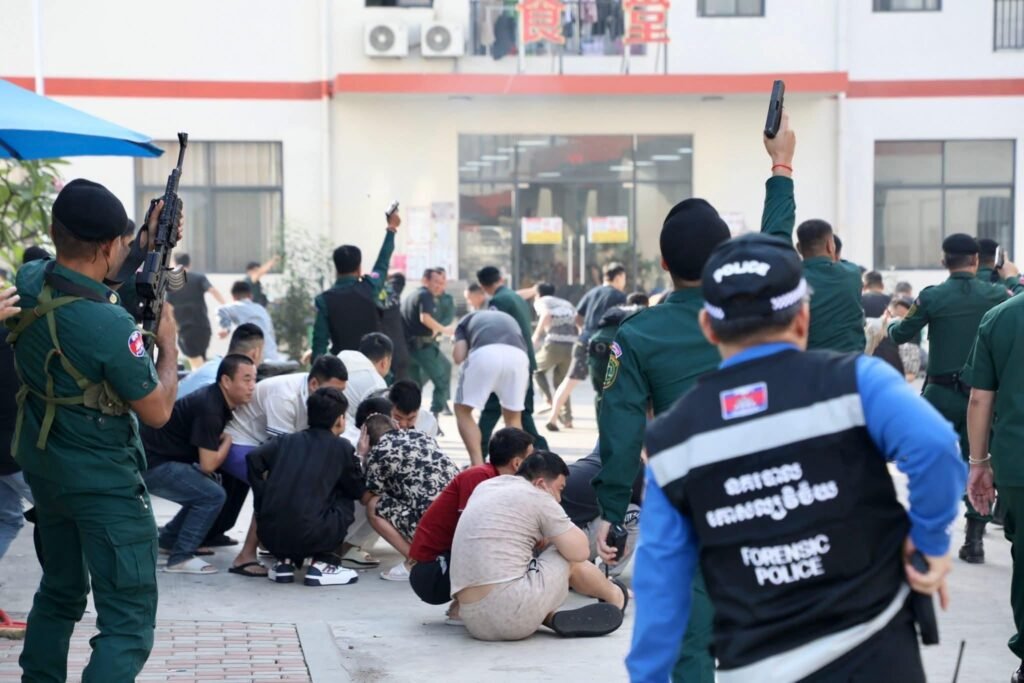
BAVET, CAMBODIA — In one of the largest enforcement operations against online fraud syndicates this year, Cambodian authorities raided a massive casino complex in Bavet City on January 31, 2026, detaining over 2,000 foreign nationals suspected of involvement in cybercrime operations.
The operation, targeting the Wan Cheng (A7) casino complex in Svay Rieng province, resulted in the detention of 36 Indian nationals among a total of 2,044 foreigners, according to an official press release from Cambodia’s Ministry of Interior.
Certified Cyber Crime Investigator Course Launched by Centre for Police Technology
Large-Scale Operation Deploys 700 Officers
The raid was executed under orders from National Police Commissioner General Sar Thet, with approximately 700 specialized personnel deployed to the 22-building casino complex located in Tabep Village, Bavet Sangkat. The operation was coordinated by Deputy Commissioners Lieutenant General Chiv Phally and Lieutenant General Moeung Sothea, with legal oversight provided by the Svay Rieng Provincial Court prosecutor.
Bavet City, situated on Cambodia’s border with Vietnam, has emerged as a notorious hub for online scam operations in recent years.

Breakdown of Detained Individuals
According to official figures, those detained include:
- 1,792 Chinese nationals
- 179 Myanmar nationals
- 177 Vietnamese nationals
- 36 Indian nationals
- 30 Nepalese nationals
- 5 Taiwanese nationals
- 2 Laotian nationals
- 1 Malaysian national
- 1 Mexican national
Authorities have not yet clarified how many of those detained will be formally arrested, charged, or treated as victims of forced labour—an issue that has repeatedly surfaced in Southeast Asia’s scam economy.
ALSO READ: Myanmar’s Paradox: When Scam Compounds Fall, Where Does the Fraud Go Next?
Bavet: A Known Scam Corridor
Bavet’s location on the Vietnam border has long made it attractive to transnational fraud syndicates, particularly those running investment scams, romance frauds, and telecom-enabled cybercrime. Friday’s raid marks another enforcement action in a region that has seen repeated but uneven crackdowns.
India–Cambodia Coordination
The operation comes weeks after senior-level engagement between India and Cambodia. On January 6, 2026, Senior Minister Chhay Sinarith, Chief of Cambodia’s Commission for Combating Online Scams (CCOS), received an Indian delegation led by Rajesh Kumar, CEO of the Indian Cyber Crime Coordination Center. The meeting focused on cooperation against online scams affecting Indian citizens, including trafficking and forced participation in scam centres.
ALSO READ: Inside Cambodia’s Scam Compounds: Torture, Trafficking, and Deepfakes
India’s Embassy in Cambodia acknowledged the development on social media, indicating that New Delhi is closely tracking cases involving Indian nationals.
Cambodia’s Message: “No Safe Haven”
Responding to the operation, Deputy Spokesperson of the Ministry of Interior Dr. Touch Sokha said the raid demonstrated Cambodia’s resolve to dismantle online scam networks.
“Cambodia is not a safe haven for criminals, but a hell for criminals,” he said, reiterating the government’s zero-tolerance stance.
The Interior Ministry credited the current enforcement push to policy direction under Hun Sen, who, on February 20, 2025, approved the creation of a dedicated national committee to combat online scams. The committee is chaired by the Prime Minister, with Deputy Prime Minister and Interior Minister Sar Sokha as vice-chairman, and the National Police leadership as members.
Crackdown Numbers Paint a Bigger Picture
According to official data, Cambodia’s National Police conducted 48 operations against online scams in the first nine months of 2025, arresting 168 individuals, prosecuting them, and deporting 2,722 foreign nationals to their home countries.
In January 2026, Cambodian authorities also announced the arrest of Chen Zhi, described as a major scam mastermind, who was deported to China after months of investigation.

Accountability Within the System
The Interior Ministry has warned that enforcement will extend inward as well. Any official found complicit or negligent in online scam operations will face strict action, including dismissal and removal from office, officials said.
What Remains Unclear
Despite the scale of the raid, Cambodian authorities have yet to release:
- Details on formal charges
- Whether detainees were trafficked or coerced
- Timelines for deportation or prosecution
- Consular access for foreign nationals, including Indians
For India, where thousands of families have reported loved ones lured to Southeast Asia with fake job offers, the detention of 36 Indian nationals will be closely watched—both for accountability and for potential rescue and repatriation efforts.
As cyber-enabled fraud continues to drain billions globally, Friday’s operation signals intent. Whether it leads to sustained disruption of scam ecosystems—or merely another temporary dent—will depend on what follows next.
Follow for daily updates on cybercrime, corporate fraud, DFIR, hacking, investigations, and digital forensics
