

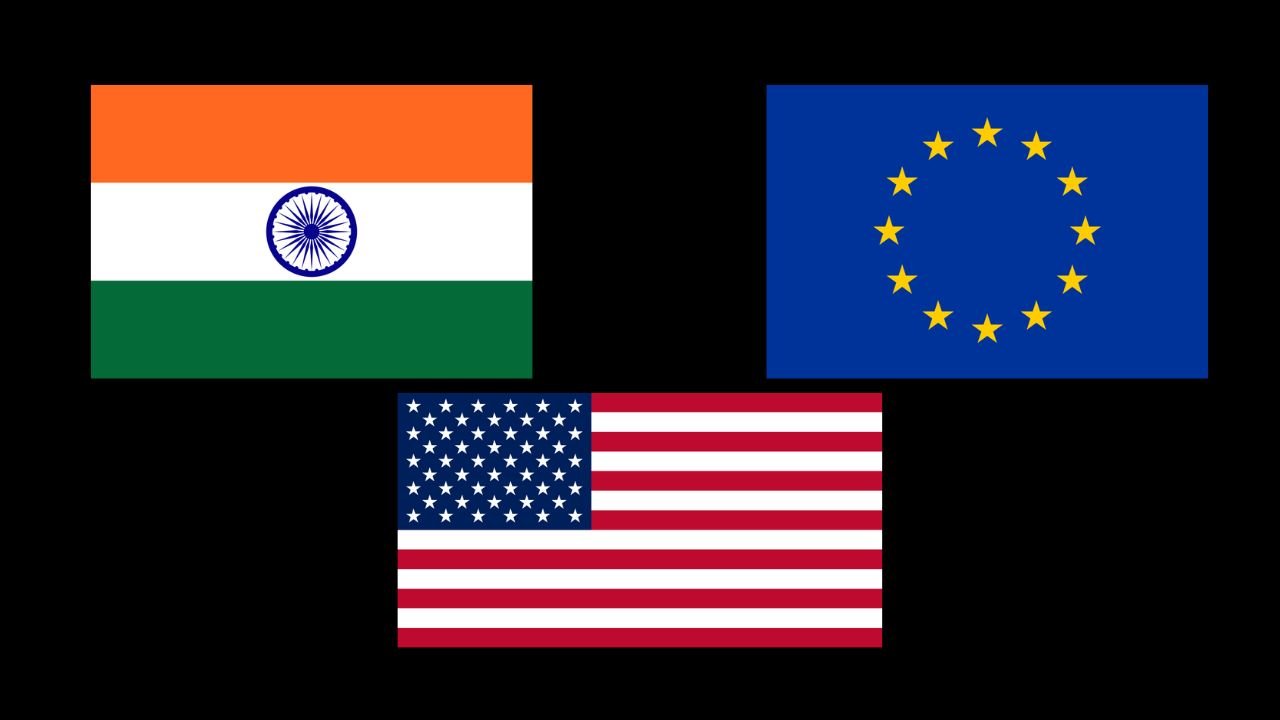

New Delhi: The United States has openly criticised the European Union’s newly concluded free trade agreement with India, accusing Europe of prioritising commercial interests over its stated commitment to supporting Ukraine during the ongoing war with Russia. The sharp remarks underline growing strains within the Western alliance over trade policy, energy flows and the strategy to economically isolate Moscow.
The criticism came a day after the European Union finalised its long-pending trade pact with India, a deal aimed at expanding bilateral commerce and reducing Europe’s strategic dependence on the US amid intensifying global trade tensions. Washington argued that the timing and substance of the agreement weakened collective pressure on Russia at a critical juncture in the conflict.
Certified Cyber Crime Investigator Course Launched by Centre for Police Technology
Speaking in a televised interview, the US Treasury chief said Europe’s decision exposed a contradiction between rhetoric and action. While acknowledging Europe’s right to pursue its own economic interests, he said the trade agreement demonstrated that commercial considerations had outweighed geopolitical commitments.
Trade deal linked to tariff divergence
US officials said the India–EU pact also explained why Brussels declined to align with Washington’s decision last year to impose higher tariffs on Indian exports linked to Russian oil purchases. According to the Treasury chief, European governments were unwilling to support US trade penalties because they were pursuing a comprehensive commercial agreement with New Delhi.
He argued that European leaders routinely emphasise solidarity with Ukraine while simultaneously taking decisions that undermine economic pressure on Russia. “Each time European leaders speak about Ukraine, this trade decision should be kept in mind,” he said, adding that Europe had chosen trade over geopolitical alignment.
Energy flows under scrutiny
At the core of Washington’s criticism is the continued flow of Russian energy into global markets. US officials alleged that European countries were indirectly financing Russia’s war effort through refined oil purchases routed via India.
According to the US assessment, Russian crude is exported to India, refined into petroleum products, and then sold onward to European buyers. While such transactions comply with current sanctions frameworks, Washington argues that the economic effect ultimately benefits Moscow.
“The oil goes into India, the refined products come out, and Europe buys them,” the Treasury chief said, adding that this dynamic diluted the impact of sanctions and weakened collective pressure on Russia.
US officials noted that similar concerns had been raised with European counterparts in the days leading up to the formal conclusion of the trade agreement, but these warnings did not alter Brussels’ approach.
Pressure imbalance within the alliance
The remarks reflect a broader sense of frustration in Washington over what it sees as an uneven distribution of economic sacrifices in the effort to end the Russia–Ukraine war. US officials said Washington had imposed tougher measures, including higher tariffs and stricter financial restrictions, while Europe continued to prioritise economic stability and energy security.
The Treasury chief said the US had borne greater costs in pressuring Moscow and had taken politically difficult decisions that Europe had avoided. He argued that coordinated action was essential if sanctions were to have a meaningful impact.
Trade, geopolitics collide
The India–EU free trade agreement is widely seen as a strategic economic move by Brussels, particularly as global trade becomes increasingly fragmented. For Europe, closer trade ties with India offer supply-chain diversification and market access at a time of uncertainty in transatlantic trade relations.
However, Washington views the deal as complicating efforts to maintain a unified front against Russia. The criticism highlights how trade policy is increasingly colliding with geopolitics, forcing allies to balance economic priorities with strategic commitments.
Implications for India and global trade
India has maintained that its energy purchases are guided by national interest and price stability, while complying with international regulations. The trade agreement with the EU marks a significant step in expanding India’s global economic footprint, even as it draws scrutiny from Washington.
Analysts say the episode underscores shifting power dynamics within global trade and diplomacy, with countries increasingly pursuing pragmatic economic strategies rather than strict bloc alignment.
Strained but interdependent ties
Despite the sharp rhetoric, officials on both sides signalled that transatlantic ties remain strong, though increasingly complex. Trade disputes, tariff disagreements and differing approaches to global conflicts are testing the cohesion of long-standing alliances.
The latest exchange, observers say, reflects a deeper debate over how far economic integration should go when geopolitical conflicts remain unresolved — and whether strategic unity can survive diverging national interests in a fragmented global order.
About the author — Suvedita Nath is a science student with a growing interest in cybercrime and digital safety. She writes on online activity, cyber threats, and technology-driven risks. Her work focuses on clarity, accuracy, and public awareness.
