

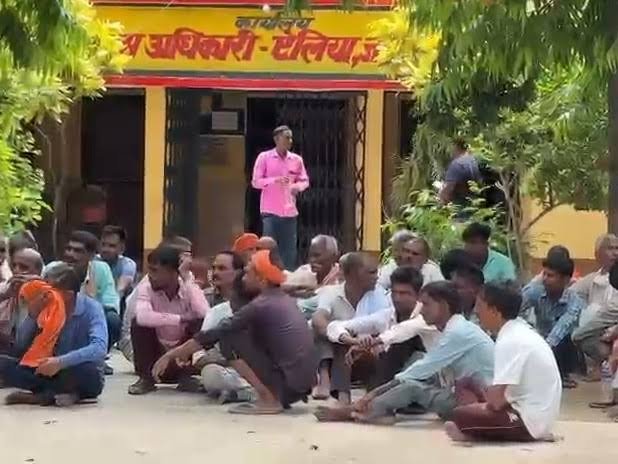

SITAPUR: In five village panchayats of Uttar Pradesh’s Sitapur district, attendance records under India’s flagship rural jobs scheme show hundreds of laborers at work on a national holiday. Villagers say no work took place — only entries did.
A Holiday That Raised Questions
In the Elia development block of Sitapur district, allegations of irregularities under the Mahatma Gandhi National Rural Employment Guarantee Scheme (MGNREGA) have brought local officials and village administrations under scrutiny. According to villagers, online records show that laborers were marked present and paid for work on a public holiday — Republic Day — even though no MGNREGA-related activity was carried out on the ground.
The accusations center on five gram panchayats where, residents say, digital attendance was uploaded despite the absence of physical work. The case has drawn attention not only to the conduct of village heads but also to the oversight mechanisms meant to prevent such discrepancies in one of India’s most closely monitored welfare programs.
Certified Cyber Crime Investigator Course Launched by Centre for Police Technology
What the Records Show
Official data accessed by villagers indicates that a total of 308 laborers were shown as present across the five panchayats on the day in question. Narbahanpur gram panchayat accounted for the highest number, with attendance recorded for 199 workers. Other panchayats listed significantly smaller figures: 45 laborers in Kainpur, 11 in Khatkari, 38 in Neri Kala, and 15 in Sarsora Kala.
Under MGNREGA rules, attendance is now typically captured through digital systems, often involving photo and geo-tagging to establish that work has actually taken place. Villagers allege that while these formalities may have been completed online, no corresponding activity occurred at the work sites.
Villagers’ Claims and the Question of Oversight
Residents of the affected villages say the discrepancy is not an isolated lapse but reflects a broader failure of supervision. They allege that despite repeated complaints, responsible officials did not conduct timely inspections or on-site verification. This, villagers argue, emboldened gram pradhans to record work that existed only on paper.
According to local accounts, even after the completion of photo geo-tagging, laborers were not called to the sites, reinforcing suspicions that the process was reduced to a procedural exercise rather than a safeguard. The absence of physical verification, they say, has weakened accountability in an otherwise ambitious rural employment program.
An Official Response, and What Comes Next
When contacted about the allegations, the district’s MGNREGA nodal officer, Chandan Dev Pandey, said that an inquiry would be conducted. Beyond that assurance, no timeline or details of the proposed investigation were shared.
For now, villagers say they are waiting to see whether the promised inquiry leads to concrete action or whether the matter will be confined to official files. They have demanded strict action against those responsible and greater transparency in the implementation of Mahatma Gandhi National Rural Employment Guarantee Scheme, a scheme intended to provide wage security but increasingly reliant on digital records that, in this case, are being openly questioned on the ground.
