

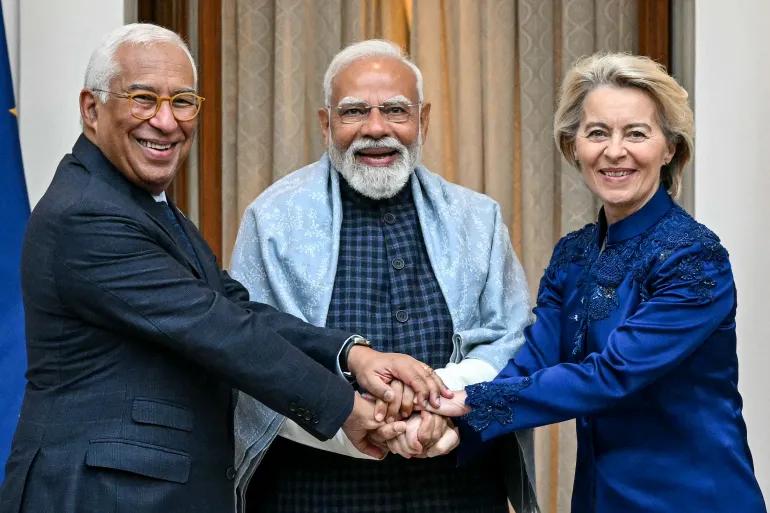
After nearly 18 years of prolonged and complex negotiations, India and the European Union have finally concluded a historic Free Trade Agreement (FTA), marking one of the most significant trade milestones in India’s economic history. Prime Minister Narendra Modi described the pact as the “mother of all deals,” calling it a decisive turning point for India’s global economic standing. Under the agreement, both sides have agreed to eliminate or sharply reduce tariffs on a vast majority of products, raising expectations of lower prices for several imported goods in the Indian market.
According to joint assessments by Indian authorities and the European Union, more than 90% of EU goods exported to India will either become completely duty-free or attract substantially reduced tariffs once the agreement is implemented. The impact is expected to span across automobiles, chemicals, machinery, pharmaceuticals, medical devices, food products and aerospace-related items, significantly altering price dynamics and trade flows.
The European Union has said the deal will give a strong push to its exports to India, while Indian companies will gain easier access to the vast and affluent market of 27 EU member states. Trade experts estimate that bilateral trade between India and the EU could double by 2032, further deepening economic ties and strengthening long-term cooperation.
Certified Cyber Crime Investigator Course Launched by Centre for Police Technology
Which Sectors Will See a Direct Impact
For Indian consumers, the FTA could translate into noticeable price relief across multiple categories. One of the most striking changes is in the automobile sector. Import duties on cars and commercial vehicles will be reduced from as high as 110% to just 10%, though an annual import quota of 250,000 vehicles has been set. This is expected to significantly lower the cost of European cars entering the Indian market.
Alcoholic beverages will also become more affordable. Tariffs on beer will be reduced to 50%, while duties on wine and spirits will be cut by up to 40%. Import duties on olive oil, margarine and vegetable oils will be eliminated altogether, while fruit juices and processed food products are also likely to see price reductions as tariffs are phased out.
The chemicals, machinery and pharmaceutical sectors are set to gain substantially. Duties of up to 44% on machinery and up to 22% on chemicals will be largely eliminated, making advanced industrial inputs cheaper for Indian manufacturers. Tariffs on medicines and medical products, currently as high as 11%, will also be reduced, potentially lowering healthcare-related costs for consumers.
In a major boost for aviation and advanced manufacturing, tariffs on aircraft and spacecraft will be brought down to zero. This is expected to encourage technology transfers, investments and deeper collaboration in the aviation and aerospace sectors.
Jobs and Investment Set to Gain Momentum
The benefits of the agreement are expected to extend well beyond price reductions. Experts believe that increased manufacturing activity and stronger export growth could lead to the creation of millions of direct and indirect jobs, particularly in export-oriented industries. Small and medium enterprises (SMEs) are expected to gain improved access to European markets, helping them integrate more deeply into global supply chains.
The European Union has also announced €500 million in financial assistance over the next two years to support India’s efforts to reduce greenhouse gas emissions. In addition, the agreement strengthens protection for trademarks, designs, copyrights and trade secrets, a move aimed at boosting investor confidence and safeguarding innovation.
Part of a Broader Global Strategy
Analysts point out that the India-EU FTA is not just a trade agreement, but also a strategic move to reduce over-dependence on China and the United States. In an era of shifting global trade alliances and rising protectionism, the deal positions India as a reliable and long-term economic partner for Europe.
Once legal and procedural formalities are completed in the coming months, the agreement will be implemented in phases. The government expects the pact to not only make goods more affordable for consumers but also strengthen India’s role in the global economic order.
About the author – Rehan Khan is a law student and legal journalist with a keen interest in cybercrime, digital fraud, and emerging technology laws. He writes on the intersection of law, cybersecurity, and online safety, focusing on developments that impact individuals and institutions in India.
