

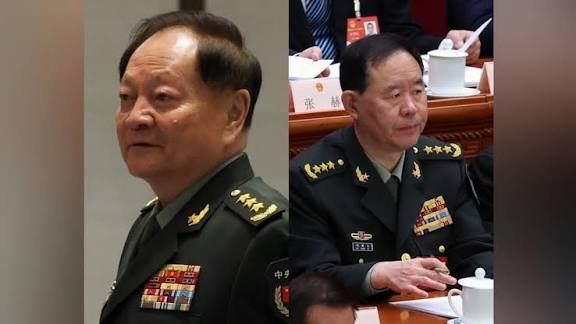

Taipei: Taiwan has said it is closely monitoring what it described as “abnormal” changes within China’s military leadership after Beijing confirmed that two of its most senior generals are under investigation for suspected serious violations of discipline and law, a development that has sharpened regional attention on China’s internal power dynamics.
China announced over the weekend that Zhang Youxia, vice-chairman of the powerful Central Military Commission and the second-in-command of the People’s Liberation Army, along with Liu Zhenli, another senior officer, had been placed under investigation. The move marks one of the most significant military probes in recent years, given the stature and influence of the two officers.
Signals Beyond Military Reshuffles
Taiwan’s defence establishment said it would use a wide array of intelligence, surveillance and reconnaissance tools to assess whether the developments point to deeper instability within China’s political and military hierarchy. Officials in Taipei stressed that no single personnel change would be sufficient to draw firm conclusions, but acknowledged that the scale and seniority involved made the situation noteworthy.
Certified Cyber Crime Investigator Course Launched by Centre for Police Technology
Zhang Youxia has long been regarded as one of the most powerful figures in China’s armed forces and is widely seen as a close ally of President Xi Jinping. He is also among the few senior Chinese commanders with direct combat experience, having participated in the 1979 border conflict with Vietnam. Liu Zhenli, meanwhile, has held key operational roles and is considered part of the uppermost tier of military leadership.
Heightened Pressure Around Taiwan
For Taiwan, the investigation comes against the backdrop of sustained military pressure from Beijing. China, which views the democratically governed island as its own territory, has never renounced the use of force to bring Taiwan under its control. Chinese warplanes and naval vessels routinely operate near Taiwan, a pattern Taipei describes as a campaign of intimidation designed to wear down its defences and morale.
Signals Beyond Military Reshuffles
Officials said the focus of monitoring would not be limited to military reshuffles alone, but would include political, economic and social indicators that could shed light on Beijing’s broader intentions. Intelligence-sharing with partners and allies would also form part of this assessment, reflecting Taiwan’s growing emphasis on coordinated regional awareness.
Late last month, China conducted another round of large-scale military exercises around Taiwan, involving air and naval assets. Beijing said the drills were aimed at deterring separatism and foreign interference, while Taipei condemned them as destabilising and escalatory. Taiwan’s government has consistently maintained that only the island’s people have the right to decide their future.
Regional observers are watching closely to see whether the investigations lead to further reshuffles or signal a broader recalibration within China’s military leadership. Any perception of instability could have implications not only for cross-strait relations but also for China’s posture in the wider Indo-Pacific, where tensions have been rising amid competing territorial claims and strategic rivalry.
For now, Taiwan has sought to project calm, emphasising vigilance rather than alarm. Officials said the objective was to build a comprehensive picture from multiple signals rather than react to isolated developments. Still, the removal of two top generals at a time of heightened regional strain has ensured that Beijing’s internal military politics are being scrutinised more closely than usual across the region.
