

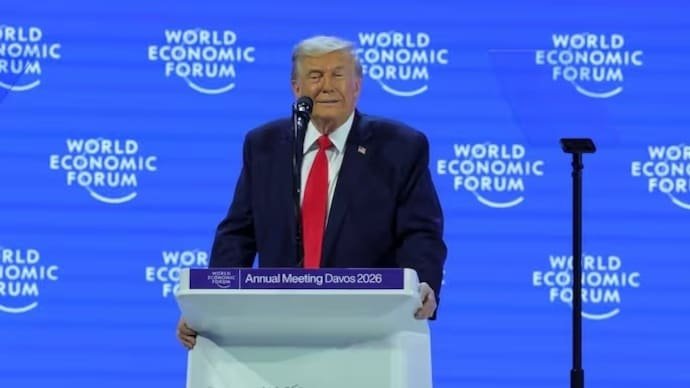

Davos/Brussels: Transatlantic relations have come under fresh strain following remarks made at the World Economic Forum (WEF) in Davos, prompting the European Parliament to temporarily halt work on a proposed trade agreement with the United States. The decision comes in response to aggressive comments by US President Donald Trump on Greenland and the possibility of imposing tariffs on European partners.
According to sources within the European Parliament, Trump’s speech in Davos struck a tone that was seen as more confrontational than conciliatory. His repeated assertion that the United States should seek control over Greenland, coupled with warnings of trade penalties against European allies opposing such a move, raised concerns across the political spectrum in Brussels. Lawmakers argued that pursuing a long-term and balanced trade partnership under such circumstances would be neither prudent nor sustainable.
Greenland, a semi-autonomous territory of Denmark, holds significant strategic and geopolitical importance, particularly in the Arctic region. Several European Union member states have already voiced objections to Washington’s stance on the issue. Trump’s renewed emphasis on Greenland during his Davos appearance further deepened these differences, ultimately leading the European Parliament to signal a pause in trade-related discussions with the US.
Certified Cyber Crime Investigator Course Launched by Centre for Police Technology
Which agreement has been put on hold?
The suspended discussions relate to a broader trade package aimed at easing economic exchange between the EU and the US. The proposal includes concessions such as the removal of EU import duties on certain American products, an extension of the zero-tariff regime on US lobster imports that began in 2020, and measures designed to simplify and reduce the cost of bilateral trade. The framework of this package was shaped during negotiations held in Scotland last year, where both sides had reached preliminary understandings.
Why is European Parliament approval crucial?
For any major trade agreement to come into force within the European Union, approval from both the European Parliament and the bloc’s member states is mandatory. Lawmakers have made it clear that unless the US clarifies and moderates its position on Greenland and tariff-related threats, moving ahead with the agreement will be difficult. The Parliament’s view is that partnerships forged in an atmosphere of pressure and public warnings lack the stability required for long-term cooperation.
Meanwhile, Trump’s presence at the World Economic Forum continues to draw global attention. His address, scheduled to be livestreamed for official participants, has already sparked intense debate about its potential impact on Europe–US relations, even before it is delivered in full.
Broader context and possible implications
The development comes at a time when the global economy is grappling with geopolitical tensions, trade uncertainties and ongoing supply chain disruptions. European policymakers have stressed that trade negotiations should be insulated from political rhetoric and conducted within a framework of mutual respect and rule-based engagement.
The European Parliament’s move is widely being interpreted as a clear signal to Washington that unilateral positions and public threats are unacceptable within the EU’s approach to international cooperation. Analysts note that while the suspension does not amount to a complete breakdown of talks, it does represent a significant pause that could delay progress on both sides.
In the coming days, attention will turn to whether diplomatic dialogue can bridge the current divide or whether the standoff will persist. For now, the Parliament’s stance suggests that without a restoration of trust and clarity on contentious issues, momentum on the EU–US trade agreement is likely to remain stalled.
