

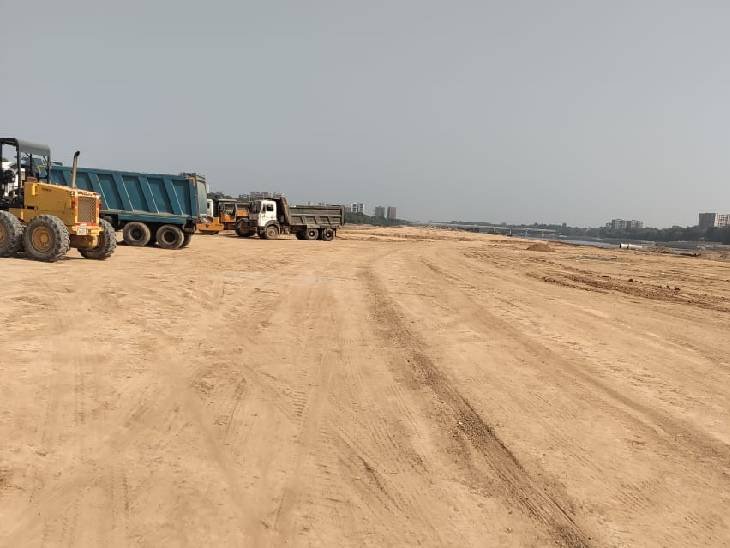

GANDHINAGAR: The Sabarmati Riverfront—an urban redevelopment project that has come to symbolize the transformation of Ahmedabad—is being extended northward toward Gandhinagar and GIFT City. Construction activity is visible near Bhat–Koteshwar village, even as official records indicate that the land under development is shown as privately owned on paper.
According to villagers and local officials, the riverfront work in this stretch has proceeded without the government formally taking possession of land that is part of the Sabarmati riverbed and adjacent ravines. If private claimants, including Manoramya Resort Pvt. Ltd., approach the courts, the state could be compelled either to provide alternate land or to pay substantial compensation.
The situation has drawn attention because, under existing law, river and ravine land belongs to the government and cannot be allotted to private entities except in cases explicitly deemed to be in the public interest. Yet, in this case, official records allegedly reflect a different reality.
Certified Cyber Crime Investigator Course Launched by Centre for Police Technology
Warnings From Officials and Political Leaders
Concerns about the land surfaced well before construction resumed. Leaders from the Bharatiya Janata Party, including former MLAs and district-level office bearers, wrote to both the Chief Minister and the Prime Minister, alleging that interference by land mafias was obstructing the riverfront project.
Former IAS officer and Riverfront Committee chairman Keshavkumar Verma warned in writing about what he described as illegal encroachment of river land. Separately, Ahmedabad Municipal Corporation commissioner Lochan Sehra wrote to the Gandhinagar collector seeking formal possession of riverfront land, underscoring the mismatch between physical control and documentary ownership.
Despite these warnings, villagers say no comprehensive corrective action followed. Instead, they allege that district-level officials orchestrated a large land transfer—valued by government committees at around ₹8,000 crore—without a formal government order.
A Retrospective Conversion and a Deep Discount Sale
At the center of the controversy is a claim by the Koteshwar Trust that the land had been converted to non-agricultural (NA) status as far back as 1961, through a trust resolution. Based on this assertion, the Gandhinagar collector’s office recorded NA Entry No. 1558 on July 7, 2022, granting NA status retrospectively from 1961. Officials and legal experts describe this as unprecedented in Gujarat, where such retrospective conversions after more than six decades have no clear precedent.
The land, first allotted free of cost to the Koteshwar Trust, was later sold to Manoramya Resort Pvt. Ltd. for ₹3.75 crore, according to registered documents. Stamp duty was paid on this declared amount, even though internal government assessments had placed the land’s value at roughly ₹8,000 crore. Local residents allege that the trust and the company are closely linked, and that undervaluation helped avoid both scrutiny and crores of rupees in stamp duty.
Experts estimate that converting land of this value to NA use should have generated around ₹700 crore in premium revenue for the state. No such premium was collected. As one official put it, even ordinary citizens are required to pay NA premiums, making the waiver in this case particularly striking.
Altered Surveys and the Halted Second Phase
Questions have also been raised about how the land area itself expanded on paper. Government measurement records originally showed Koteshwar land at 3,81,011 square metres. A new survey number—247—later recorded the area as 7,45,457 square metres. To bridge this gap, villagers allege that 1,83,569 square metres of land from neighboring Bhat village, including river area, was illegally added using fabricated maps.
This adjustment enabled government-owned river land to be transferred to the trust, opening the door to further privatization. In 2020, work began on the second phase of the riverfront between Hansol and Indira Bridge. By 2021, construction near Bhat–Koteshwar was abruptly halted. Villagers allege the pause was deliberate, allowing time for disputed land records and transfers to be completed.
An official letter submitted by villagers states that in 2018, the collector’s purchase committee had valued 12,76,761 square metres of Sabarmati riverbed and ravine land at around ₹8,000 crore—a figure that has since risen with rapid development around the area.
