

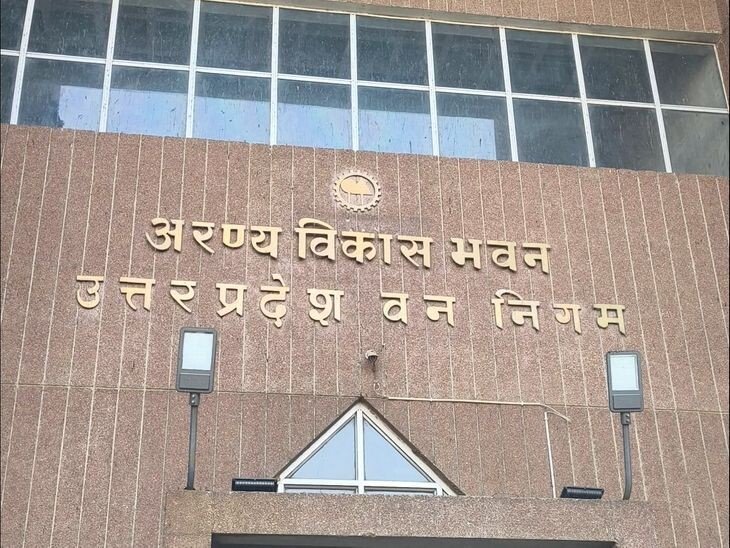

Lucknow | Fresh details have emerged in the high-value financial fraud involving funds of a state-run forest corporation, revealing how forged documents and procedural lapses enabled the transfer of ₹6.95 crore within just four days. Investigators say bank officials failed to detect multiple red flags during the account-opening process, allowing the scamsters to briefly gain control of a public-sector account created solely to divert funds.
According to documents accessed by central investigators, forged identity and authorisation papers were submitted to open a savings account in the name of the forest corporation at a public-sector bank’s Sadar branch in December 2025. The account was subsequently used to move crores of rupees to multiple accounts in Delhi and Kolkata before the fraud was detected.
Fake KYC Documents Used to Open Account
Investigative records show that the accused submitted a forged PAN card purportedly issued to the forest corporation, along with fake GST registration documents, as part of the know-your-customer (KYC) process. A fabricated internal proposal dated December 19, 2025, was also presented, falsely authorising a private individual to open and operate the account on behalf of the corporation.
Certified Cyber Crime Investigator Course Launched by Centre for Police Technology
Despite the high-risk nature of the account and the institutional name involved, bank officials failed to flag discrepancies in the documents. The savings account was formally opened on December 22, 2025, and a cheque book was issued four days later.
Investigators believe the account was created with the sole intent of facilitating fund diversion and had no legitimate operational purpose.
Rapid Transfers Between January 2 and 5
Between January 2 and January 5, nearly ₹6.95 crore was transferred from the account to six different bank accounts located in Delhi and Kolkata. The transfers were carried out in quick succession, effectively draining the account before internal or external alerts could be triggered.
Officials said the speed and coordination of the transfers indicate pre-planned execution, aimed at ensuring that funds were dispersed before scrutiny could begin.
The irregular transactions came to light only on January 5, when officials of the forest corporation contacted the bank seeking details about the account and the transfers. By then, the bulk of the funds had already been moved out.
Fixed Deposits Also Created Using Forged Authority
In addition to the savings account, investigators found that fixed deposits worth over ₹7 crore were also created at the same branch using forged authorisation letters. These deposits were allegedly positioned as routine treasury operations of the forest corporation.
One such fixed deposit was prematurely liquidated and the proceeds transferred to the fraudulent savings account, forming part of the ₹6.95 crore that was later siphoned off.
CBI Takes Over, Seizes Records
The Central Bureau of Investigation has now taken over the probe and seized all relevant documents from the local police, including account-opening forms, KYC records, internal bank approvals and transaction logs.
Officials said the seized records point to “serious procedural failures” at multiple levels of the bank’s operations. The agency is examining whether the lapses were due to negligence or involved active collusion.
Role of Bank Officials Under Scrutiny
Investigators are closely examining the role of branch-level officials who processed the account opening, approved KYC documents and authorised cheque book issuance. The focus is on why enhanced due diligence was not applied despite the account being opened in the name of a government corporation.
Sources indicated that internal controls meant for institutional accounts—such as cross-verification with the organisation, independent confirmation of authorisation letters and escalation to higher offices—were either bypassed or not followed.
Wider Implications for Banking Oversight
The case has raised concerns about vulnerabilities in banking compliance systems, particularly in handling accounts linked to government bodies. Financial experts say the episode highlights the need for stricter verification mechanisms, real-time alerts for high-value transfers and stronger accountability within banks.
Authorities are also tracking the money trail to identify the final beneficiaries of the diverted funds. Further action is expected as investigators analyse transaction data and communication records linked to the scam.
