

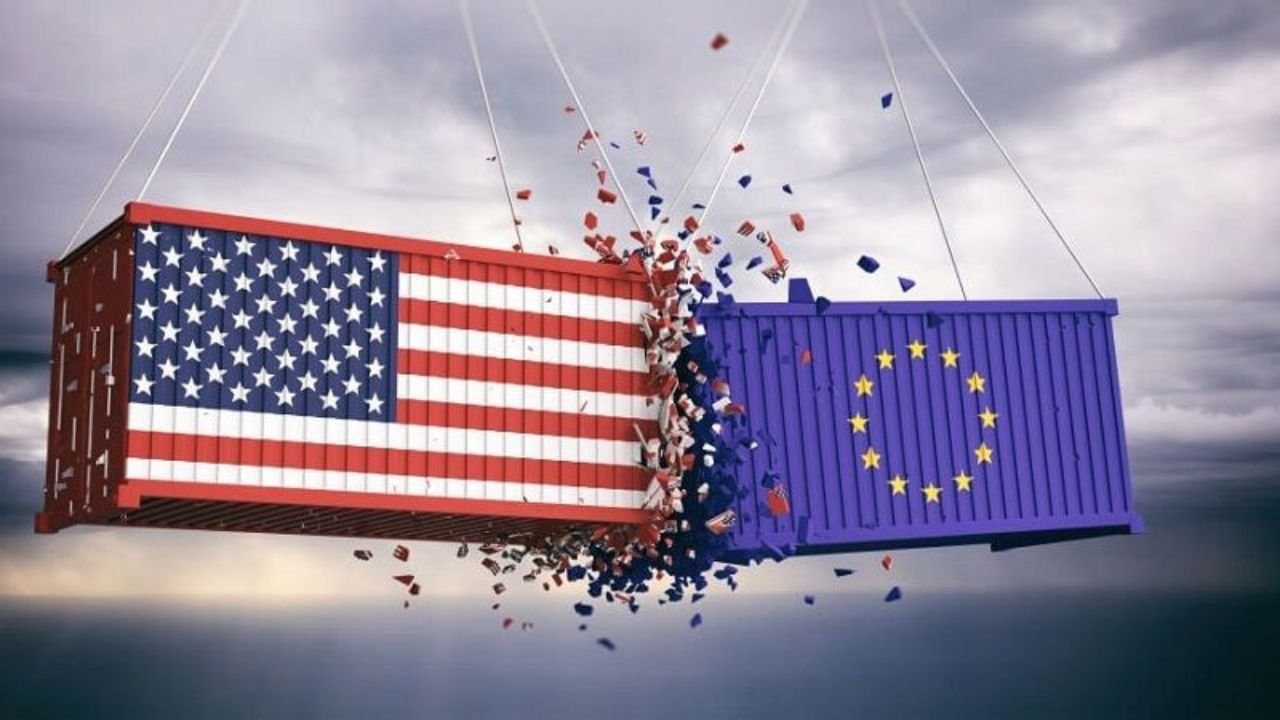

Washington | Escalating rhetoric from the United States over Greenland has triggered widespread international concern, with analysts warning that the dispute could spiral into a broader trade conflict between Washington and Europe. Remarks by former US president Donald Trump, suggesting that the United States could assert control over Greenland if required, have unsettled European capitals and revived fears of tariffs, economic retaliation, and long-term damage to transatlantic relations.
Greenland, an autonomous territory within the Kingdom of Denmark, has assumed growing strategic importance due to its location, mineral resources, and role in Arctic security. US statements framing Greenland as a national security priority have been viewed in Europe as a direct challenge to sovereignty and international norms, prompting warnings that economic and political fallout could extend far beyond diplomacy.
Certified Cyber Crime Investigator Course Launched by Centre for Police Technology
Trade tensions resurface amid geopolitical strain
Economic experts note that the Greenland issue has arrived at a time when global trade relations remain fragile. Any attempt by Washington to exert pressure through tariffs or economic restrictions on Denmark could invite a coordinated response from the European Union, raising the prospect of a tit-for-tat trade confrontation.
European policymakers have cautioned that trade measures linked to geopolitical disputes could disrupt supply chains, weaken investor confidence, and revive protectionist trends reminiscent of earlier trade wars. Analysts say markets are particularly sensitive to signals of renewed tariff escalation, especially involving major economies with deep commercial ties.
Europe signals firm resistance
European officials have underscored that Greenland forms part of a sovereign state that is closely linked to the European Union. Any unilateral move affecting its status, they argue, would undermine established international arrangements and could not go unanswered.
From a European perspective, the concern is not limited to Greenland alone. The episode is seen as part of a broader pattern in which trade, security, and diplomacy are increasingly intertwined. Observers say this convergence raises the risk that economic tools such as tariffs and sanctions could be deployed alongside political pressure, amplifying global instability.
Markets brace for volatility
Financial analysts warn that even the perception of a looming trade war can have tangible economic consequences. Equity markets, commodities, and currencies tend to react sharply to geopolitical uncertainty, particularly when it involves potential restrictions on trade and investment flows.
A prolonged standoff between the US and Europe could weigh on export-oriented sectors, disrupt transatlantic business operations, and complicate monetary and fiscal planning on both sides of the Atlantic. Emerging markets, too, could feel secondary effects through capital flows and currency volatility.
Security implications add another layer
The Greenland dispute also carries strategic and military dimensions. The Arctic region has become an arena of heightened geopolitical competition, drawing the attention of global powers concerned about shipping routes, resource access, and defence positioning.
European analysts note that rising tensions could place additional strain on security alliances such as NATO, where unity among members is critical. Any rift between the US and its European partners, they warn, could complicate coordination at a time of multiple global security challenges.
Recent military movements and joint exercises in the region have been interpreted as signals of resolve by European allies, reinforcing the message that Greenland’s security is a collective concern rather than a unilateral issue.
Broader economic and political stakes
Beyond immediate trade risks, experts argue that the episode reflects a deeper shift in global politics, where economic leverage is increasingly used to advance strategic objectives. This trend, they say, makes conflicts more complex and harder to contain, as disputes in one domain quickly spill over into others.
If tariffs or countermeasures were imposed, the consequences could extend to regulatory cooperation, climate initiatives, and technology partnerships between the US and Europe. Such outcomes would further fragment an already strained global economic order.
What lies ahead
For now, diplomatic channels remain open, but analysts caution that rhetoric alone can shape expectations and behaviour. Even without immediate policy action, continued uncertainty could dampen business sentiment and slow cross-border investment.
As governments on both sides weigh their next steps, markets and allies alike are watching closely. Whether the Greenland dispute evolves into a full-fledged trade confrontation or is contained through diplomacy may prove a defining test for transatlantic relations in the months ahead.
About the author — Suvedita Nath is a science student with a growing interest in cybercrime and digital safety. She writes on online activity, cyber threats, and technology-driven risks. Her work focuses on clarity, accuracy, and public awareness.
