
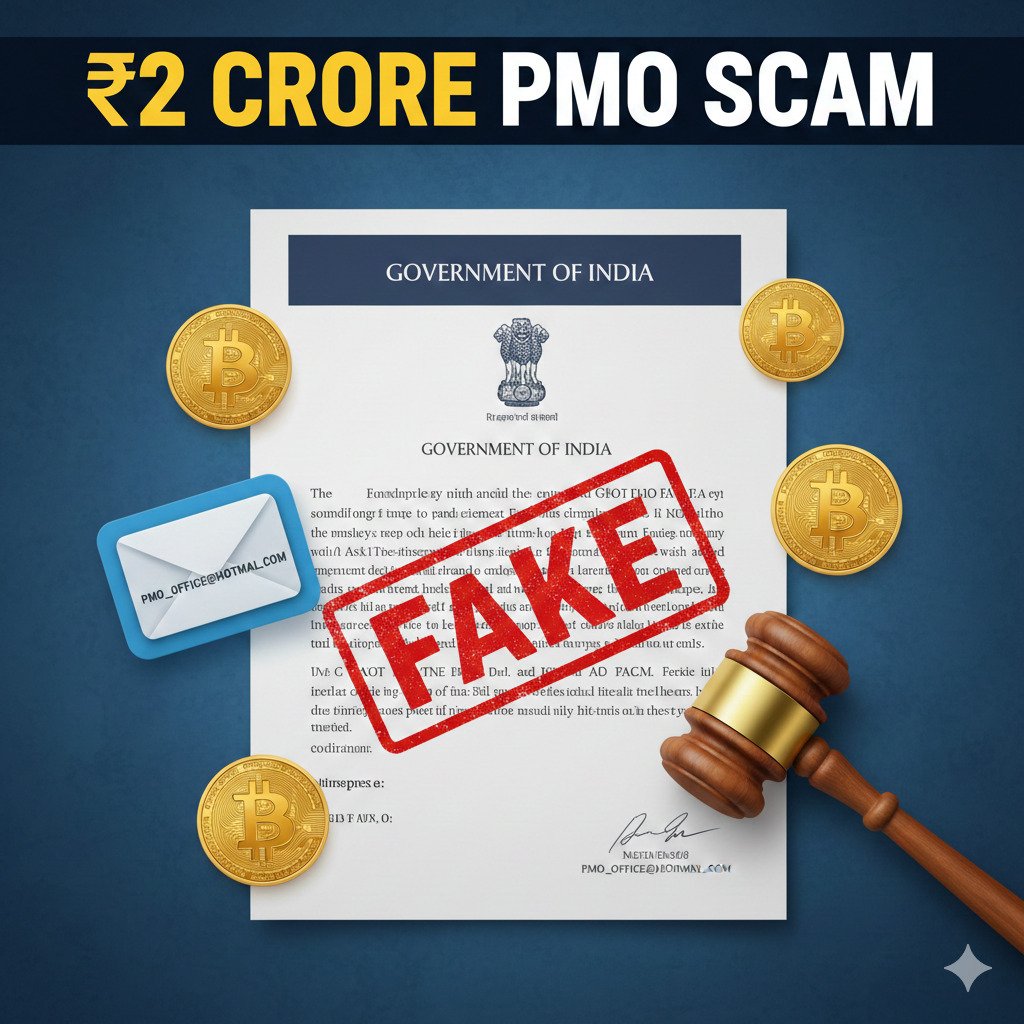
A major case of ₹2 crore fraud carried out in the name of the Prime Minister’s Office (PMO) has come to light in the Chakeri police station area. Medical store operator Aditya Singh allegedly gained the trust of victims by introducing one of his associates as a PMO official and cheated four people of nearly ₹2 crore by promising to get frozen cryptocurrency funds released and offering one-and-a-half times returns. Police have arrested the accused and sent him to jail, while his associate Rohit Yadav is absconding.
According to police, the accused misled victims by sending forged documents through email IDs resembling official PMO addresses. Emails sent from addresses such as PMO NEW DELHI@hotmail.com and newdelhipmo@gmail.com contained a PMO letter, alleged Supreme Court judgments, documents purportedly linked to the Reserve Bank of India (RBI) and GST, along with firm registration papers and PAN cards. Convinced by the apparent authenticity of these documents, the victims believed the claims to be genuine.
Final Call: FCRF Opens Last Registration Window for GRC and DPO Certifications
Web Spun Using Bitcoin and Supreme Court Claims
The complainant Umashankar, a resident of Girija Nagar, told police that Aditya Singh, who ran a medical store in Raja Market, Ahirwan Sainik Nagar, lived in his neighbourhood. Familiarity as neighbours helped build trust. Exploiting this, Aditya claimed that he had purchased Bitcoin nearly 20 years ago, which had now grown in value to ₹44 crore. He alleged that due to regulatory provisions, the amount had been frozen by the RBI, and that he had fought and won a case in the Supreme Court of India to get the funds released.
Aditya further claimed that to secure the release of the frozen amount, a new firm would need to be formed, in which investors could be inducted as partners. Once the funds were released, they would receive one-and-a-half times returns. To reinforce the narrative, he showed forged documents purportedly issued by the Supreme Court, RBI and other institutions.
Associate Posed as ‘PMO Officer’ on Phone
To strengthen the deception, the accused made his associate Rohit Yadav speak to the victims on the phone, introducing him as a PMO official. Rohit posed as a senior officer and repeatedly assured them that the release of funds was imminent. During this period, he also sent several documents by email, including a PMO letter, which further deepened the victims’ trust.
₹2 Crore Collected Over Four Years
Police investigation revealed that between August 2021 and November 2025, the accused floated a firm named SSRA Group and induced investments from the victims. During this period, ₹1.25 crore was taken online, while ₹75 lakh was collected in cash. Apart from Umashankar, money was also taken from Yogendra, Anil Gupta and Samar Shukla, one of whom was a neighbour.
Umashankar stated that to arrange the funds, he even sold his plot in Saniganwan and his jewellery. When repeated delays and evasive responses followed and neither the principal amount nor the promised returns materialised, the victims realised they had been cheated and approached the police.
Accused Jailed, Search On for Associate
According to the station in-charge, a case has been registered and Aditya Singh has been arrested and sent to jail. Police are examining the forged documents, email IDs and digital evidence used in the fraud. Meanwhile, efforts are underway to trace and arrest absconding accused Rohit Yadav.
Future Crime Research Foundation (FCRF) Flags a Growing Cybercrime Pattern
Cybercrime researchers at the Future Crime Research Foundation (FCRF) say such cases highlight the growing trend of authority-impersonation fraud, where the names of top constitutional institutions are misused to create instant credibility. FCRF studies have repeatedly pointed out that the use of official-sounding designations, fake email domains and forged PDFs has become a common tactic in high-value financial scams.
Expert View: Exploitation of Institutional Trust
Renowned cybercrime expert and former IPS officer Triveni Singh said the case underscores how criminals exploit public trust in powerful institutions.
“Names like the PMO, RBI or the Supreme Court carry unquestioned authority. When these are combined with forged documents and coordinated phone calls, even cautious individuals can be misled. Claims involving frozen crypto funds, court orders or guaranteed returns linked to government offices should always be treated as clear red flags,” Singh said.
Police have once again urged citizens to verify the authenticity of emails, phone calls and investment offers made in the name of government offices or officials through official channels before entering into any financial transaction, to avoid falling prey to such frauds.
About the author – Ayesha Aayat is a law student and contributor covering cybercrime, online frauds, and digital safety concerns. Her writing aims to raise awareness about evolving cyber threats and legal responses.
