
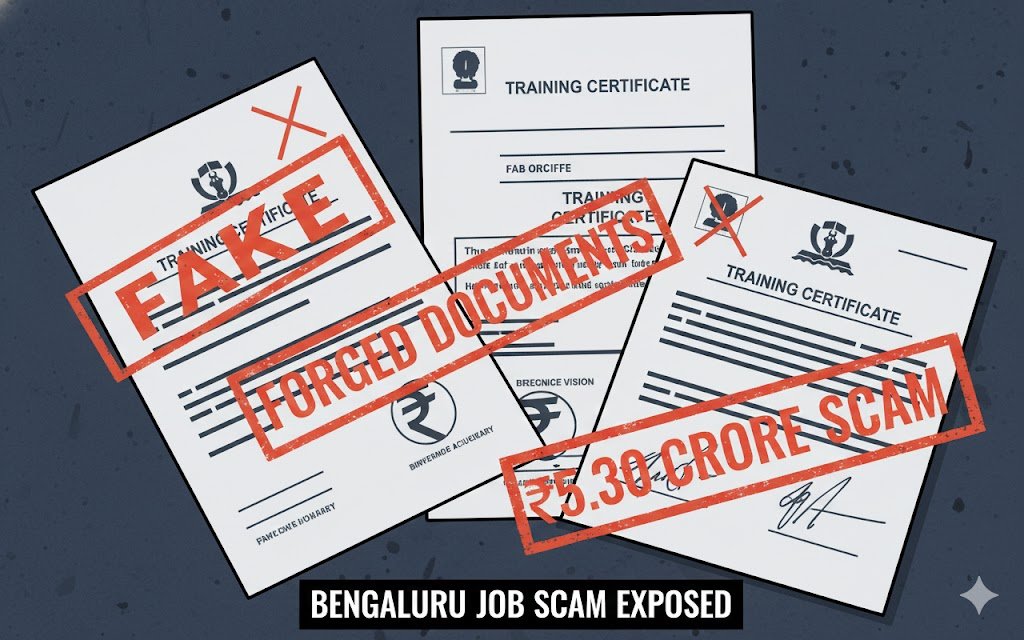
A large-scale job scam has come to light in Karnataka’s capital, where a woman allegedly posed as the general secretary of the KPCC Mahila unit and duped more than 20 job aspirants of nearly ₹5.30 crore. The operation involved fake appointment letters, forged political connections, and staged training programmes aimed at convincing candidates of their successful recruitment.
The case emerged after a complaint by Sangamesh Rachayya Vastrad, a resident of Vijayapura. Based on his complaint, the City Crime Branch (CCB) registered an FIR against Shamshad Begum, her father MM Mansoor Ahmed, her sister Shamee Begum, and two others — Ramesh and Sharath — who allegedly posed as government officials.
Political identity used to gain trust
According to the complaint, Shamshad introduced herself as the KPCC Mahila general secretary, while her father claimed to be a KPCC joint secretary. They reportedly displayed photographs with influential ministers and senior bureaucrats, building credibility and convincing victims that they had strong political connections capable of arranging government jobs.
Aspirants were promised positions in departments including:
- Railways
- Water Resources
- Health
- Social Welfare
Several candidates were issued forged appointment letters, giving them the impression that they had cleared official recruitment processes successfully.
Fake offices, officers, and staged training
To maintain authenticity, victims were taken to the Karnataka Examination Authority (KEA) office, where Sharath posed as an official, while Ramesh represented himself as a senior Railway officer.
Aspirants were then transported to Kolkata for what they were told was three months of official training. Additional sessions were conducted at Chhatrapati Shivaji Terminus in Mumbai, further cementing the impression of a genuine government selection process.
Exams, backlog vacancies, and more money
The accused issued fake hall tickets, claiming that regular exams would be followed by a special examination for them. Candidates were assured that if immediate appointments were unavailable, they would be placed under government backlog quotas.
Around ₹56 lakh was reportedly collected for placements in various state departments. Complainant Sangamesh admitted to collecting funds from youths in his village and acquaintances, transferring money to accounts linked to the accused. Bank records are now critical evidence for investigators.
₹5.30 crore lost — accused still absconding
Authorities confirmed that between July and October 2023, the group collected ₹5.30 crore via cash and online transfers. All five accused are absconding, with ongoing efforts to locate and apprehend them. Investigators believe more victims may come forward, potentially widening the scope of the scam.
Pattern mirrors other large-scale job frauds
Officials noted that the case reflects a familiar pattern seen in fake recruitment rackets:
- Misuse of political titles
- Forged appointment letters
- Pressure to pay “processing fees”
- Extended fake training sessions
- Disappearance once doubts arise
Aspirants’ desire for secure government employment was systematically exploited, with perpetrators leveraging trust and perceived credibility.
Investigation underway and advisory for aspirants
Authorities are examining financial trails, digital communications, and alleged forged documents. Efforts are also underway to identify any insiders who may have assisted in the scam.
For victims, both financial and emotional losses are substantial. Many sold assets or borrowed money, believing they were securing stable employment. Experts advise aspirants to verify all credentials, documents, and agents thoroughly before transferring money or signing agreements.
About the author – Ayesha Aayat is a law student and contributor covering cybercrime, online frauds, and digital safety concerns. Her writing aims to raise awareness about evolving cyber threats and legal responses.
