

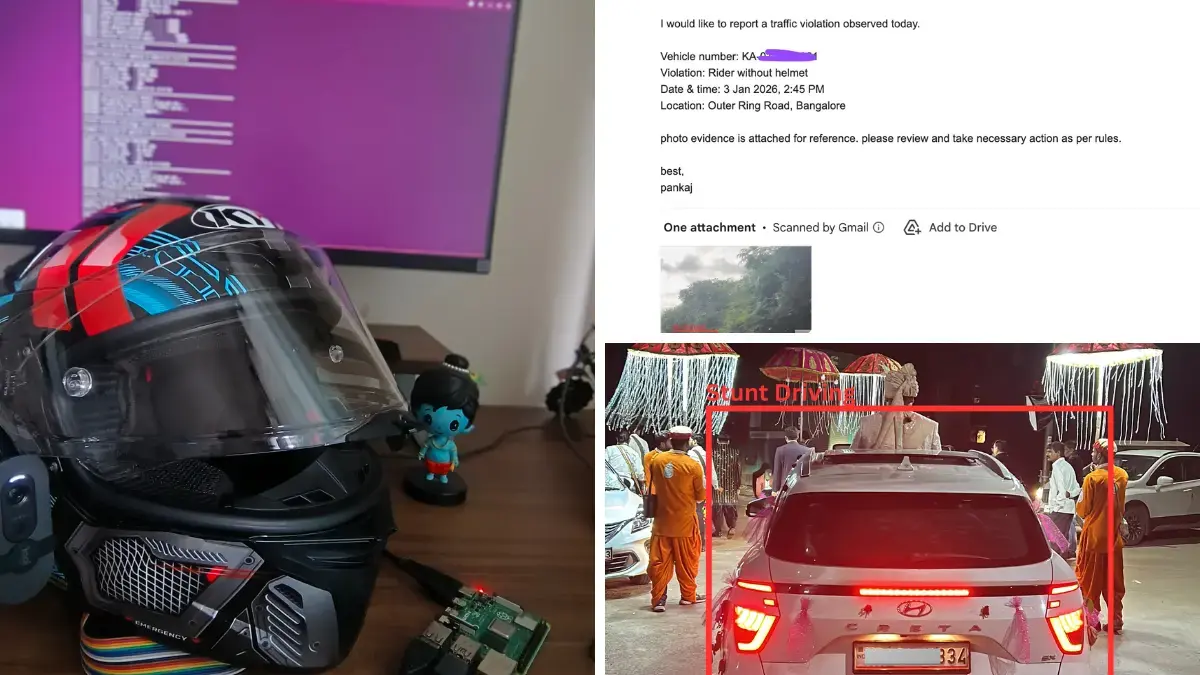

Frustrated by everyday violations on Bengaluru’s streets, a software engineer built an artificial-intelligence system into his helmet. The experiment, shared online, quickly became a talking point about technology, enforcement, and civic order in India’s tech capital.
A Commute Turned Experiment
On a typical ride through Bengaluru’s traffic, Pankaj Tanwar found himself confronting what many residents describe as a daily reality: widespread disregard for basic traffic rules. Two-wheelers without helmets, vehicles ignoring lanes, and near-misses at intersections had become routine. Tanwar, an engineer by training, decided to respond not with a complaint, but with a project.
“I was tired of stupid people on road, so I hacked my helmet into a traffic police device,” he wrote in a post on X, formerly Twitter.
The helmet, fitted with a camera and powered by artificial intelligence, runs an AI agent while he rides. According to Tanwar, the system operates in near real time, identifying riders and vehicles that violate traffic rules and capturing visual proof. The post, accompanied by a demonstration of the technology at work, quickly spread across social media, drawing attention far beyond Bengaluru’s commuting circles.
i was tired of stupid people on road so i hacked my helmet into a traffic police device 🚨
while i ride, ai agent runs in near real time, flags violations, and proof with location & no plate goes straight to police.
blr people – so now ride safe… or regret it. pic.twitter.com/lWaRO01Jaq
— Pankaj (@the2ndfloorguy) January 3, 2026
How the System Works on the Road
Tanwar explained that the AI agent embedded in the helmet processes video footage as he moves through traffic. When a violation is detected—such as a rider without a helmet—the system flags the incident. It records evidence that includes the vehicle’s number plate and location data.
“While I ride, AI agent runs in near real time, flags violations, and proof with location and no plate goes straight to police,” he wrote, adding a warning directed at fellow commuters: “Bengaluru people, so now ride safe or regret it.”
In one example shared online, Tanwar showed the system identifying and reporting a scooter rider who was not wearing a helmet. The clip illustrated the technology’s ability to capture violations without manual intervention, relying instead on automated detection.
A Viral Moment and Public Reaction
As the post circulated, it amassed more than 1.5 lakh views. The reaction was swift and varied, though largely positive. Social media users praised the idea as both inventive and emblematic of Bengaluru’s reputation as a technology hub.
“Peak Bengaluru innovation. This is some cool engineering,” one user wrote. Another added, “Love it, love it. Vehicles should come with this tech.”
Some responses went further, imagining broader applications. A commenter suggested that similar systems could be integrated into car dashcams, connected to cloud services, and even linked to incentive structures, where a portion of traffic challan fines might be shared with those whose devices reported violations. Others struck a more ambivalent tone.
“Bro turned road rage into a production system,” one user wrote. “Not sure whether to be impressed or scared. If it works, traffic discipline might finally level up.”
From Personal Project to Public Conversation
Overwhelmed by the response, Tanwar emphasized that the helmet was not conceived as a commercial product or an official enforcement tool. He described himself as someone who “just loved building weird, fun projects” and shared examples of earlier experiments to underline that the idea grew out of personal curiosity rather than a formal mandate.
Still, the episode sparked a wider conversation about the role of citizen-built technology in public spaces and the blurred lines between innovation and authority. While many applauded the ingenuity, others questioned how such systems might fit within existing legal and regulatory frameworks.
