

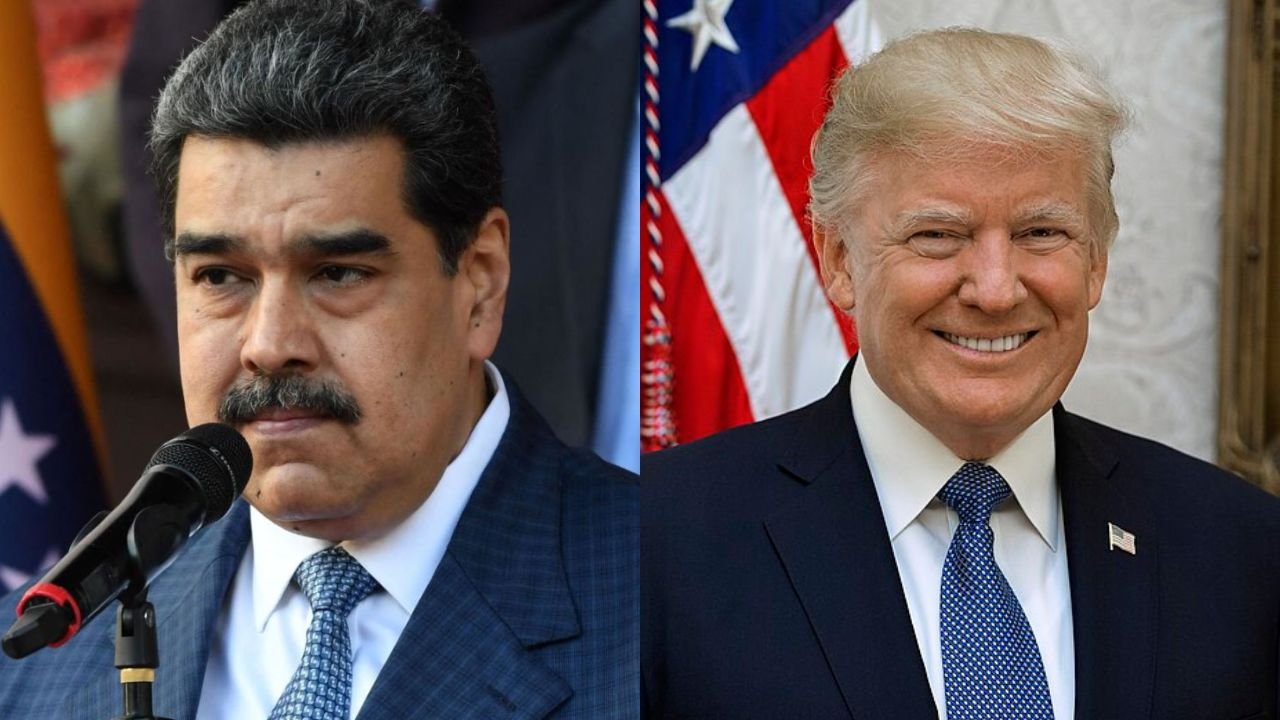

New Delhi | January 3, 2026 | Venezuela’s prolonged political crisis took a dramatic turn when Donald Trump claimed that American forces had detained Nicolás Maduro following what he described as a “large-scale military operation.” Trump made the assertion on his social media platform Truth Social—almost simultaneously with reports of explosions in Caracas, the Venezuelan capital. The claim triggered global attention and sharply escalated diplomatic tensions.
According to Trump, US forces carried out an operation inside Venezuela, captured President Maduro along with his wife, and flew them out of the country. The Venezuelan government, however, categorically denied the claim, calling it disinformation and psychological warfare. Despite the denial, the statement once again pushed the long-running standoff between Washington and Maduro into the centre of international debate.
Why the US Wants Maduro
For several years, the United States has accused Nicolás Maduro of leading an international drug trafficking and narco-terrorism network. American agencies allege that Maduro sits at the top of the so-called “Cartel of the Suns”, an organisation said to involve senior Venezuelan political and military officials.
According to the US State Department, Maduro allegedly coordinated with Colombia’s FARC to move multi-ton shipments of cocaine through Central America, facilitate trafficking routes, supply weapons, and support armed militias.
Maduro has consistently rejected these accusations. He argues that Washington’s actions are politically motivated and aimed at overthrowing his government because Venezuela possesses the world’s largest proven oil reserves.
A Historic ₹415 Crore Bounty
Last year, the United States raised the reward for information leading to Maduro’s arrest or conviction to ₹415 crore (approximately $50 million)—the largest bounty ever announced under the US Narcotics Rewards Program.
When Maduro was indicted in March 2020 by a federal court in New York on charges of narco-terrorism, conspiracy to traffic cocaine, and weapons-related offences, the reward was initially set at ₹125 crore ($15 million). It was increased to ₹208 crore ($25 million) in January 2025. In July 2025, after the US Treasury designated the Cartel of the Suns as a global terrorist organisation, the bounty was doubled to ₹415 crore.
US officials say Maduro is the first individual in the programme’s history to carry a reward exceeding ₹200 crore.
Questions of Legitimacy and Global Isolation
Nicolás Maduro assumed office in 2013 following the death of former president Hugo Chávez. Since 2019, however, his legitimacy has been widely disputed after Venezuela’s opposition-controlled National Assembly declared that he had usurped power.
Today, more than 50 countries, including the United States, do not recognise Maduro as Venezuela’s legitimate president. Washington also rejected his claim of victory in the disputed July 2024 presidential election, further deepening the country’s international isolation.
Explosions, Claims and Denials
Trump’s claim came amid reports of explosions and low-flying aircraft over Caracas, fuelling speculation of possible US military involvement. Venezuelan officials, however, insisted that no arrest of Maduro had taken place and accused Washington of spreading false narratives.
International reaction was swift. Several countries condemned any unilateral military action, while Spain and other European nations urged restraint and offered mediation to prevent further escalation.
A Symbol of US–Venezuela Confrontation
According to analysts, the ₹415 crore bounty represents the peak of hostility between the United States and Venezuela. While Washington frames its actions as part of a global fight against drugs and terrorism, critics argue that targeting a sitting head of state sets a dangerous precedent in international relations.
Whether Trump’s claim proves accurate or not, it is clear that Venezuela’s crisis has moved far beyond domestic politics. It has become a focal point where geopolitics, energy security, drug enforcement, and regime-change narratives collide.
For now, Nicolás Maduro remains at the centre of one of the most extraordinary manhunts in modern political history—defined by a record-breaking ₹415 crore bounty and a US–Venezuela standoff that shows no immediate sign of resolution.
About the author — Suvedita Nath is a science student with a growing interest in cybercrime and digital safety. She writes on online activity, cyber threats, and technology-driven risks. Her work focuses on clarity, accuracy, and public awareness.
