

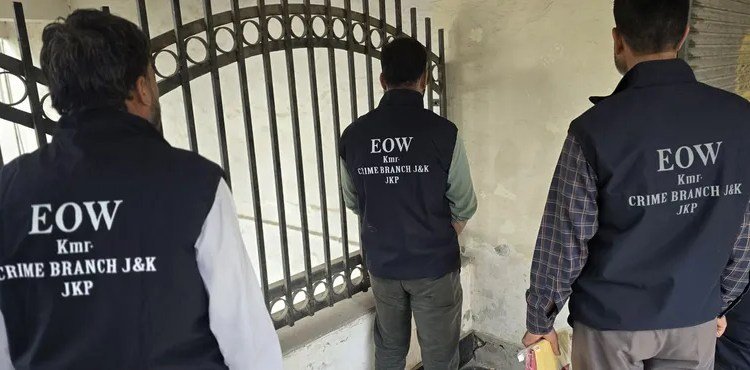

SRINAGAR: What began as a handful of complaints from job-seeking youth in Srinagar has unfolded into a meticulous account of forged authority fake seals, fabricated signatures, and the quiet misuse of public trust inside a government office.
A Complaint That Opened a Larger File
On a winter morning in Srinagar, investigators with the Jammu and Kashmir Police’s Crime Branch began examining what appeared, at first, to be a familiar allegation: a claim that a government employee had promised jobs and land in exchange for money. The complaint, filed by victims who said they had been handed official-looking documents, quickly pointed to something more elaborate.
According to the police, the accused was a Class-IV employee posted in the office of the Deputy Commissioner, Srinagar. The allegations were not confined to a single instance. Instead, they described a pattern—fake allotment orders for shops and residential plots, along with appointment letters for junior government posts—circulated among unemployed youth and economically vulnerable families.
Forged Authority and the Illusion of Officialdom
The Economic Offences Wing (EOW) of the Crime Branch found that the documents carried fabricated signatures of senior officials, including the Additional Deputy Commissioner, Srinagar, and bore forged seals of the District Magistrate’s office. These papers, investigators said, were designed to look indistinguishable from genuine government orders.
Police statements indicate that the accused allegedly operated in a private capacity after office hours, impersonating or invoking high-ranking officials from multiple departments. Victims were reportedly told that allotments at locations such as Jehangir Chowk and Bemina—or appointments in government offices—were imminent, pending only the completion of “formalities.” To many recipients, the paperwork was persuasive enough to justify handing over large sums of money, often representing years of savings.
The Human Cost Behind the Paper Trail
Investigators say the alleged fraud extracted lakhs of rupees from numerous victims, many of them unemployed youth and low-income families. The promise of a government job or a small commercial space carried particular weight in a region where public employment is seen as a rare source of stability.
Statements from the Crime Branch describe how trust in official seals and signatures became the central instrument of deception. Victims have told police that the accused projected access to powerful offices and portrayed herself as a conduit within the administrative system—an image reinforced by her actual posting in a government office.
The case, police say, is not an isolated one. Authorities describe the accused as a “habitual offender,” citing multiple FIRs registered at different police stations in Srinagar and several other complaints still under investigation by the EOW.
Charges Filed, and Questions That Linger
On December 25, the Crime Branch Kashmir announced that it had filed a charge sheet in FIR No. 54/2023 before the court of the 4th Additional Munsiff Judge, Srinagar. The charges include cheating, forgery, and using forged documents as genuine, under Sections 419, 420, 467, 468, and 471 of the Indian Penal Code.
Separately, departmental proceedings have already moved ahead. The accused has been placed under suspension, and a departmental inquiry has recommended her premature retirement under Article 226(2) of the Jammu and Kashmir Service Conduct Rules, based on an inquiry report dated October 14, 2023.
