

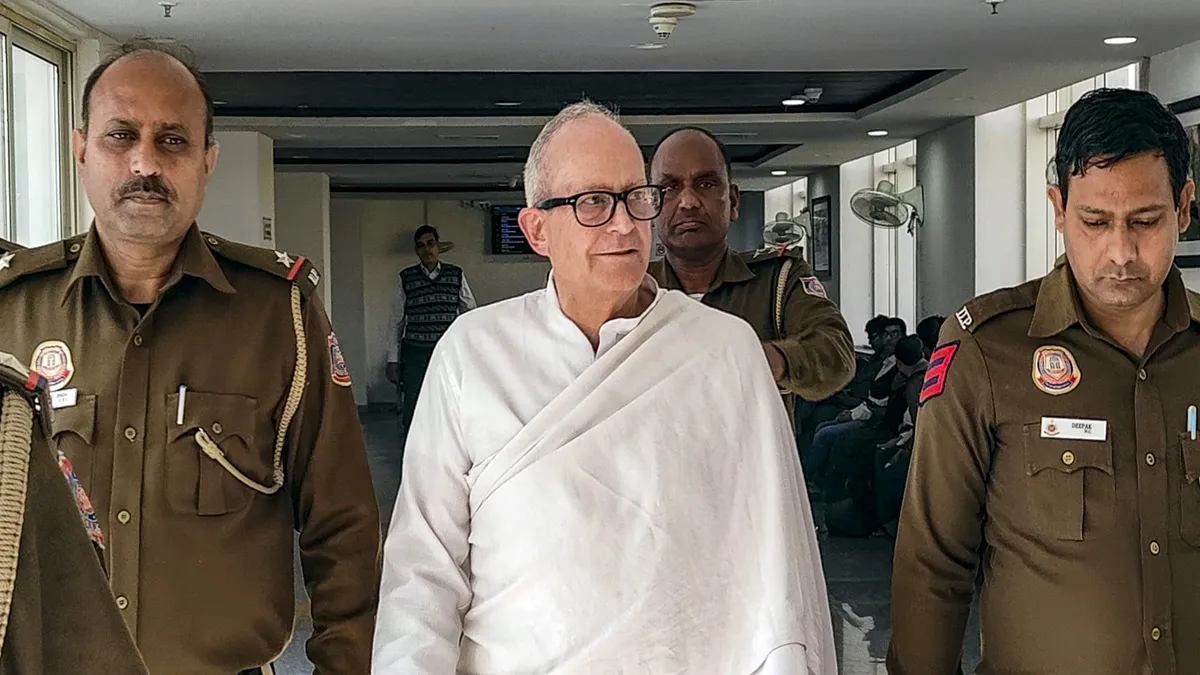

NEW DELHI: After nearly seven years behind bars and more than a decade of investigation, a Delhi court’s order to release Christian James Michel has reopened difficult questions about prolonged pretrial detention, the pace of complex corruption cases, and the limits of India’s criminal process.
A Case That Outran Its Calendar
On a winter morning in New Delhi, a special court ordered the release of Christian James Michel from custody in a money-laundering case linked to the AgustaWestland VVIP helicopter deal. The decision rested not on an assessment of guilt or innocence, but on time itself. Under Indian law, an undertrial prisoner cannot be detained beyond the maximum sentence prescribed for the alleged offense. Michel, the court noted, would complete seven years in custody on December 21—the statutory ceiling under the Prevention of Money Laundering Act.
The ruling was precise and procedural. Citing the second proviso to Section 436A of the Code of Criminal Procedure, the judge held that continued detention would be unlawful. Michel’s lawyers submitted that he would participate in the trial even if released, arguing that prolonged incarceration had turned the process into what they called a “mockery of justice.”
The order was narrowly tailored. It applied only to the money-laundering case filed by the Enforcement Directorate, leaving Michel still in custody in a parallel corruption case pursued by the Central Bureau of Investigation.
Twelve Years of Investigation, Seven Years in Jail
Michel’s legal journey has been unusually long even by the standards of high-profile Indian prosecutions. Investigators from the ED and the CBI have been probing the AgustaWestland deal for more than 12 years, tracing alleged kickbacks in the purchase of VVIP helicopters for the Indian government.
Extradited from Dubai in December 2018, Michel was arrested immediately upon arrival. The CBI filed its chargesheet accusing him of acting as a middleman, while the ED later charged him with laundering proceeds of crime. Court records show that trials in both cases have moved slowly, marked by voluminous documents, multiple accused, and repeated procedural delays.
During a recent hearing, Michel’s counsel emphasized the disparity between the length of the investigation and the pace of adjudication. Despite having secured bail earlier, the lawyer told the court, Michel remained unable to leave jail because of overlapping cases—an outcome the defense said defeated the purpose of bail itself.
The Legal Line on Prolonged Detention
The court’s reasoning turned on a technical but increasingly consequential provision of criminal law. Section 436A was introduced to prevent undertrials from languishing in jail longer than the sentence they might eventually receive if convicted. In Michel’s case, the maximum punishment under the money-laundering statute is seven years.
“In view of the mandatory provisions,” the judge said, the accused was “entitled to be released” and could not be detained beyond the statutory limit. The language was categorical, underscoring that the court’s discretion narrows once the time threshold is crossed.
Legal scholars note that such orders are becoming more frequent as courts confront backlogged trials and overcrowded prisons. The provision does not exonerate defendants; it simply enforces a temporal boundary on the state’s power to detain.
What Release Means and What It Does Not
Despite the order, Michel’s immediate freedom remains constrained. He continues to face custody in the CBI’s corruption case, where the court has sought a response from investigators and scheduled further hearings. The money-laundering release, therefore, offers partial relief rather than closure.
For prosecutors, the case illustrates the challenge of sustaining complex financial prosecutions within the limits imposed by criminal procedure. For the defense, it underscores the human cost of investigations that stretch across decades. And for the courts, Michel’s case sits at the intersection of due process and delay—where the passage of time becomes not just a backdrop, but a decisive factor.
