

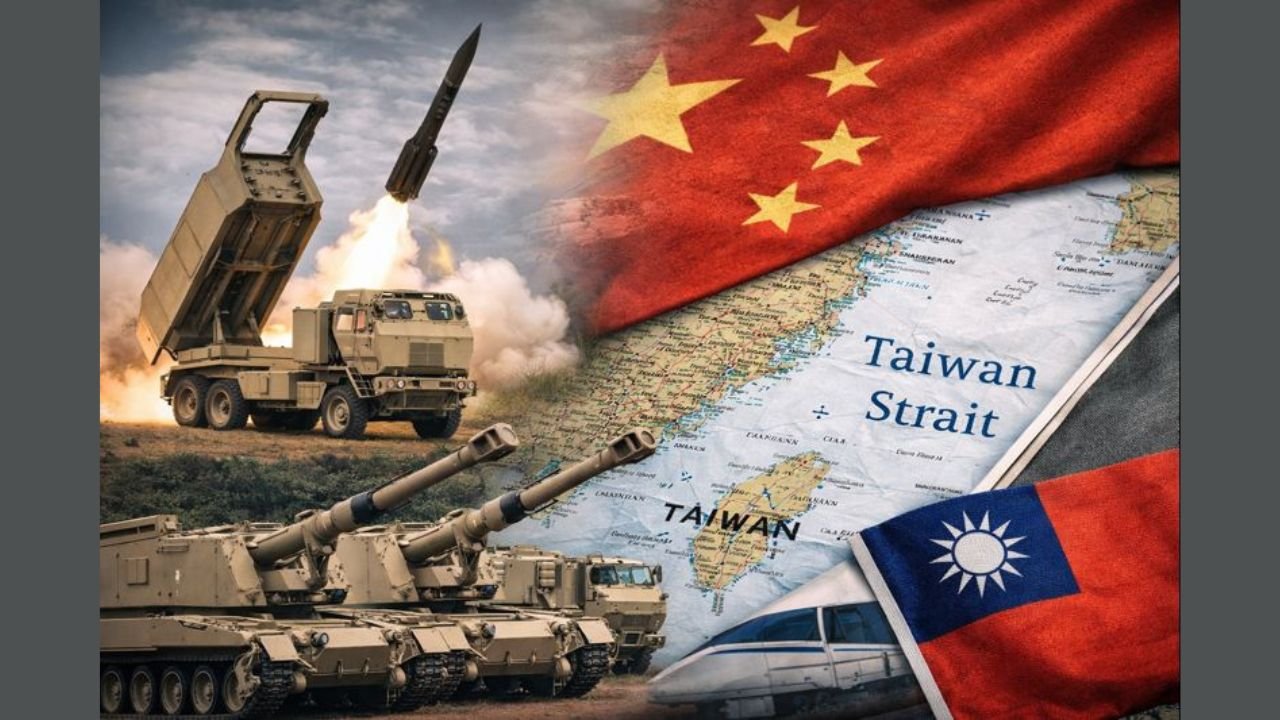

Washington | Amid escalating geopolitical tensions over Taiwan, the United States has approved its largest-ever arms sale to the island, a move that has intensified strategic anxieties across Asia and triggered a strong reaction from China. The defence deal, valued at approximately $11.15 billion, or nearly ₹93,000 crore, comes at a time when Beijing has stepped up military and diplomatic pressure on Taipei, particularly in the Taiwan Strait and surrounding waters.
The decision has not only drawn criticism from China but has also reignited debate across the Indo-Pacific region about the shifting balance of power and the likelihood of deeper US–China confrontation in the coming years. Strategic experts say the scale and timing of the deal underscore Washington’s intent to strengthen Taiwan’s deterrence capabilities amid rising regional uncertainty.
Part of Taiwan’s $40 Billion Supplementary Defence Budget
According to Taiwan’s Ministry of National Defense, the newly approved arms package forms part of a $40 billion supplementary defence budget announced in November by President Lai Ching-te. The administration has made clear that bolstering Taiwan’s self-defence capabilities is a top priority in response to what it describes as growing security threats from mainland China.
President Lai has repeatedly stated that Taiwan must be prepared to defend itself against any form of coercion. He has set a target for the island to achieve high-level combat readiness by 2027, a timeline that aligns with intelligence assessments suggesting that China may significantly escalate pressure—or even attempt a forceful move—within the next few years.
Lai has warned that China could seek to seize control of Taiwan by 2027, citing what he described as unprecedented military build-up and increasingly assertive actions by Beijing across the Taiwan Strait, the East China Sea and the South China Sea.
What the Arms Package Includes
The defence deal includes a wide range of advanced weapons systems designed to enhance Taiwan’s long-range strike capabilities, ground defence and maritime security. According to official disclosures and media reports, the package includes:
- 82 HIMARS (High Mobility Artillery Rocket Systems), valued at approximately $4.05 billion
- 420 ATACMS missiles, capable of striking targets at distances of up to 300 kilometres
- 60 M109A7 self-propelled howitzer systems, estimated to cost more than $4 billion
- Javelin and TOW anti-tank missile systems, with a combined value exceeding $700 million
- Additional components such as drone surveillance systems, military software, and spare parts for helicopters and anti-ship missile platforms
Military analysts say the package will significantly strengthen Taiwan’s ability to respond to potential threats, particularly by enhancing its precision strike capacity and reinforcing its coastal and maritime defences.
Strong Reaction from China, Heightened Military Signals
China responded sharply to the US decision. A spokesperson for China’s Ministry of Foreign Affairs accused Taiwan’s ruling Democratic Progressive Party (DPP) of pursuing separatist ambitions through military support from foreign powers, warning that such efforts would ultimately fail.
Beijing has reiterated its long-standing position that Taiwan is an inseparable part of China and has consistently opposed any foreign military assistance to the island. Chinese officials have described the arms sale as a violation of the “One China” principle and a destabilising factor for regional peace.
Amid the heightened tension, Taiwan’s defence ministry reported on social media platform X that China’s Fujian aircraft carrier had transited through the Taiwan Strait. The ministry said Taiwan’s armed forces closely monitored the situation and took necessary precautionary measures.
Taiwan Relations Act and Washington’s Strategic Role
While the United States does not maintain formal diplomatic or defence ties with Taiwan, the Taiwan Relations Act of 1979 provides the legal framework for Washington to supply defensive arms and related services to the island. Under this law, the US has consistently supported Taiwan’s ability to maintain sufficient self-defence capabilities.
Analysts note that the latest arms package goes beyond routine military assistance and signals Washington’s broader strategic intent amid intensifying US–China rivalry.
What Lies Ahead
Overall, the US–Taiwan arms deal is widely seen as more than a routine defence transaction. It reflects deepening strategic fault lines in Asia, heightened competition between Washington and Beijing, and growing concerns about the possibility of a major regional confrontation.
As Taiwan accelerates its military preparedness and China hardens its rhetoric, the coming months are expected to be critical in determining whether regional stability can be preserved or whether tensions will continue to escalate further.
