

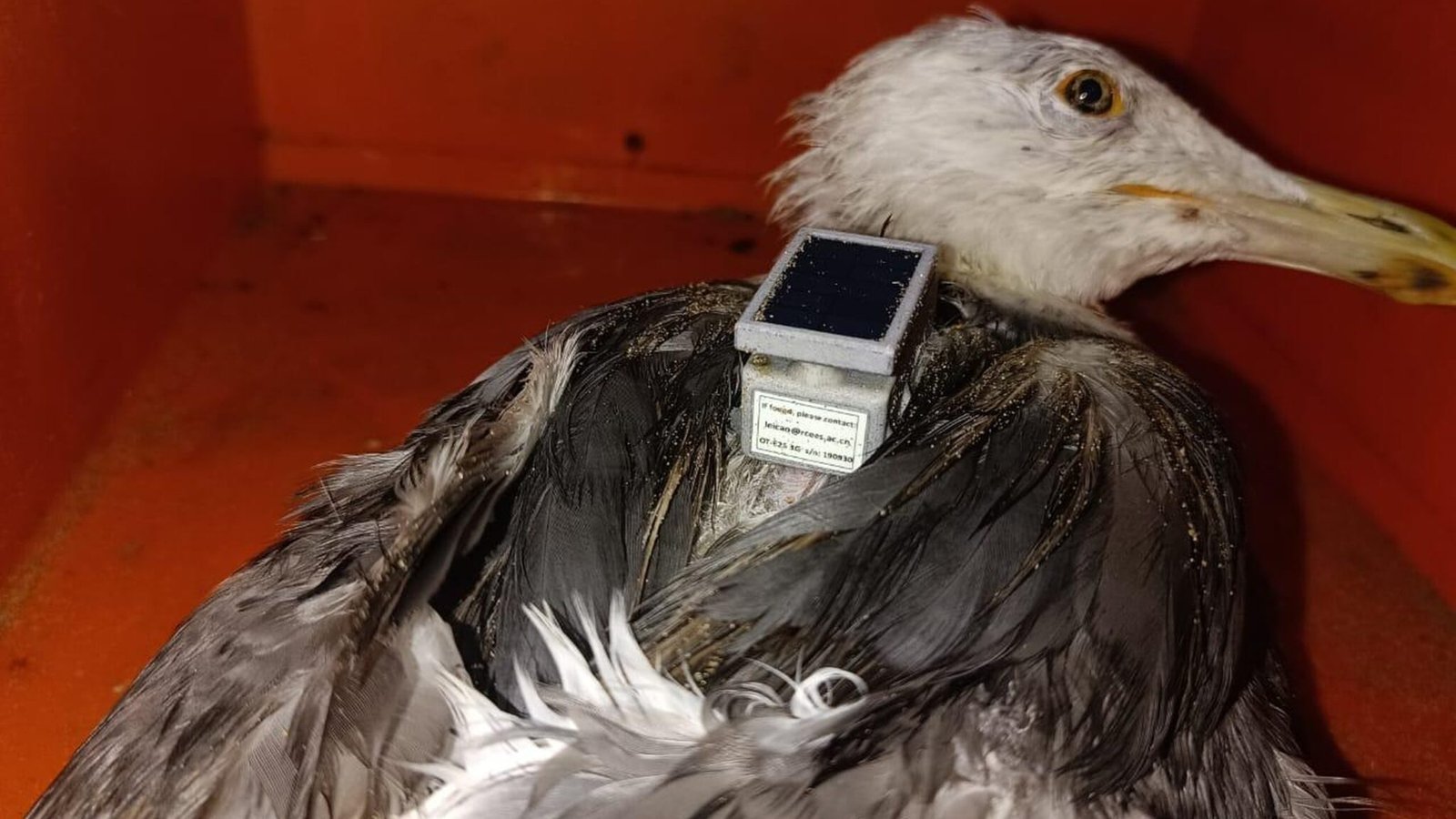

KARWAR: What began as a moment of unease on a quiet stretch of Karnataka’s coastline an exhausted seabird bearing a mysterious device quickly became a case study in how suspicion, social media and security anxieties can collide with the realities of modern science
A Discovery on the Shore
On Wednesday morning, locals walking along Karwar beach noticed a migratory seagull struggling on the sand, its movements slow, its body visibly fatigued. What drew immediate attention, however, was not just the bird’s condition but a small electronic device strapped to it. In a coastal town that lies close to sensitive naval installations, the sight was enough to trigger alarm.
Word spread quickly. Photos circulated on social media and messaging platforms, some suggesting the device could be a spy camera or surveillance equipment. Forest department officials were alerted, and the bird was soon taken into custody, both to assess its health and to examine the unfamiliar attachment.
The seagull, officials later said, had suffered minor injuries and appeared exhausted—hardly surprising for a bird that would turn out to have traveled extraordinary distances.
Science Meets Suspicion
At the forest department office, the device was carefully removed. Authorities identified it as a GPS tracker commonly used in wildlife research to study migratory patterns. Police and intelligence officials visited the beach to verify the circumstances and assess whether the incident posed any security risk. Their conclusion was unambiguous: it did not.
Forest department sources said the Wildlife and Nature Protection Society of Sri Lanka (WNPS) was contacted and confirmed that the bird had been tagged as part of a long-term scientific study tracking migration routes. The tracker, manufactured in China—a routine source for such equipment—contained no camera or audio recording capability.
Data retrieved from the device showed that the seagull had flown more than 10,000 kilometers, traversing Arctic regions before reaching India’s western coast. For researchers, such data offers rare insight into the endurance and navigational precision of migratory birds. For the public, unfamiliar with the mechanics of wildlife science, it had initially appeared far more ominous.
The Geography of Anxiety
Karwar’s proximity to the INS Kadamba naval base added a layer of sensitivity to the episode. In recent years, heightened awareness of surveillance and espionage—amplified by global geopolitical tensions—has shaped how unusual objects are interpreted, especially near strategic sites.
A section of the media speculated that the tracker could be a covert spying device, a theory that officials moved quickly to dispel. Intelligence agencies found no evidence to support such claims, emphasizing that GPS tagging of birds is a standard, internationally accepted research practice.
Authorities urged the public not to spread misinformation, noting that unfounded speculation can escalate unnecessary fear and divert attention from legitimate scientific and conservation efforts.
Migration, Data and the Modern Wild
The episode underscores how advances in technology have transformed wildlife research. Lightweight GPS trackers now allow scientists to map migration routes with unprecedented accuracy, revealing how birds respond to climate change, shifting food supplies and habitat loss. Such studies often involve international collaboration, reflecting the borderless nature of animal migration.
For the seagull rescued in Karwar, the device told a story of resilience rather than intrigue—a journey spanning continents and climates. After examination, the bird was kept under observation by forest officials, its fate tied not to geopolitics but to recovery and eventual release
