
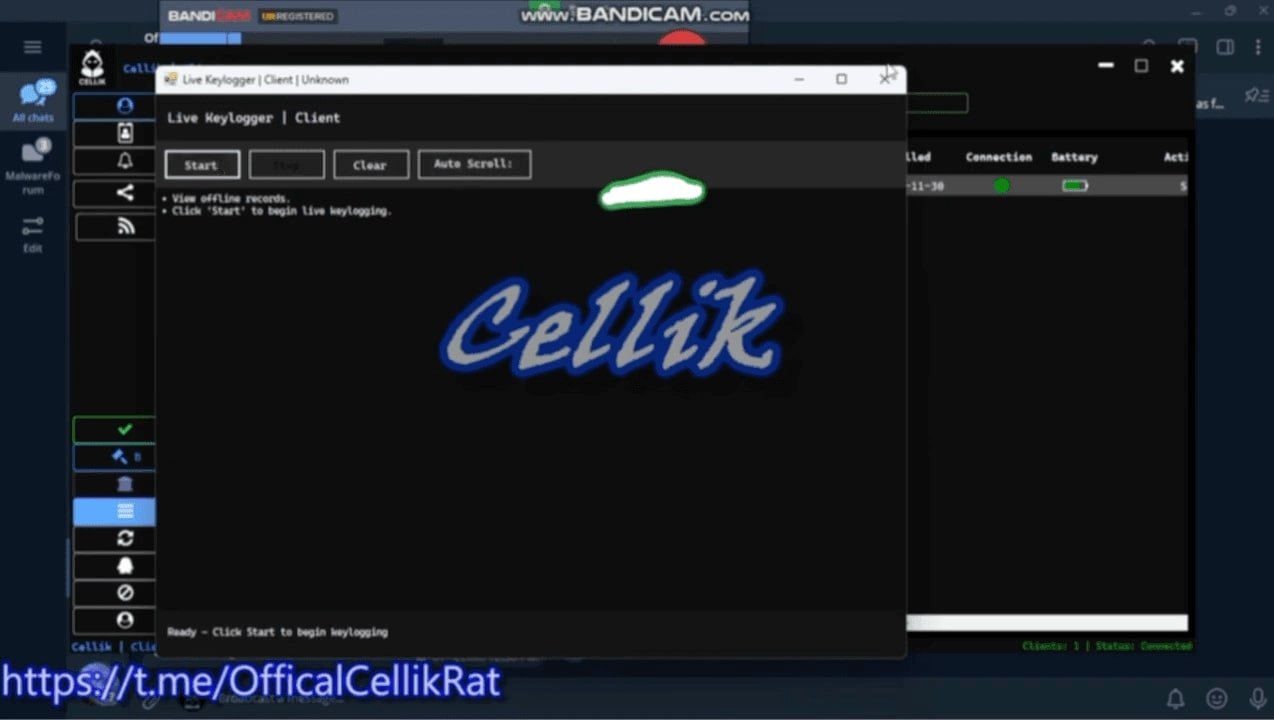

A newly uncovered Android spyware tool called Cellik is drawing scrutiny from cybersecurity researchers for how seamlessly it blends into the mobile app ecosystem, illustrating how sophisticated surveillance capabilities are increasingly being packaged for mass use in cybercrime markets.
A New Entrant in the Android Spyware Economy
In the crowded and fast-evolving underground economy of mobile malware, Cellik stands out less for inventing new techniques than for how efficiently it assembles existing ones into a single, accessible platform. Marketed as an Android remote access trojan, or RAT, Cellik offers attackers comprehensive control over infected devices, from real-time screen monitoring to file access, microphone activation, and keylogging.
Security analysts who have examined the tool describe it as a fully modular spyware system. Once installed, an operator can view a victim’s phone screen in near real time, simulate touches, navigate apps, and quietly observe notifications as they arrive. Messages, one-time passwords, and alerts from banking or messaging applications can be intercepted without the user’s awareness, turning an ordinary smartphone into a continuous stream of intelligence.
What makes Cellik particularly notable is not just its breadth of features, but the way those features are packaged. The malware is sold as a service, complete with a polished control panel and automated tools that lower the technical barrier for would-be attackers, reflecting a broader shift toward the industrialization of cybercrime.
Play Store Integration and the Repackaging Problem
Among Cellik’s most alarming capabilities is its integration with the Google Play ecosystem. According to researchers, the platform includes an automated APK builder that allows an attacker to browse legitimate apps from Google Play and bundle them with the Cellik payload. The resulting file appears, on the surface, to be the original application.
Once installed on a victim’s device, the repackaged app behaves as expected, while the spyware component operates quietly in the background. Developers of the tool claim that this method can evade Google Play Protect, enabling malicious versions of trusted apps to circulate undetected through sideloading or other informal distribution channels.
The technique itself is not new, but its automation is significant. By reducing the process to a few clicks, Cellik removes much of the technical expertise once required to weaponize popular apps, allowing attackers to scale campaigns rapidly and target a wide range of users with minimal effort.
Hidden Browsers and App Injection Attacks
Beyond repackaging, Cellik incorporates mechanisms for direct interaction with a victim’s digital life. One component functions as a concealed browser, running invisibly in the background. Through it, attackers can open websites, submit forms, and exploit stored cookies or autofill data to gain access to online accounts, all without displaying anything on the device’s screen.
The malware also supports app injection attacks. Using custom-built overlays, operators can place fake login screens over legitimate applications, including banking, email, and social media platforms. Unsuspecting users who enter credentials into these overlays effectively hand them directly to the attacker, with the data transmitted back to a central control server.
Communications between infected devices and those servers are encrypted, adding another layer of stealth and making detection by network monitoring tools more difficult. Together, these features enable a form of phishing that unfolds entirely on the victim’s own phone, blurring the line between social engineering and direct system compromise.
Lowering the Bar for Advanced Surveillance
Cellik’s design reflects a broader trend in malware development: the repackaging of advanced surveillance techniques into consumer-like products for criminal use. Capabilities once associated primarily with state-sponsored spyware such as persistent monitoring, live screen control, and covert data exfiltration are now being marketed with user-friendly interfaces and one-click deployment.
For cybersecurity professionals, the emergence of such tools underscores a growing challenge. As malware becomes easier to deploy and harder to distinguish from legitimate software, traditional trust signals such as an app’s appearance or its resemblance to well-known brands offer diminishing protection.
Rather than representing a single dramatic breakthrough, Cellik illustrates how incremental improvements in automation, distribution, and usability can collectively reshape the threat landscape. In doing so, it highlights the widening gap between the complexity of modern mobile operating systems and the shrinking effort required to exploit them at scale.
