
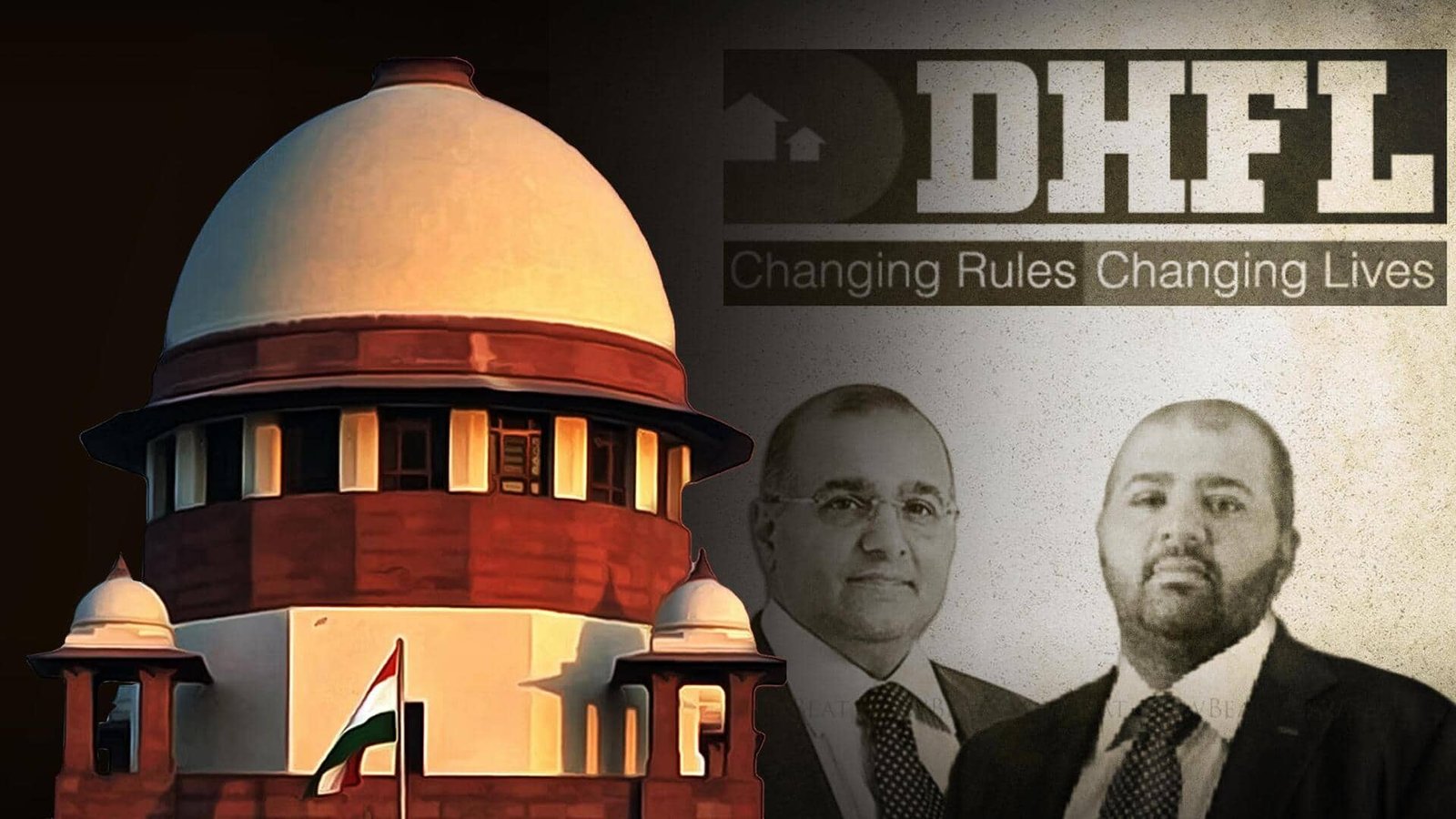

NEW DELHI: After more than five years in custody without the commencement of trial, the Supreme Court has ordered the release on bail of DHFL promoters Kapil and Dheeraj Wadhawan, invoking constitutional guarantees of liberty and sharply questioning the state’s ability to justify prolonged incarceration in complex economic crime cases.
A Five-Year Detention and a Trial Yet to Begin
On paper, the case against Kapil and Dheeraj Wadhawan ranks among the largest bank fraud prosecutions in India’s history. The Central Bureau of Investigation (CBI) has alleged that loans and credit facilities worth ₹57,252 crore availed by Dewan Housing Finance Limited (DHFL) from a consortium of 17 banks were systematically siphoned off through shell companies linked to the promoters. Of this amount, investigators claim, ₹34,926 crore was diverted.
In practice, however, the proceedings have barely moved. The brothers have been in custody since April 2020. The first chargesheet was filed only in October 2022, followed by multiple supplementary filings that expanded the case to 110 accused—70 companies and 40 individuals. The chargesheet itself runs into nearly four lakh pages, names 736 witnesses and is supported by 17 truckloads of documents and digital records exceeding two terabytes.
Before a bench of Justices J.K. Maheshwari and Vijay Bishnoi, the Supreme Court noted that despite the enormity of the record, the trial had not even commenced. Even if hearings were to be held daily, the Court observed, the evidence could not reasonably be completed in less than two to three years.
“Bail Is the Rule”: Constitutional Limits on Pre-Trial Custody
Against this backdrop, the Court returned to first principles. Citing Article 21 of the Constitution, it underscored that personal liberty and the right to a speedy trial cannot be subordinated indefinitely to the seriousness of allegations. “Bail is the rule and jail is the exception,” the Bench reiterated, stressing that the presumption of innocence survives even in grave financial offences.
The judges rejected the prosecution’s argument that economic crimes, by their scale alone, warrant extended detention. Pre-trial incarceration, the Court said, must not slide into punishment before conviction. When there is no realistic prospect of a timely trial, continued custody becomes unconstitutional.
In doing so, the Bench relied on its earlier ruling in Union of India v. K.A. Najeeb (2021), which held that courts are ordinarily obliged to grant bail once prolonged incarceration and trial delay become evident, regardless of statutory restrictions. The state, the Court said pointedly, cannot oppose bail on the ground of seriousness if it lacks the wherewithal to ensure a speedy trial.
Reading the New Criminal Law Through Article 21
The judgment also examined Section 479 of the Bharatiya Nagarik Suraksha Sanhita (BNSS), the new criminal procedure law that allows undertrials to be released after serving half of the maximum possible sentence. The provision, the Court clarified, was intended as a mechanism to decongest prisons, not as a tool to deny bail in serious cases.
Section 479, the Bench held, must be interpreted in harmony with Article 21. Any reading that undermines personal liberty or normalises prolonged pre-trial detention would defeat its constitutional purpose. The Court firmly rejected the government’s submission that delays in economic offence trials should not automatically translate into bail, holding instead that constitutional rights must prevail when prosecuting agencies are unable to move cases forward.
Arguments, Opposition and the Weight of the Record
Senior Advocate Mukul Rohatgi, appearing for the Wadhawans, argued that the case was largely document-based and did not justify continued custody. He pointed out that the loans in question were sanctioned after regulatory scrutiny, including by the Reserve Bank of India, and that DHFL had already undergone corporate insolvency proceedings before the National Company Law Tribunal. Its assets, he noted, were sold to Piramal Capital and Housing Finance for ₹17,700 crore under a resolution plan approved by the NCLT and affirmed by the Supreme Court itself earlier this year.
The prosecution, led by Additional Solicitor General S.V. Raju, countered that the alleged fraud—pegged at over ₹29,000 crore siphoned off—was among the most serious in the country’s history and demanded strict scrutiny. But the Court was unmoved by the scale alone. It noted that the investigation was complete, that the brothers had already secured bail in multiple connected cases, including under the Prevention of Money Laundering Act and in the Yes Bank fraud matter, and that all other co-accused in related prosecutions had been released.
Concluding that further incarceration was unjustified, the Court ordered the Wadhawans’ release on stringent conditions: bonds of ₹10 lakh each with two sureties, surrender of passports, monthly reporting to local police, and prior permission for foreign travel.
