
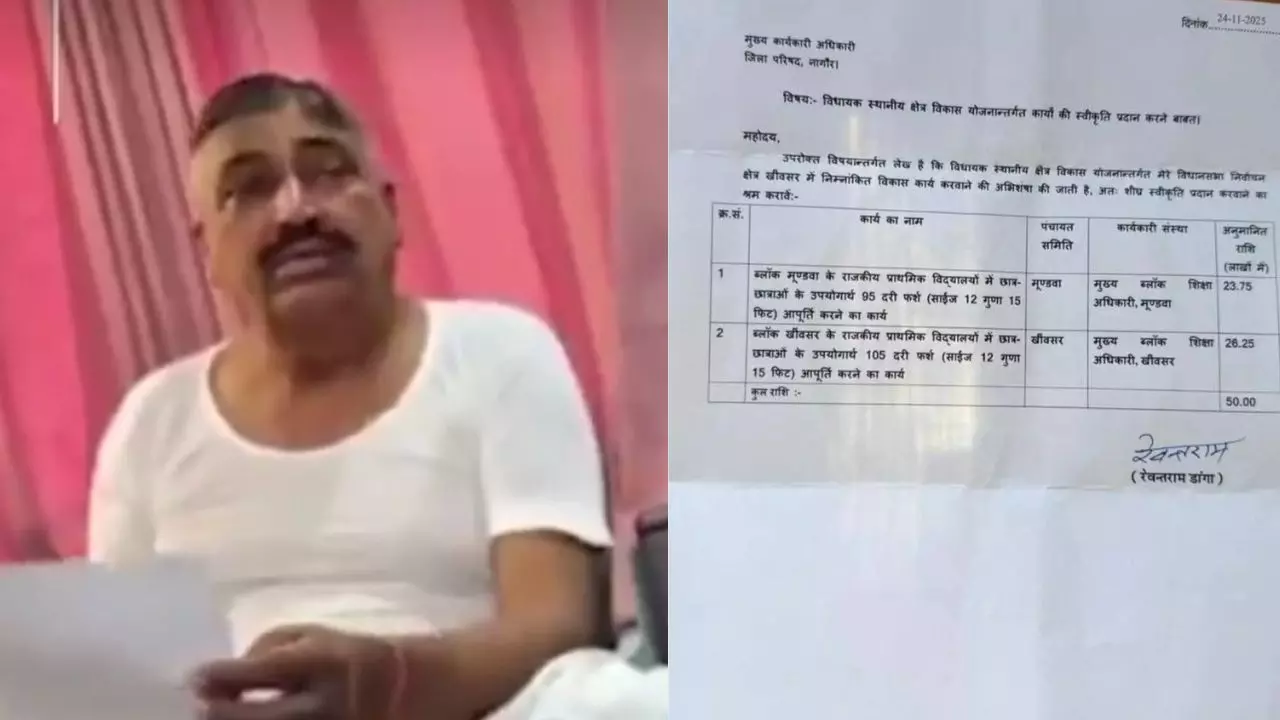

JAIPUR: A hidden-camera investigation into Rajasthan’s MLA Local Area Development (MLA-LAD) funds has triggered a political storm, raising uncomfortable questions about how discretionary development money is recommended, approved, and monitored and how easily those processes can be bent by informal power.
A Sting That Shook the Assembly
In early December, a media investigation set off tremors in Rajasthan’s political establishment. The report alleged that several legislators across party lines had sought commissions in exchange for recommending development works under the MLA Local Area Development (MLA-LAD) scheme, a fund meant to address local infrastructure gaps.
The investigation named three legislators: Rewant Ram Danga, a Bharatiya Janata Party (BJP) MLA from Khivsar; Anita Jatav, a Congress MLA from Hindaun; and Ritu Banawat, an Independent MLA from Bayana in Bharatpur district. According to the report, each was linked to separate alleged arrangements involving commission demands or monetary inducements tied to development recommendations
The allegations landed in Jaipur with immediate political consequences. Opposition leaders demanded explanations, while ruling-party figures questioned the methods and intent of the investigation. At the center of the controversy was not only the alleged conduct of individual MLAs, but also the larger system that allows elected representatives significant discretion over public funds.
The Alleged Deals and the Money Trail
According to the investigation, Rewant Ram Danga was accused of seeking a commission of up to 40 percent while assuring development work worth ₹50 lakh. Anita Jatav was alleged to have accepted ₹50,000 in return for recommending projects valued at around ₹80 lakh. In the case of Ritu Banawat, the report claimed that a deal involving ₹40 lakh was finalized through her husband.
The report further alleged that recommendation letters were issued in the name of the district council’s chief executive officer, without a detailed assessment of the actual need or priority of the proposed works. Such letters are crucial: under the MLA-LAD framework, they often serve as the gateway through which projects are sanctioned and executed by local authorities.
Rajasthan MLAs receive ₹5 crore annually under the scheme, a pool of money intended to fund small but critical local projects roads, community buildings, school facilities that might otherwise be overlooked. The scale of the funds, combined with limited real-time public scrutiny, has long made the scheme vulnerable to allegations of favoritism and misuse.
Denials, Defenses, and Political Pushback
All three legislators have denied the allegations. Rewant Ram Danga went further, offering a defense that drew widespread attention: he claimed that the reporter involved had hypnotized him and forcibly placed money on him, a statement that was met with skepticism across political and media circles.
Party responses reflected familiar fault lines. Leaders emphasized that the allegations were claims, not convictions, and questioned the ethics of sting operations. Others argued that the details disclosed commission percentages, project values, intermediaries were too specific to be dismissed lightly.
Behind the scenes, the controversy intensified an already simmering debate within Rajasthan’s political class about accountability mechanisms for discretionary funds. While formal audits exist, critics argue that they are often retrospective and ill-equipped to detect collusion or informal arrangements made before projects are sanctioned.
Inside the Reporting Method and the Larger Questions
The investigation relied on an undercover reporter posing as the proprietor of a dummy firm, claiming ties to the Khadi and Village Industries Board and seeking contracts to supply durries and carpets to government schools.
During recorded interactions, the focus of the conversations reportedly shifted quickly from project specifications to commissions. Discussions of quality standards, pricing or actual local requirements were largely absent, according to the report. Instead, the alleged negotiations revolved around the percentage or amount expected in return for a recommendation letter.
State Intervention and the Freeze on Development
Amid mounting pressure, Chief Minister Bhajan Lal Sharma announced a high-level inquiry, directing the Chief Secretary and the Director General of Police to oversee an investigation by a committee chaired by the State Chief Vigilance Commissioner, the Additional Chief Secretary (Home). The MLA LAD accounts of the three constituencies were frozen, and all implementation and payment processes for works recommended by the accused legislators were put on hold. A four-member committee headed by ACS Home Bhaskar A. Sawant was tasked with submitting its report within 15 days.
Former Chief Minister Ashok Gehlot described the episode as “extremely serious and concerning,” urging immediate cognisance by the Speaker and a thorough investigation to uphold integrity in public life. For residents of the affected constituencies, the administrative freeze has had immediate consequences, stalling sanctioned projects and underscoring how allegations alone before any findings can disrupt local development.
