

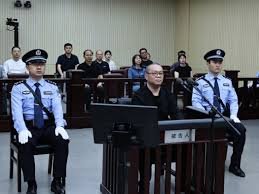

China on Tuesday executed Bai Tianhui, a former executive at a major state-owned asset management company, for accepting bribes worth US$156 million (₹1,300 crore) between 2014 and 2018.
Former Huarong International Executive Put to Death
According to state broadcaster CCTV, Bai Tianhui, former general manager of China Huarong International Holdings (CHIH), was executed on Tuesday morning in Tianjin after being convicted of large-scale corruption.
The court found Bai guilty of accepting US$156 million in bribes in exchange for granting favorable treatment in project acquisitions and financing during his tenure from 2014 to 2018.
CHIH is a subsidiary of China Huarong Asset Management, one of the country’s largest state-controlled firms specializing in bad-debt management.
Court Calls Crimes “Extremely Serious”
Bai’s death sentence was initially handed down in May 2024 by the Tianjin No. 2 Intermediate People’s Court. In China, death sentences for corruption are often issued with a two-year reprieve, after which they may be commuted to life imprisonment. However, Bai’s sentence was not suspended.
He appealed the ruling, but the verdict was upheld in February 2025. The Supreme People’s Court (SPC) later confirmed the execution, stating that Bai’s actions had caused “extremely serious harm.”
“The amount of bribes accepted was exceptionally large, the circumstances of his crimes were extremely severe, and the social impact was egregious,” the SPC said in a statement quoted by CCTV. “The interests of the state and the people suffered exceptionally significant losses.”
Part of Xi Jinping’s Expanding Anti-Corruption Drive
Bai’s execution marks the latest move in President Xi Jinping’s sweeping anti-corruption campaign, which has targeted China’s powerful financial and state-owned sectors.
China Huarong Group has been central to several of these probes. In 2021, its former chairman Lai Xiaomin was executed for accepting bribes worth US$253 million, one of the largest graft cases in China’s history.
Recent cases include:
- Yi Huiman, former head of China’s top securities regulator, placed under investigation in September 2025.
- Li Xiaopeng, ex-chairman of the state-owned Everbright Group, sentenced to 15 years in prison in March 2025 for taking bribes of 60 million yuan.
- Liu Liange, former Bank of China chairman, sentenced to death with a two-year reprieve in November 2024 for accepting bribes worth 121 million yuan.
Final Meeting Before Execution
CCTV reported that Bai met with close relatives before his execution in Tianjin. The report did not disclose the method of execution.
China treats all death penalty statistics as state secrets, but Amnesty International and other human rights groups estimate that thousands of executions occur in the country each year.
Critics Call It a Political Tool
While supporters argue that Xi’s campaign promotes clean governance and public trust, critics contend that the anti-graft drive also serves as a political weapon to consolidate power and eliminate rivals.
Despite such criticism, Beijing maintains that strict enforcement against corruption—particularly in financial institutions—is essential to safeguard economic stability and public confidence.
