

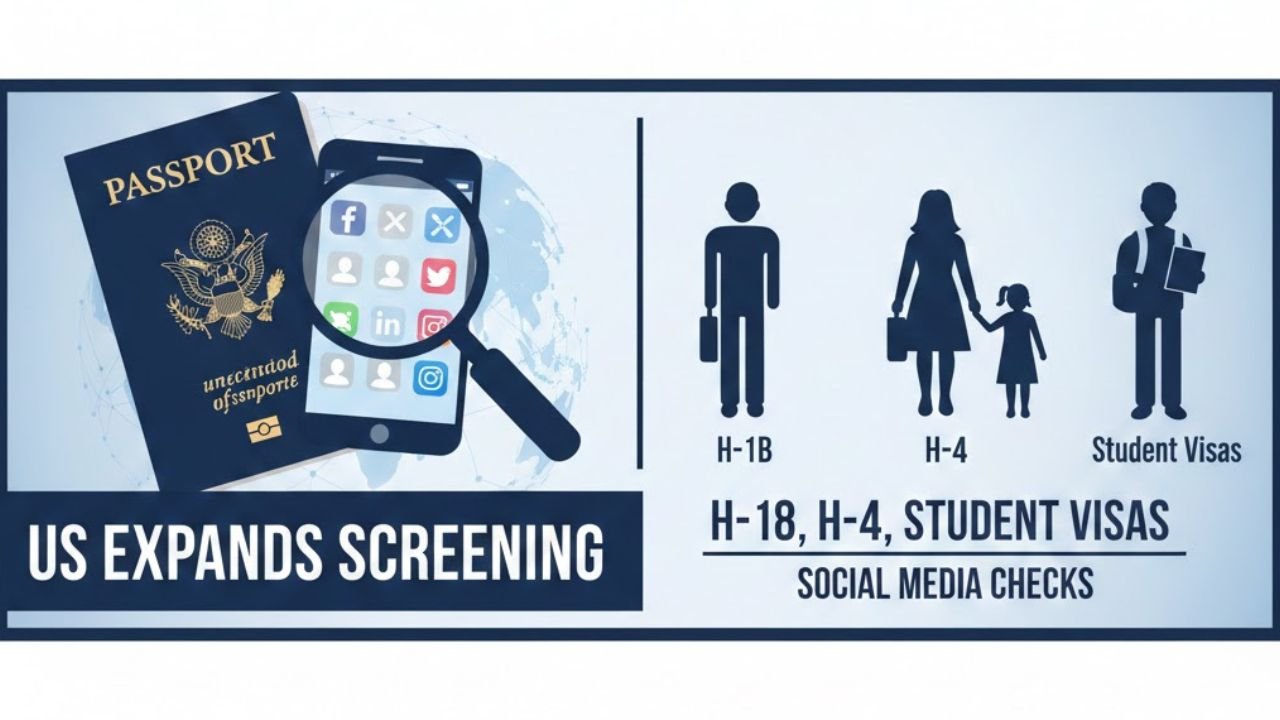

New Delhi | December 5, 2025 | The United States has introduced stricter visa vetting rules, making social media checks mandatory for all H-1B, H-4, and student visa categories (F, M, and J). The directive, effective December 15, 2025, is raising concern among Indian IT and tech professionals — who make up nearly three-fourths of all H-1B visa holders in the US.
Under the new policy, visa applicants and their dependents must ensure that their social media accounts are switched to ‘public mode’, allowing immigration and consular officials to review their digital footprint, professional history, and online conduct before approval.
State Department expands surveillance scope
A State Department cable dated December 2 directs US consular missions to conduct “mandatory online presence reviews” for every H-1B applicant and their dependents. The same will apply to students, researchers, and exchange visitors already under social media scrutiny.
The memo instructs officers to examine applicants’ profiles across LinkedIn, resumes, and online platforms, with a focus on individuals working in:
- Content moderation
- Fact-checking and misinformation analysis
- Online compliance or digital safety
- Platforms regulating free speech
The internal note also clarifies that individuals found to have participated in “censorship of free expression” or to be associated with organizations engaged in content regulation may be denied visa entry.
‘Free speech’ becomes a policy test
The latest directive appears to be part of Washington’s broader debate over free speech versus online censorship. Officials argue that examining digital activities helps assess whether applicants’ roles could “undermine democratic discourse” or “support ideological manipulation” online.
However, policy experts warn that such vague definitions could result in subjective assessments and arbitrary visa denials.
“This is no longer just about documentation — your digital behavior can now shape your visa fate,” said an immigration attorney based in New York. “Posts, retweets, or professional affiliations could all be interpreted politically.”
Implications for Indian professionals
India remains the largest beneficiary of the US H-1B visa program, accounting for nearly 75% of the total issued annually. The rule change could disproportionately affect Indian engineers, data analysts, and tech workers, many of whom maintain professional or advocacy-related social media profiles.
Industry observers say the move will further complicate the already rigorous visa process, particularly for applicants linked with digital media or policy platforms.
“Applicants working in AI ethics, fact-checking, or tech policy could face more intense questioning,” noted a Bengaluru-based visa consultant. “Many will now think twice before posting or engaging on politically sensitive topics.”
Public social media profiles made compulsory
According to the official cable, applicants for H-1B, H-4, F, M, and J non-immigrant visas must adjust their privacy settings to ‘public’ across all platforms to enable verification. The review may include platforms such as Facebook, X (formerly Twitter), Instagram, LinkedIn, and YouTube.
The US Department of State maintains that the expanded checks are part of a national security initiative designed to identify potential threats and prevent visa fraud.
Privacy and discrimination concerns
Digital rights organizations, however, have criticized the policy as a form of digital surveillance that compromises individual privacy. They argue that forcing public visibility of personal accounts amounts to self-censorship and could unfairly target those from certain nationalities or professions.
“This level of monitoring may discourage applicants from expressing legitimate opinions,” said a digital privacy researcher at Stanford University. “It effectively creates a chilling effect on free expression.”
Students and researchers express unease
Indian students and researchers in the US — especially those pursuing social sciences or political studies — fear that academic posts or opinions could be misinterpreted during the vetting process.
A graduate student at the University of California commented:
“What if a classroom debate or a research opinion on governance is seen as anti-policy? It’s unclear how officials will differentiate between academic discussion and political activity.”
Balancing transparency and freedom
While Washington insists that the move is meant to enhance transparency and security, immigration lawyers believe it risks reinforcing a climate of “digital fear.”
“The US wants openness, but it’s blurring the line between transparency and surveillance,” said a senior policy analyst at the Brookings Institution. “For Indian professionals, this means managing both professional credibility and political neutrality online.”
As global scrutiny of digital behavior tightens, experts predict a growing trend of “preemptive digital sanitization” — where applicants clean up their social profiles before applying for visas.
