
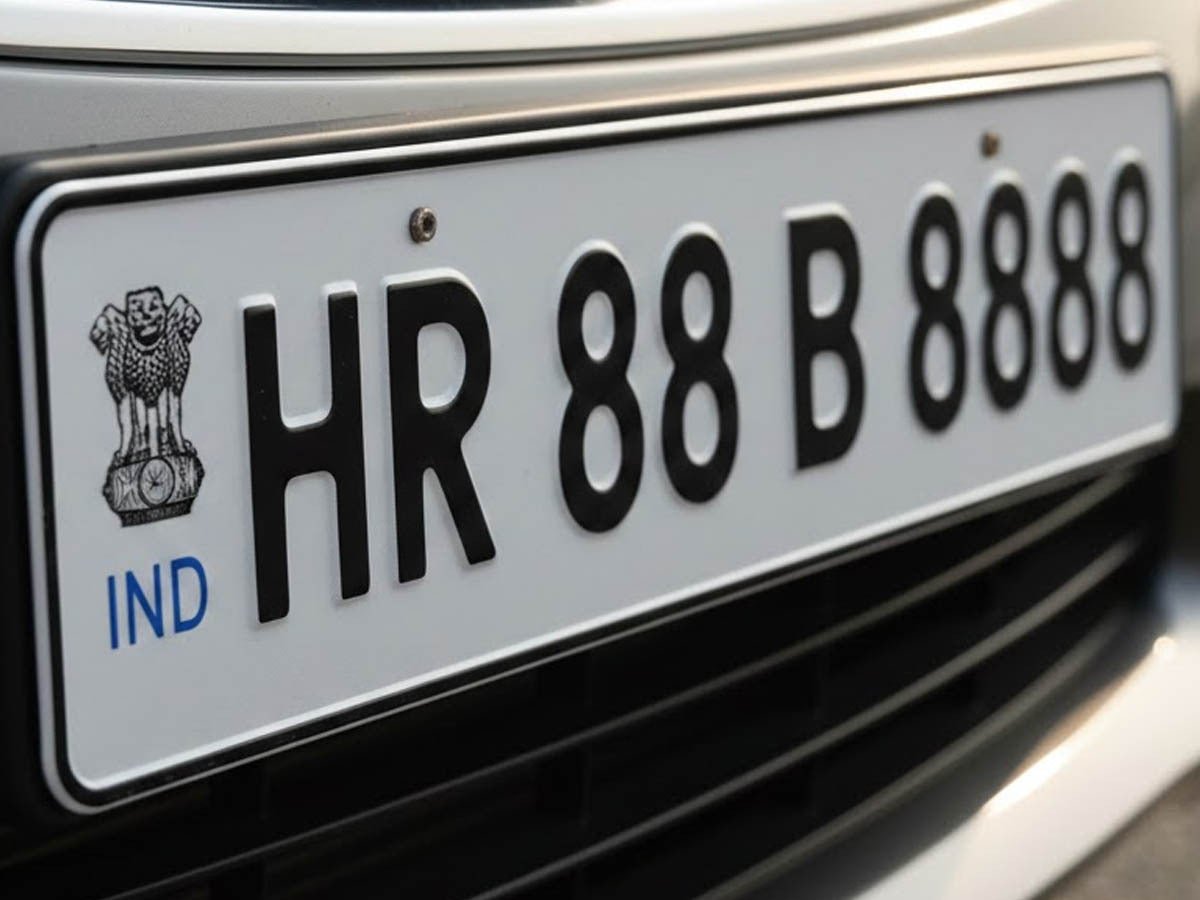

The bidding for a sought-after Haryana vehicle registration number HR88B8888 has ignited an unusual political and financial storm, raising questions about transparency, wealth disclosure and the culture of prestige around India’s booming market for VIP license plates.
A Number Plate That Became a National Story
Haryana’s weekly online auctions for VIP or “fancy” vehicle numbers are typically routine affairs, drawing enthusiasts willing to pay a premium for rare numerical combinations. But the bidding for HR88B8888, a plate that visually resembles a string of eights, quickly became an outlier.
The alphanumeric sequence “HR” indicating Haryana, “88” reflecting the specific Regional Transport Office code, “B” marking the vehicle series, and “8888” forming the sought-after quadruple-digit pattern drew 45 applications. With a base price of ₹50,000, the number soared to a staggering ₹1.17 crore, making it the costliest vehicle registration number ever auctioned in India. The bidder, Sudhir Kumar, a director at Romulus Solutions Private Limited, won the auction on November 26. But he did not pay.
A Missing Payment and Mounting Questions
The deadline to deposit the full amount was December 1. Mr. Kumar failed to do so, and the reasons remain murky. He later said he attempted to make the payment twice on Saturday night but was blocked by a “technical glitch.” He also acknowledged tension within his family, some of whom reportedly opposed spending more than a crore on a number plate.
Because the payment lapsed, the state automatically forfeited Mr. Kumar’s ₹11,000 security deposit, a safeguard built into the auction system. The number plate will now be reauctioned. The lapse might have ended quietly except that the scale of the bid prompted Haryana officials to scrutinize the bidder’s financial capacity, triggering a cascade of political and regulatory inquiries.
Government Orders Probe Into Bidder’s Assets
Haryana Transport Minister Anil Vij directed his department to investigate whether Mr. Kumar possessed the financial wherewithal to make a bid of ₹1.17 crore. The minister also said he would write to the Income Tax Department to examine Mr. Kumar’s assets and income, adding that bidding in state auctions “is not a hobby, it’s a responsibility.”
Authorities have begun checking whether the bidder’s declared net worth matches the amount he committed to paying. Mr. Vij said that the purpose of the scrutiny is to deter individuals from artificially inflating auction prices without the means to follow through a practice that could distort revenue expectations and undermine the credibility of state-run auctions.
The investigation also comes at a moment when Indian states are increasingly relying on VIP number plate auctions to raise funds, making transparency and financial compliance central to their operations.
A Culture of Prestige Meets Regulatory Pressure
Fancy registration plates — especially those with repeated digits like 0001, 7777 or 8888 — carry enormous symbolic value in parts of India, seen variously as signs of status, auspiciousness, or business success. Haryana’s weekly online auctions open every Friday evening and close Monday morning, with results announced midweek. The system has encouraged competitive bidding, sometimes intensifying into high-stakes contests.
But the HR88B8888 episode has exposed the vulnerabilities of this model: the absence of upfront financial verification, the potential for speculative bidding, and the administrative complexities of reclaiming unpaid numbers. As the state prepares to reauction the plate, policymakers are weighing whether stricter vetting or revised rules are needed to protect the integrity of the process.
