

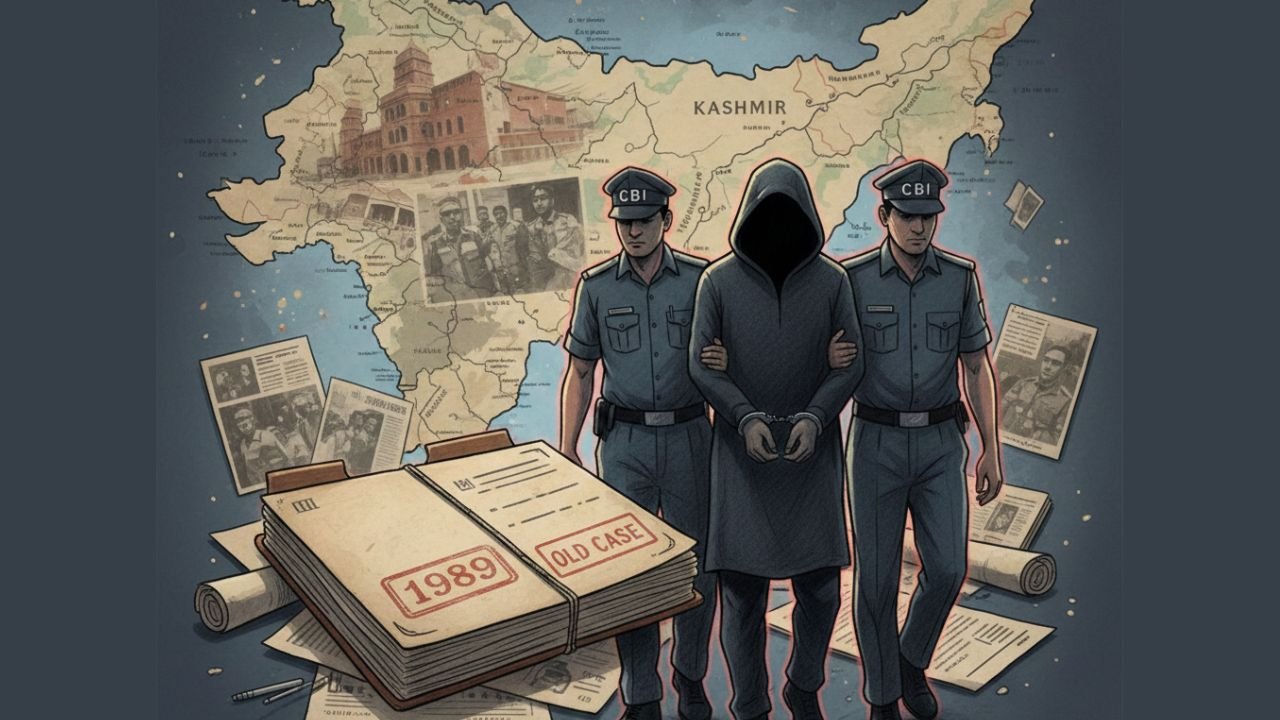

Jammu | In a major breakthrough in a case that altered the security landscape of Jammu & Kashmir, the Central Bureau of Investigation (CBI) has arrested absconding accused Shafat Ahmed Shangloo, wanted for over 35 years in the sensational kidnapping case of Dr. Rubiya Sayeed — daughter of former Union Home Minister Mufti Mohammad Sayeed.
The arrest marks a significant step in the pursuit of justice in one of India’s most high-profile and historically critical terror crimes. Officials confirmed that Shangloo was carrying a reward of ₹10 lakh, declared for information leading to his capture. The agency has stated that he will be produced before the TADA Court in Jammu as per due legal procedure.
The 1989 abduction that shook the nation
The kidnapping of 23-year-old Dr. Rubiya Sayeed on 8 December 1989 in Srinagar remains one of the earliest and most high-impact incidents of insurgency in Kashmir. The abduction was carried out while she was returning from Lal Ded Hospital, triggering widespread panic and political upheaval.
The terror outfit JKLF (Jammu & Kashmir Liberation Front) demanded the release of five arrested terrorists in exchange for Rubiya’s freedom. Under intense pressure and fears of escalation, the government complied — releasing five JKLF operatives. Rubiya was later freed at Sopore after days of intense negotiations.
Security analysts still argue that the decision emboldened separatist militancy, and its consequences reverberated for decades.
Shangloo’s alleged role: A key conspirator
According to CBI investigators:
- Shangloo was actively involved in the conspiracy with JKLF leaders including Yasin Malik
- He allegedly assisted in orchestrating and facilitating the kidnapping
- Charges against him include offences under RPC (Ranbir Penal Code) and TADA (Terrorist and Disruptive Activities Act)
Officials believe Shangloo remained underground using fake identities and operated covertly within and beyond Kashmir to evade arrest. The recent intelligence-led efforts finally resulted in his capture.
A case revived: Justice catches up after decades
Experts say the arrest has three major implications:
- 1. Reinforcement of justice in cold terror cases
It strengthens public trust in long-pending terror investigations. - Crucial link in mapping Kashmir’s early insurgency network
Shangloo’s interrogation could shed new light on the operational structure of JKLF during the period. - Boost to ongoing legal action against Yasin Malik and others
Malik, currently serving a life sentence in a separate terror-financing case, is one of the main accused in this kidnapping plot as well.
The CBI has in recent years intensified its scrutiny of the case — reopening evidence, tracking absconders, and reviving witness testimonies.
CBI’s firm messaging on national security
A senior CBI official, while commenting on the arrest, asserted that:
“Terror-related crimes against the nation are not bound by limitation.
The pursuit of justice continues until every accused faces trial.”
The agency reiterated that tracking absconding terror suspects remains a top national priority.
Conclusion: A symbolic victory for justice
More than three decades later, the arrest of Shangloo stands as a reminder that:
- Terror crimes do not fade with time
- The legal system continues to pursue accountability
- Every accused will eventually face the rule of law
For the Rubiya Sayeed kidnapping case — a defining moment in Kashmir’s conflict history — this development signals renewed judicial momentum.
CBI is now examining Shangloo’s network, movements, and support channels over the years to strengthen their case and build a clearer picture of the terror ecosystem during the period.
Even delayed justice becomes crucial—when it upholds the nation’s resolve against terrorism.
