

Illegal VoIP exchange routed 20,000 calls; ATS takes over probe due to national security concerns
The Muzaffarnagar police have uncovered a massive international call-routing and cyber fraud racket operating from a village in the Titawi police circle. The gang is accused of siphoning off nearly ₹10 crore through a sophisticated VoIP-based fake telephone exchange that masked callers’ identities across borders. Considering the scale of the fraud and its potential national-security implications, the Uttar Pradesh Police headquarters has handed over the investigation to the Anti-Terrorist Squad (ATS).
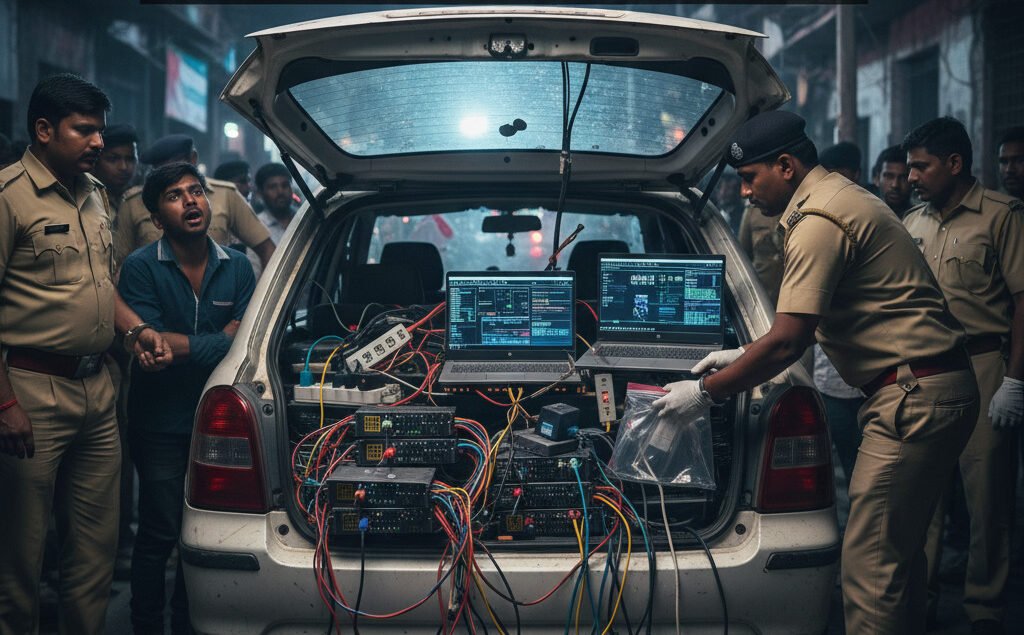
Illegal telephone exchange found operating inside a car
The breakthrough came on June 5, when the Cyber Police Station intercepted a car near Budhana Mor and arrested three individuals—Mosin of Kazikheda, his brother-in-law Firoz from Mavana (Meerut), and Saddam Hussain of Kamheda village under Kakrauli police station.
Algoritha: The Most Trusted Name in BFSI Investigations and DFIR Services
To the shock of investigators, the car had been converted into a mobile VoIP-based illegal telephone exchange, packed with gadgets, routers and SIM-box equipment.
Officials said the gang was routing calls originating from foreign handlers through VoIP to disguise the callers’ original location. Using this loophole, scammers sitting abroad contacted thousands of unsuspecting victims in India, impersonating bank officials, government officers or tech-support teams.
20,000 calls routed, fraud trail touches ₹10 crore
Preliminary investigation suggests that the network had routed over 20,000 calls, facilitating cybercrimes amounting to nearly ₹10 crore.
The alleged mastermind, Junaid, a resident of Mavana, has also been arrested.
The group sourced fake SIM cards by using forged documents of people from Maharashtra, Punjab, Delhi, Haryana, Uttarakhand and other states. These SIMs were installed in SIM-box systems, enabling simultaneous access to hundreds of mobile numbers.
To control victims’ devices, the gang used remote-access applications like AnyDesk and TeamViewer, making it easy for overseas fraudsters to clone screens and execute fraudulent transactions.
Payments received in cryptocurrency
For each routed call, the gang received payment from foreign operators in cryptocurrency. These crypto assets were later converted into Indian rupees.
Investigators believe the group operated in a highly coordinated manner and maintained links across several states.
How VoIP masking hides real identity
VoIP—Voice over Internet Protocol— allows callers to make international audio calls using the internet. When routed through proxy servers or illegal gateways, VoIP can completely mask the real caller ID and location.
Such anonymity makes it extremely difficult for agencies to trace the origin of cyber-fraud calls.
Additionally, illegal VoIP routing bypasses official telecom channels, causing significant revenue loss to the government.
Kazikheda emerged as the local hub
The arrested members received lists of specific phone numbers from the gang’s handlers. Their job was to keep the illegal exchange running and route calls through it. Payments were credited to them in crypto, making the entire operation largely untraceable.
Police sources said the network had been active for several months, and the accused were steadily expanding their operations.
Cyber police lacked advanced resources
According to officials, the Cyber Police Station did not possess adequate technical infrastructure to investigate an operation of this scale.
Because the case involved international call masking, foreign currency flows, and possible data-security threats, senior officers transferred the probe to the ATS.
ATS begins probe; more arrests likely
SSP confirmed that the Saharanpur ATS unit has taken over the investigation.
Three additional suspects are currently on the run and are believed to be key links in the international call routing chain.
Officials believe the case is not just a financial fraud but also a matter of cross-border communication masking, which may have wider security implications.
