

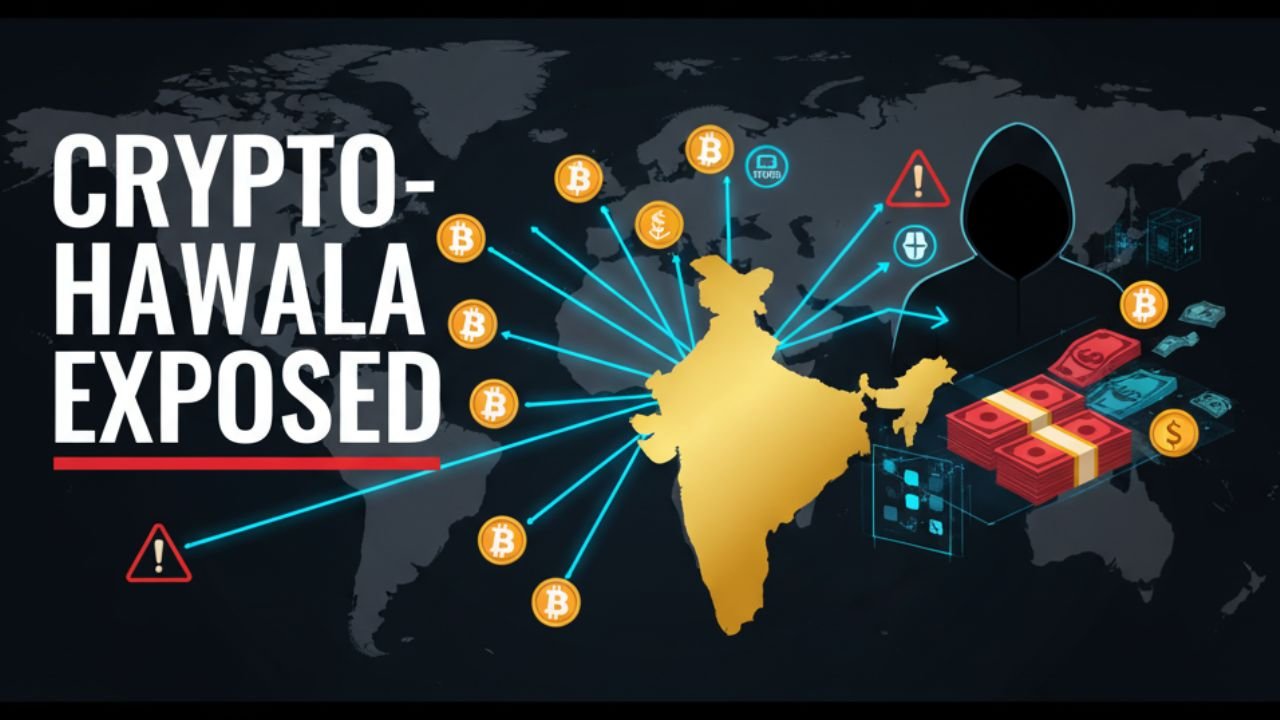

New Delhi: Following the decline of traditional tax havens, cryptocurrency has become a new shelter for black money. The Indian Express, in collaboration with the International Consortium of Investigative Journalists (ICIJ), conducted The Coin Laundry Investigation, which revealed that over the past three years, crores of rupees stolen by cybercriminals have been routed through crypto exchanges to international networks.
I4C Analyses 144 Cases
The Indian Cyber Crime Coordination Centre (I4C), under the Ministry of Home Affairs, identified at least 27 crypto exchanges between January 2024 and September 2025. Through these platforms, an estimated Rs 623.63 crore was moved from around 2,872 victims. One exchange handled transactions worth up to 360.16 crore, while another accounted for 6.01 crore.
The I4C analysis revealed a suspicious and illegal route through which stolen money is transferred from cybercrime victims to international syndicates via cryptocurrency.
How the Crypto–Hawala Network Works
Cryptocurrency is a digital token that can be bought, sold, or transferred without a bank. Every transaction is recorded on the blockchain, but wallet addresses allow users to remain anonymous. This anonymity has made crypto exchanges—operating like stock exchanges—attractive to fraudsters and money launderers.
Globally, crypto regulations are fragmented. Countries like Japan, Singapore, and EU nations enforce strict licensing and monitoring, whereas many jurisdictions have minimal oversight. Exploiting this, ransomware gangs, drug cartels, and cyber fraud networks can move money across countries within minutes.
Regulatory Gaps in India
Despite growing interest among retail investors, India lacks a clear regulatory framework for cryptocurrency. Authorities note a dilemma: regulating crypto could be interpreted as government support, while the asset remains volatile and risky.
Agencies also face the challenge of storing seized crypto assets. A major agency reportedly kept about $4 million worth of digital assets temporarily with a custody company, while the Enforcement Directorate (ED) awaits guidance from the Ministry of Home Affairs for secure storage.
Growing Pressure on the Crypto Industry
Crypto exchanges claim that regulatory uncertainty disrupts their operations. Overseas platforms, outside Indian jurisdiction, continue providing uninterrupted services to Indian users.
Taxation (1% TDS and 30% capital gains tax) and unclear rules have affected trading volumes. Between April 2022 and July 2023, Indian exchanges saw a 97% decline in trading volume, with nearly Rs 35,000 crore shifting to offshore platforms.
Leading Indian exchanges—CoinDCX, WazirX, Mudrex, CoinSwitch, Pi42, Onramp, and BitBNS—operate under foreign holding companies. Founders state that this is a standard approach to attract global investment, though some argue that India’s regulatory uncertainty forced a complex ownership structure.
Global Context and Risks
Internationally, consumer protection regulations are evolving slowly. In the US, Binance founder Changpeng Zhao received a settlement, even after admitting money-laundering offenses.
In India, regulatory gaps have increased risk for ordinary investors. Millions of Indians investing in crypto face uncertainty, as there is no recourse from RBI or SEBI if an exchange freezes withdrawals or shuts down.
Conclusion:
Cryptocurrency has now become a new hub for black money. Regulatory uncertainty in India and the reach of global platforms have amplified these risks. Law enforcement agencies urgently need strict monitoring and clear guidelines to manage the emerging digital financial landscape, or the new black money network could expand even faster.
