

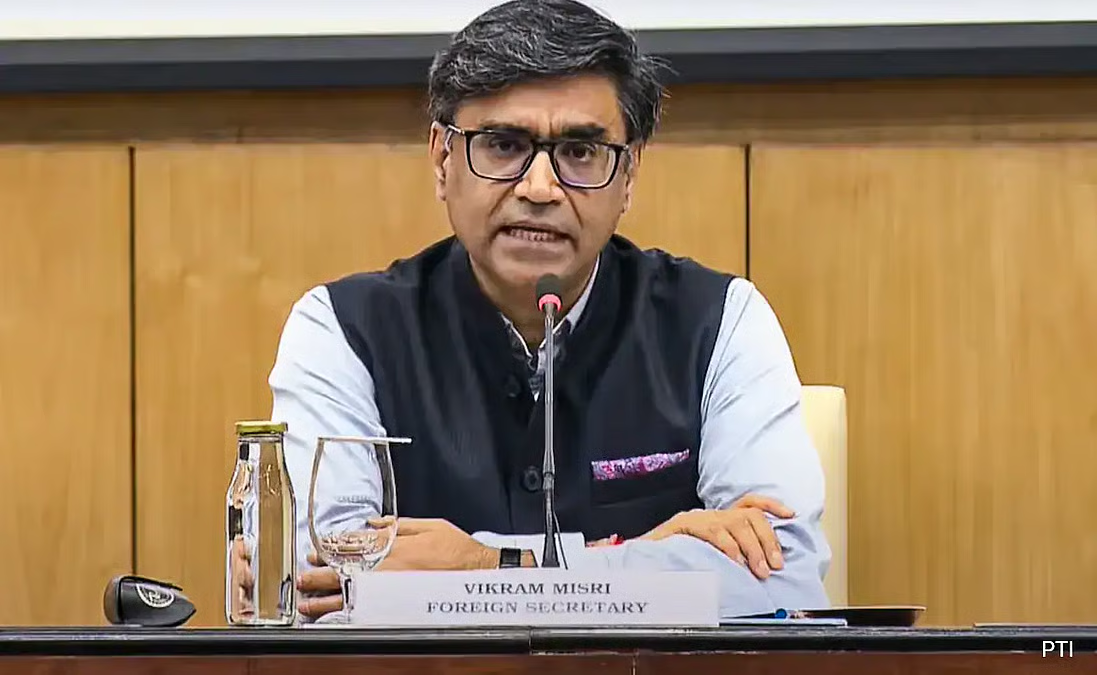

After Foreign Secretary Vikram Misri announced a government decision to de-escalate tensions with Pakistan, a torrent of personal abuse followed—targeting not only him but his family. The backlash has sparked a rare and unified response from India’s top civil services, political leaders, and bureaucratic associations defending the sanctity of public service.
Civil Services Close Ranks to Defend Integrity of Bureaucracy Amid Rising Toxicity Online
In a striking example of how digital discourse in India can veer into vitriol, Foreign Secretary Vikram Misri became the latest target of an orchestrated online attack—this time, for delivering a message of peace. On May 10, 2025, Misri, acting on behalf of the Government of India, announced a mutual cessation of military operations between India and Pakistan. Within hours, his personal X (formerly Twitter) account was flooded with abusive and deeply personal messages, many of them targeting his daughter and family.
By May 11, the vitriol had reached such a crescendo that Misri was compelled to lock his account. The trolling campaign wasn’t limited to anonymous fringe voices it was amplified by hyper-partisan social media accounts that accused him of being a “compromiser,” blaming him for what they deemed a “sellout” to Pakistan.
In response, India’s top bureaucratic associations representing the Indian Administrative Service (IAS), Indian Police Service (IPS), and senior civil servants—have mounted a robust public defense, underscoring both solidarity and the mounting toll of political toxicity on the bureaucracy.
Also Read: Attention Startups! Showcase Your Smart Policing Solutions on India’s Biggest Stage
Civil Services Condemn ‘Unwarranted Personal Attacks’
The IAS Association was first to speak out, issuing a public statement on X: “Unwarranted personal attacks on civil servants performing their duties with integrity are deeply regrettable. We reaffirm our commitment to uphold the dignity of public service.”
Soon after, the IPS Association echoed the sentiment: “Unequivocally condemn the deplorable personal attacks against Foreign Secretary Shri Vikram Misri and his family. Such unwarranted assaults on civil servants committed to their duties are absolutely intolerable.”
Secretary at the Department of Administrative Reforms and Public Grievances and Misri’s batchmate, added a personal note: “Vikram Misri is amongst India’s most celebrated diplomats… [he] has always epitomised the best values of service above self and Nation First approach.”
For many civil servants, the episode represented not just a personal attack on one diplomat but an erosion of the institutional dignity of public service itself.
Political Leaders Urge Civility, Highlight Chain of Command
Cutting across political lines, several leaders stood by Misri and emphasized the structural reality: bureaucrats execute the decisions of the political executive.
AIMIM chief and Member of Parliament Asaduddin Owaisi tweeted: “Our civil servants work under the Executive… they shouldn’t be blamed for the decisions taken by The Executive / or any political leadership running Watan E Aziz.”
Congress leader Sachin Pilot said the targeting of diplomats and civil servants was “unacceptable,” stressing that those who serve the country should not be vilified for fulfilling their duties. Gaurav Gogoi, Deputy Leader of the Congress in Lok Sabha, added, “There is absolutely no reason for anyone to feel malice towards him. He has only conveyed the message that the political leadership of India has taken.”
The response indicates a growing consensus that bureaucrats—especially those dealing with sensitive national security issues—must be insulated from partisan attacks that not only demoralize individuals but also weaken governance institutions.
A Mirror to Digital India’s Ugly Side
The incident is the latest in a series of online campaigns targeting public officials. Misri’s case, however, is distinctive due to the nature of the abuse: deeply personal, extended to his family, and triggered not by policy-making, but by conveying a decision taken by elected representatives.
