
Stay ahead with our breaking stories and exclusive coverage prioritized on Google.
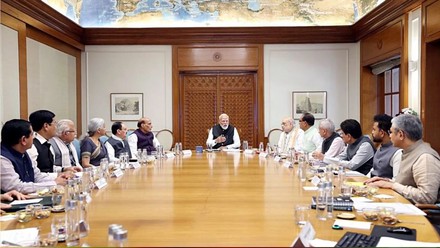
Add The420 on Google →The Union Cabinet on Friday approved a Constitution Amendment Bill linked to delimitation and women’s reservation, clearing the way for a 50 percent increase in Lok Sabha and state Assembly seats and the implementation of 33 percent reservation for women from the 2029 general elections. The meeting, chaired by Prime Minister Narendra Modi, also cleared a mechanism to preserve the existing proportional share of Lok Sabha seats among states until 2051.
Following Cabinet approval, the legislative package will be introduced in a special session of Parliament. The Lok Sabha is scheduled to meet on November 30 and the Rajya Sabha on December 2, with proceedings expected to extend up to December 3 if required. Through these bills, the government aims to delink the rollout of women’s reservation from the next census and subsequent delimitation exercise so that roughly one-third of seats in the Lok Sabha and state Assemblies can be reserved for women in 2029.
Expansion of Lok Sabha to 850 Seats and State Share Freeze
At present, the Lok Sabha has 543 elected seats. Under the proposed framework, the maximum strength of the Lower House could be raised from 550 to 850, allocating up to 815 seats for states and 35 for Union Territories. Existing Lok Sabha seats across all states are proposed to be increased uniformly by 50 percent. Based on this formula, Uttar Pradesh’s tally could rise from 80 to 120, Bihar’s from 40 to 60, Maharashtra’s from 48 to 72, and West Bengal’s from 42 to 63, while Tamil Nadu’s representation is estimated to increase from 39 to around 59 seats. The final numbers will be determined through the delimitation process and relevant legislative provisions.
A central feature of the proposal is maintaining the proportional representation of states based on the 1971 census until 2051. Even as total seat numbers expand, no state’s relative share in the Lok Sabha will change. This safeguard addresses concerns raised by southern states, which feared that fresh delimitation strictly based on current population figures would reduce the political weight of states that achieved better population control while increasing the share of more populous states.
Delimitation Mechanism and Rollout of Women’s Quota
Delimitation involves redrawing the boundaries of Lok Sabha and Assembly constituencies and determining seat allocations through an independent Delimitation Commission to maintain balanced voter representation. Alongside the constitutional amendment, the government plans to introduce the Delimitation Bill 2026 to set up a commission for redrawing both parliamentary and state Assembly constituencies. The legislative package also includes amendments to Union Territory laws covering the electoral structures of Delhi, Puducherry, and Jammu and Kashmir.
The 33 percent quota for women in Parliament and state legislatures was originally enacted through the Nari Shakti Vandan Adhiniyam in 2023, but its implementation was tied to the completion of the next census and delimitation, raising concerns over possible delays. By modifying this framework alongside seat expansion, the government seeks to operationalise the quota in time for the 2029 Lok Sabha polls.
Opposition Divisions and the Special Majority Test
Opposition parties remain divided over the proposals. While the Congress and the Samajwadi Party have raised objections to the proposed delimitation framework, the DMK and the BRS have signalled conditional support, with southern parties emphasising the need to protect inter-state political balance.
Passing a Constitution Amendment Bill requires a special majority in both Houses of Parliament, meaning a majority of the total membership of each House and at least two-thirds of members present and voting. In the 543-member Lok Sabha, three seats are currently vacant, leaving an effective strength of 540. If all 540 members vote, the government will require at least 360 votes. With the ruling NDA estimated to have around 320 MPs, securing support from sections of the opposition will be crucial for passage.