
Follow us on Google News

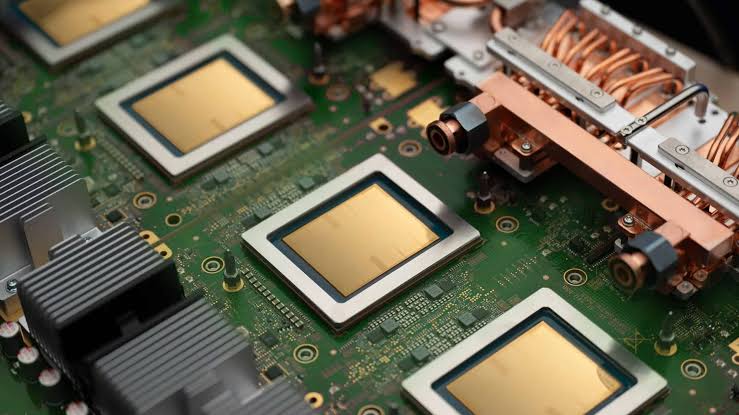
Google has introduced two new artificial intelligence computing systems designed to handle increasingly demanding AI applications, strengthening its challenge to Nvidia in the rapidly expanding market for advanced chips.
The systems, called TPU 8tx and TPU 8i Max, were announced on Monday as part of Google’s eighth-generation Tensor Processing Unit (TPU) portfolio.
The announcement marks a shift towards more specialised hardware. Instead of relying on one type of system for every AI task, Google is developing configurations designed for specific requirements, including stronger data protection and the ability to process enormous amounts of information.
Google Expands Its AI Hardware Lineup
Google’s latest announcement brings its eighth-generation TPU portfolio to four systems.
Earlier this year, the company introduced TPU 8t for large-scale AI model training and TPU 8i for applications requiring fast responses.
The newly announced TPU 8tx and TPU 8i Max build on that technology, adapting existing hardware for additional uses.
This distinction is important because the company is introducing new computing configurations rather than designing two completely new generations of processors.
The approach allows Google to adjust how chips, memory, networking equipment and other components work together.
It could also help the company respond more quickly as businesses demand increasingly powerful systems for running artificial intelligence.
Google says it now serves nearly 100 TPU customers, including technology companies, research organisations, retailers and universities.
Its growing customer base reflects efforts to establish TPUs as an alternative to the graphics processing units, or GPUs, that dominate much of today’s AI infrastructure.
TPU 8tx Focuses On Protecting Sensitive Data
The TPU 8tx is designed for organisations that need additional protection when processing confidential information through AI systems.
This includes financial institutions, government agencies and businesses handling sensitive customer or commercial data.
Ordinarily, information may be encrypted while stored or transmitted but must be made available for processing when a computer uses it.
Google says TPU 8tx adds hardware-level security protections intended to keep sensitive information isolated even while AI applications are running.
The system combines Google’s TPU technology with processors supplied by AMD.
According to Google, the configuration can deliver up to twice the responsiveness of the earlier TPU 8t system, with minimal additional performance cost.
These are company-reported performance claims. Their results in real-world deployments will depend on the applications and operating conditions involved.
For organisations considering AI tools that process confidential records, the announcement could provide another infrastructure option.
However, hardware security protections do not automatically eliminate risks involving compromised accounts, insecure applications or improper handling of data.
TPU 8i Max Targets Larger AI Workloads
Google’s second system, TPU 8i Max, addresses a different challenge: the growing amount of information advanced AI systems must handle simultaneously.
Modern AI applications are increasingly expected to examine lengthy documents, analyse video recordings, understand large software projects and complete tasks involving multiple steps.
These activities demand significant computing power and rapid access to memory.
Google says TPU 8i Max combines two TPU 8i chips in a single package.
The resulting configuration offers double the computing capacity, memory and memory bandwidth of the standard TPU 8i, according to the company.
In simple terms, the system is designed to handle larger and more complicated AI tasks without slowing down as quickly.
Google also says the configuration allows data centres to fit more computing capacity into the same physical space.
This matters because AI infrastructure operators face rising costs associated with equipment, electricity, cooling and data-centre expansion.
The company is also expanding software support for its TPUs, including tools intended to make it easier for developers to use existing AI frameworks.
Why Google’s Expansion Matters For Nvidia
Nvidia remains a leading supplier of AI processors used by cloud providers, technology companies and AI developers.
Its GPUs are widely used to train and operate the large models powering modern generative AI services.
Google’s latest announcement reflects growing competition over which companies will supply the computing infrastructure behind those services.
The rivalry is no longer limited to raw processing speed. Security, memory capacity, energy efficiency and the ability to run specific AI applications are becoming important selling points.
Google is also working to make its TPU technology easier for outside developers and businesses to adopt.
For Indian technology companies, the expansion could eventually increase the range of cloud-based AI computing options available to them.
However, Google has not established that the new configurations will automatically be cheaper or faster than comparable Nvidia systems across all workloads. Independent testing and commercial availability will determine their practical competitiveness.
What This Means For You
Businesses developing AI applications should compare hardware options based on their actual requirements, particularly data security, computing costs and performance. The announcement does not require ordinary users to change their devices or existing AI services.