

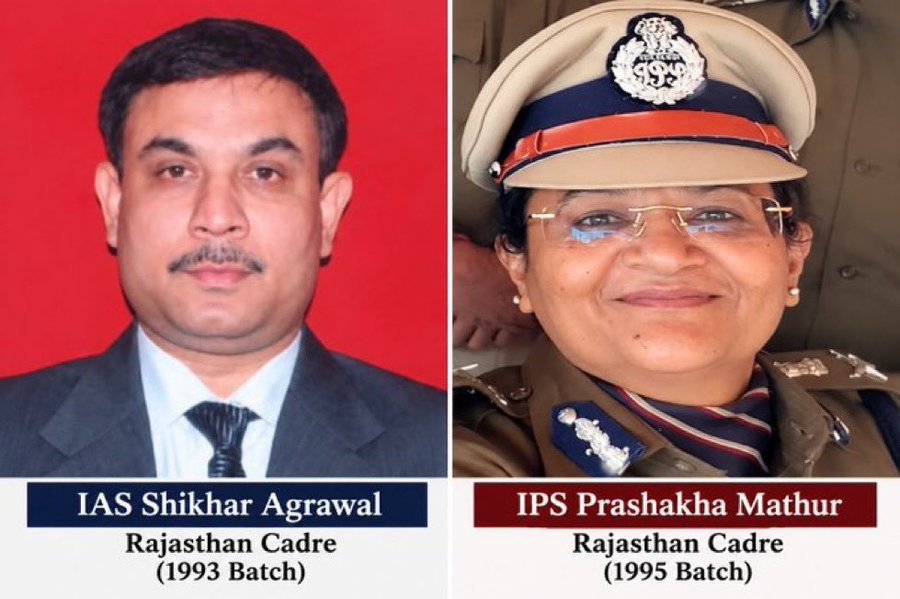

JAIPUR — A senior Indian Administrative Service officer, his wife, a high-ranking Indian Police Service officer, and members of their family have come under scrutiny following a media investigation alleging that they acquired 40 luxury villas and cottages in Rajasthan over approximately two and a half years, in transactions valued at more than ₹6 crore.
According to an investigation published by Bhaskar, the family of Shikhar Agarwal, an Additional Chief Secretary in the Rajasthan government, and his wife, Prashakha Mathur, an Additional Director General of Police, allegedly purchased the properties from a single private company, Goyal Fashions Private Limited.
What makes the reported transactions particularly striking is not merely the number of properties acquired but the financial arrangement that allegedly followed.
The same company that sold the properties reportedly leased all 40 units back from the family, under agreements providing for a combined annual rent of ₹1.80 crore.
The reported arrangement raises important questions about the source of investment funds, the commercial terms of the transactions, potential conflicts of interest and compliance with mandatory asset-disclosure requirements.
The reported acquisitions and lease agreements do not, by themselves, establish corruption or illegality. Whether any wrongdoing occurred would depend on examination of the underlying documents, financial records and applicable service rules.
A Family Property Portfolio Built Across Two Luxury Resorts
According to Bhaskar’s investigation, the 40 properties were acquired at two Ananta-branded resort developments in Rajasthan.
Twenty cottages at Bujhada in Udaipur district were reportedly registered in September 2023. Another 20 villas at Ajabgarh in Alwar district were reportedly registered in March 2026.
The properties were allegedly acquired in the names of the IAS-IPS couple, their two sons and other family members, including relatives from Mathur’s family.
Bhaskar reported that the combined registered purchase value was approximately ₹6.16 crore, with individual properties priced between ₹14 lakh and ₹16.5 lakh.
The report further alleged that the sale deeds and corresponding lease agreements were registered simultaneously.
This arrangement effectively allowed the company to retain commercial use of the properties while transferring ownership to the purchasers and agreeing to pay them annual rent.
Such sale-and-leaseback arrangements are not inherently unlawful and can serve legitimate commercial purposes. Nevertheless, when they involve senior public officials responsible for government policy and administration, they warrant careful scrutiny of transaction values, financing, approvals and the nature of the commercial relationship.
The significant concentration of properties within one family, allegedly purchased from the same company under similar terms, makes the transaction structure an important subject for independent verification.
₹1.80 Crore in Annual Rent: Questions Over an Unusual Financial Arrangement
According to the Bhaskar report, the 20 cottages at Bujhada were leased back to Goyal Fashions for ₹4 lakh each annually, while the 20 villas at Ajabgarh attracted an annual lease amount of ₹5 lakh per property.
The reported agreements therefore provide for ₹80 lakh annually from the Udaipur cottages and ₹1 crore from the Alwar villas.
Together, this represents ₹1.80 crore in contracted annual rental payments against approximately ₹6.16 crore in reported acquisition costs.
That equates to a gross contractual annual yield of roughly 29 percent, a figure sufficiently substantial to warrant closer examination of the underlying business arrangements. It does not establish the net profitability of the investments or confirm that all contracted payments were actually received.
Investigators examining these allegations would need to establish whether the stated purchase prices reflected fair market valuations, whether the lease terms were commercially reasonable and how the acquisitions were financed.
Equally important is whether the company had any business, regulatory or administrative dealings with departments overseen by either officer.
A commercial relationship involving a serving bureaucrat is not automatically a conflict of interest. But an undisclosed relationship involving official decision-making could create serious ethical and legal concerns.
The central issue is therefore not whether public servants may legitimately invest in real estate. They may. It is whether the reported investments were transparently financed, properly disclosed and conducted without any misuse of public office.
Property Declarations Raise a Separate Set of Questions
Among the more consequential aspects of Bhaskar’s investigation are allegations concerning the couple’s annual Immovable Property Returns, or IPRs.
According to the report, 28 of the 40 villas and cottages were allegedly registered in the names of Agarwal and Mathur, while Agarwal’s property return contained details of 14 units.
Bhaskar further reported that Mathur’s return, filed in January 2026, did not contain details of properties allegedly held in her name.
These allegations require a careful comparison between the registration records and the declarations filed by each officer.
There is also an important chronological distinction: properties reportedly registered in March 2026 would not ordinarily appear in returns submitted in January 2026 for the preceding year. Earlier acquisitions, including the properties reportedly registered in September 2023, raise a different disclosure question.
Under Rule 16 of the All India Services (Conduct) Rules, 1968, IAS and IPS officers are required to submit annual immovable property declarations. Property transactions are also subject to government intimation requirements and, in specified circumstances, prior sanction.
A discrepancy between a property deed and an officer’s declaration does not automatically prove deliberate concealment. Authorities would need to examine ownership, dates, sources of funding, the reporting obligations applicable to each asset and any subsequent disclosures.
In a statement reproduced by Bhaskar, Agarwal maintained that relevant property details had been disclosed in his property and tax returns. He also indicated that his children would have to account for properties held in their own names.
His explanation is an important part of the public record and would need to be assessed alongside the relevant documents.
What remains unclear is whether the Rajasthan government has undertaken a comprehensive reconciliation of the reported acquisitions, registered deeds, financial transactions and official declarations.
Senior Positions Make Transparency Particularly Important
The controversy assumes additional significance because of the positions occupied by the two officers.
At the time described in the Bhaskar report, Agarwal held the position of Additional Chief Secretary and oversaw influential portfolios including Industries, Micro, Small and Medium Enterprises, public sector undertakings, industrial corridor development and investment-related affairs.
He also held leadership responsibilities in major state industrial development institutions and previously served in the Chief Minister’s Office.
Mathur, meanwhile, was serving as an Additional Director General of Police, handling Planning, Modernisation and Welfare.
These senior positions carry considerable administrative influence, making transparency regarding private commercial interests especially important.
The allegation is not that the officers necessarily misused their positions. Rather, their responsibilities create a heightened public interest in determining whether any private business relationship intersected with their official duties.
An independent examination would need to consider whether the purchases and leases were duly report
, whether necessary government permissions were obtained and whether any official decisions could have benefited the company involved.
It would also be necessary to establish the source of the money used to acquire the properties and whether the reported rental receipts are consistent with income-tax records and other financial disclosures.
Without that examination, allegations remain allegations, however serious the questions they raise.
If Allegations Are Proven, Will the System Hold Senior Officials Accountable?
Beyond the property transactions, the controversy raises a broader question about the credibility of accountability mechanisms within India’s senior bureaucracy.
The Indian administrative system imposes detailed conduct rules, annual disclosure obligations and vigilance procedures on public servants. Yet the effectiveness of these safeguards depends on whether potential violations are independently examined and whether findings lead to proportionate action.
If an impartial investigation were to establish deliberate nondisclosure, conflicts of interest, unexplained assets or a corruption-related offence, the consequences could extend beyond routine departmental scrutiny.
Depending on the evidence and applicable law, authorities could consider disciplinary proceedings, restrictions on sensitive appointments, criminal investigation, prosecution or recovery of unlawfully acquired assets.
Conversely, if the transactions were legitimate, properly financed and fully compliant with the rules, the officers should have an opportunity to establish that through a transparent examination of the records.
The more troubling institutional question is what happens when serious allegations involving powerful officials are reported but no visible, substantive accountability process follows.
Such circumstances can deepen a public perception that senior officials enjoy protections unavailable to ordinary citizens, whether or not that perception is justified in an individual case.
The government therefore has a responsibility not only to investigate credible allegations but also, within legal and privacy limits, to explain whether an inquiry has been conducted, what it established and whether any action is warranted.
Silence, without clarification, can erode public trust just as surely as an inadequately conducted investigation.
Ultimately, the test is not whether a senior IAS or IPS officer possesses substantial wealth. The test is whether that wealth was lawfully acquired, properly disclosed and accumulated without exploiting public office.
And if wrongdoing is established, the decisive question will be whether the same standards of accountability that apply to ordinary public servants are enforced against those at the very top of the administrative hierarchy.
For a system that depends on public confidence, allegations involving powerful officials cannot be allowed to disappear into bureaucratic silence. Nor should accusations be treated as proof before a fair examination.
The public deserves evidence, due process and a clear answer—not simply another controversy without a conclusion.
Reporting basis: Bhaskar’s investigation and the property-transaction details reproduced from it. The allegations have not been independently established in this article, and no finding of criminal misconduct is asserted.
Follow for daily updates on cybercrime, corporate fraud, DFIR, hacking, investigations, and digital forensics
