

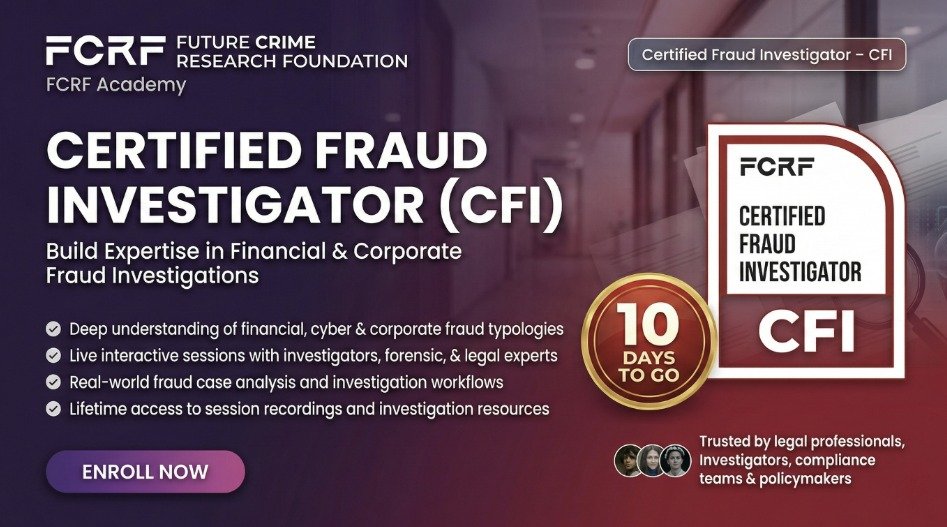

With just ten days remaining before the start of the Certified Fraud Investigator (CFI) program, professionals across the banking, compliance and legal sectors are confronting a reality that has become increasingly difficult to ignore: fraud today is rarely a simple accounting irregularity.
Instead, modern fraud often emerges at the intersection of technology, finance and law. A phishing campaign may lead to vendor payment manipulation. A shell company may disguise procurement kickbacks. A digital identity breach can trigger large-scale financial losses within minutes.
In such cases, the traditional boundaries between departments collapse. Compliance teams must investigate. Lawyers must interpret digital evidence. Risk professionals must detect patterns buried within financial data.

The upcoming CFI program, organized by FCRF Academy, is being positioned as a structured response to that convergence. Scheduled to begin shortly, the program seeks to equip professionals with an integrated understanding of fraud risk, investigative methodology and legal procedure.
Fraud Is No Longer a Niche Discipline
For decades, fraud investigation was often treated as a specialized domain reserved for forensic accountants or law enforcement agencies. Today, however, the responsibilities have expanded across organizations.
Internal auditors are expected to identify red flags within financial statements. Compliance officers must understand money-laundering risks and regulatory reporting obligations. Corporate legal teams increasingly manage internal investigations before matters escalate to enforcement agencies.
Meanwhile, financial institutions face mounting pressure to detect fraudulent transactions early, freeze suspicious accounts and cooperate with investigative authorities.
This evolving landscape has created demand for professionals who can navigate multiple domains simultaneously — accounting principles, investigative techniques, digital evidence, regulatory frameworks and criminal law.
Training programs such as the CFI certification attempt to bridge those gaps, introducing participants to fraud typologies, investigative planning, interview techniques, chain-of-custody principles and the legal frameworks governing economic offences.
The Institutional Context Behind the Program
The launch of the CFI program also reflects the broader growth of specialized professional training in India’s cybersecurity and compliance ecosystem.
FCRF Academy, the training arm of the Future Crime Research Foundation, has in recent years developed several certification programs addressing emerging regulatory and technological risks. These include initiatives focused on cyber crisis management, data protection governance, cyber law and governance risk compliance.
Thousands of professionals from corporate, government and law enforcement backgrounds have participated in those earlier programs.
The CFI certification represents a further expansion into the domain of financial crime and fraud investigation — a field that increasingly overlaps with cybercrime, regulatory enforcement and corporate governance oversight.
Program organizers say the objective is not simply to explain fraud concepts, but to train professionals in the practical mechanics of fraud examination: identifying red flags, conducting structured investigations and documenting findings in ways that withstand regulatory and judicial scrutiny.
Why the Program Is Drawing Broad Interest
Interest in the upcoming training has come from a wide spectrum of professionals — including compliance officers, lawyers, forensic auditors, corporate investigators, banking professionals and law enforcement officials.
The diversity reflects how fraud now touches nearly every layer of institutional decision-making.
For a general counsel, a fraud allegation can trigger litigation risk and reputational damage. For a compliance officer, it may signal regulatory exposure. For a bank’s risk team, it could represent a systemic vulnerability in payment systems.
Understanding how such incidents unfold — and how they should be investigated — has become an essential skill set.
The CFI program’s curriculum therefore emphasizes the lifecycle of fraud: prevention, detection, investigation, response and recovery. Participants are introduced to accounting red flags, anti–money laundering frameworks, cyber-enabled fraud techniques and investigative procedures designed to produce legally defensible evidence.
With the program’s start date approaching, the countdown has added a sense of urgency for professionals seeking structured training in an increasingly complex field.
In an era where financial misconduct can move across digital networks as quickly as money itself, the ability to understand fraud — and investigate it methodically — is no longer a specialized skill.
For many organizations, it is becoming a foundational capability. Interested participants can click here to register for the Certified Fraud Investigator (CFI) program.
