
Follow us on Google News

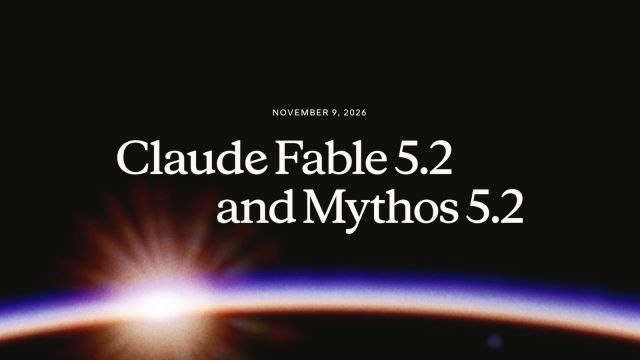
Anthropic has introduced Claude Fable 5.2 and Mythos 5.2, two AI models designed for complex technical and research tasks.
The company announced the models on November 9, 2026, ahead of a potential initial public offering. The release follows CEO Dario Amodei’s earlier call for a slowdown in artificial intelligence development. Anthropic says the models deliver up to 30% faster output than their predecessors while costing approximately 20% less, with improvements in coding, reasoning and visual understanding.
What Makes the New Claude Models Different?
According to Anthropic, Fable 5.2 and Mythos 5.2 share the same underlying AI model but differ in their safety restrictions and availability. Fable 5.2 includes safeguards limiting potentially dangerous cybersecurity and biological research applications, allowing broader public access. Mythos 5.2 has fewer restrictions and is intended for vetted organisations conducting specialised cybersecurity and biomedical research.
Both models are designed for demanding technical projects requiring sustained reasoning and coordination between multiple AI agents. Anthropic has priced them at approximately ₹749.46 per million input tokens and ₹3,747.32 per million output tokens, based on the November 10, 2026 exchange rate. Upstox The company says the improvements could make complex AI-assisted development more efficient.
https://the420.in/fcrf-certified-chief-ai-officer-second-cohort-november-2026/
How Did the Models Perform in Testing?
Anthropic reported that Fable 5.2 achieved 49.1% on FrontierCode 2.0, a benchmark measuring agent-based software development, compared with 45.5% for Claude Opus 5.5 and 42.8% for OpenAI’s GPT-6 Astra. It also scored 69.9% on FrontierSWE v2, against 62.3% for Opus 5.5. On Terminal-Bench-Science, Fable recorded 74.6%, while Mythos reached 75.3%.
Fable also achieved 89.5% on OSWorld 2.1, which evaluates computer-use capabilities, and 64.9% on RoboDojo, a robotic-control benchmark. These results come from Anthropic’s own evaluations and do not necessarily reflect performance in everyday applications.
Can These Models Handle Complex Scientific Research?
Anthropic said Fable 5.2 demonstrated its ability to coordinate more than 1,000 AI agents to build a working operating system over eight days. In another experiment, the model reportedly helped formalise a proof of Fermat’s Last Theorem within 30 hours using 1,000 agents. The company also reported progress on two open theoretical physics problems involving black holes.
Mythos 5.2 is particularly intended for cybersecurity research, including identifying software vulnerabilities and assisting security teams with remediation. Anthropic also reported that the model successfully represented 28 of 34 protein structures associated with adeno-associated viruses used in gene therapy research.
Where Are the Models Available?
Claude Fable 5.2 is available through Anthropic’s Claude platform, Claude Code and its application programming interface. Developers can also access the model through Amazon Web Services, Google Cloud and Microsoft Azure, extending its availability across major cloud platforms.
Mythos 5.2 is not generally available and is intended for approved organisations working in specialised research fields. The different access arrangements reflect Anthropic’s approach to deploying advanced capabilities while maintaining restrictions on potentially sensitive applications.