

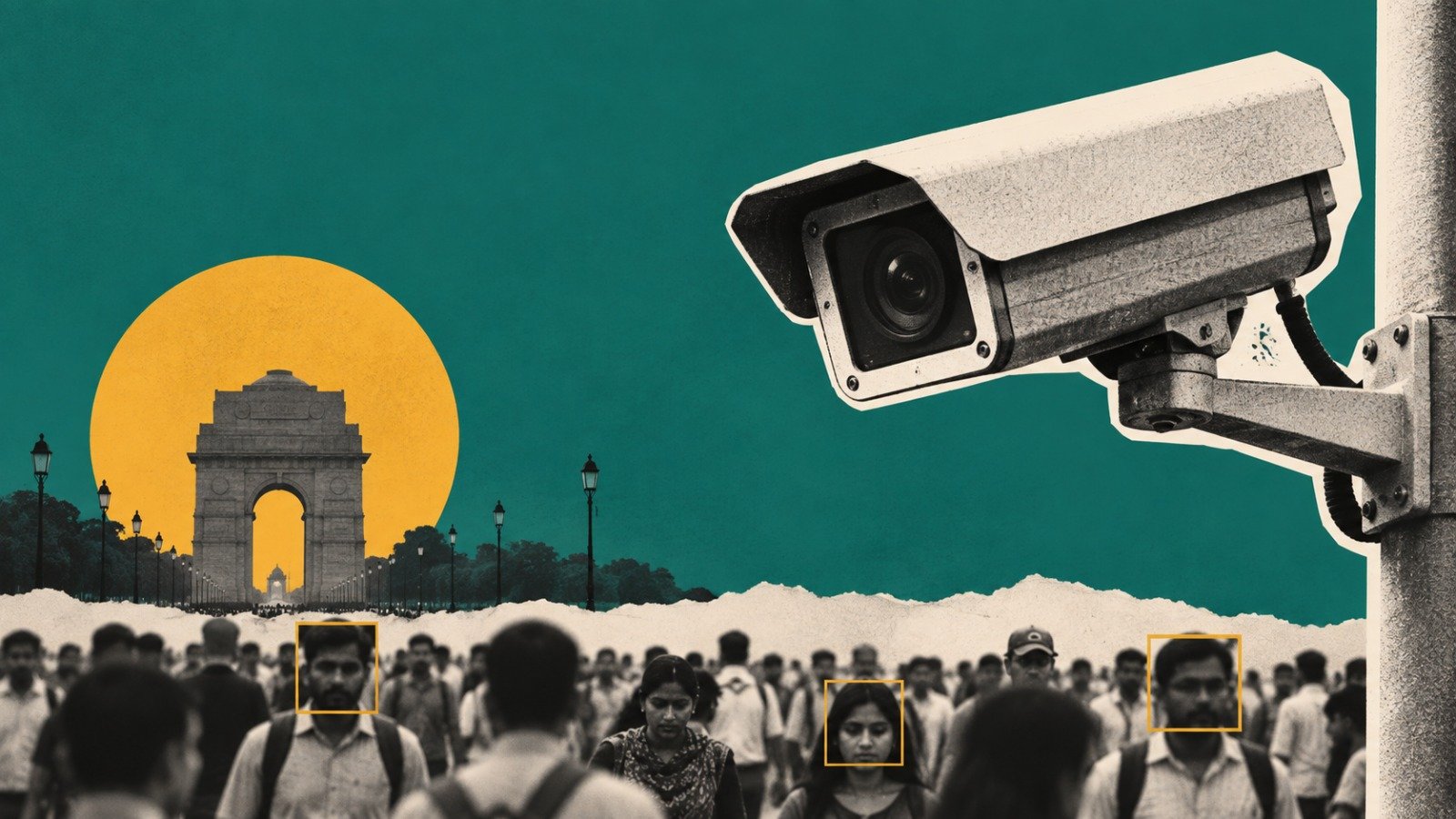

Delhi Police’s ₹857-crore Safe City project is building an AI-enabled surveillance network that can combine camera feeds with government databases, facial recognition and vehicle identification tools.
The first phase was inaugurated in February 2026. By then, 2,100 new cameras had gone live and more than 15,000 existing cameras had been integrated with the system, according to the Union Home Ministry.
Official Delhi planning documents show that the project goes much further than installing CCTV cameras.
It includes facial recognition, artificial intelligence, machine learning, video analytics and integration with 32 government datasets. The stated purpose is to allow selected information from separate systems to be brought together for investigation and decision-making.
That could make Delhi Police considerably faster at moving from a face or vehicle captured on camera to a possible identity.
It also raises a harder question: how much information should one policing platform be able to connect about an ordinary citizen?
Proposal for Conducting Cyber Crisis Drill, Tabletop Exercise (TTEx) & CCMP Readiness Exercise
Cameras Are Becoming Search Points, Not Just Recording Devices
Traditional CCTV mainly records what happens in front of a camera.
The Safe City architecture is designed to add another layer.
A facial recognition system can take an image from footage and compare it with photographs already available in connected databases. Automatic Number Plate Recognition, or ANPR, can do something similar with vehicle registration plates.
Delhi’s own planning documents describe integration of location-based services and crime databases with CCTV feeds, alongside AI-generated alerts.
The Ken reported that datasets being connected include information linked to police clearance certificates, criminal justice records, voter IDs, vehicle registration and driving licences.
Delhi Police separately operates digital systems for police clearance certificates, character verification, tenant verification and domestic-help verification. The national Digital Police platform also provides police access to systems such as CCTNS and ICJS.
The significance lies in combining those records.
A photograph that once required officers to manually compare several systems could potentially become the starting point for an automated search across multiple datasets.
What Facial Recognition, ANPR and Database Integration Actually Mean
Facial recognition does not simply “know” who a person is.
Software measures features visible in an image and converts them into a mathematical representation. It then compares that representation with stored photographs and produces possible matches.
A result is therefore a similarity match, not automatic proof of identity.
That distinction is important because image quality, camera angle, lighting and the underlying database can affect accuracy.
Recent reporting on Delhi Police facial recognition has highlighted this problem. Police sources cited by The Times of India said similarity scores can fall sharply when captured images are poor, while Delhi Police has maintained that facial recognition is an investigative aid and matches require further verification.
ANPR performs a related job for vehicles. It reads a registration plate from an image and converts it into searchable text.
Database integration is the bigger step.
Instead of keeping vehicle, identity and police information in completely separate digital silos, software can retrieve selected information across systems through APIs or other authorised connections.
That can make investigations faster. It also means one access point may reveal much more information than before.
Delhi Assembly Incident Shows the Potential, but Attribution Needs Caution
The usefulness of rapid camera-based tracing was visible after the April security breach at the Delhi Legislative Assembly.
A masked man drove a white Tata Sierra through the VIP gate, placed a bouquet near Speaker Vijender Gupta’s vehicle and fled.
Police identified him as Sarabjit Singh of Pilibhit and detained him around two hours later after tracing the vehicle to the Roop Nagar area.
The Ken reported that Safe City technology helped police identify and track the vehicle.
Public police accounts confirm the rapid arrest and the use of CCTV footage, but they do not independently spell out which specific Safe City systems were used.
That distinction matters because the capabilities of a surveillance network should be judged on documented performance, not assumed from its design.
The Privacy Question Is Bigger Than Criminal Records
The most sensitive part of the project is not necessarily the camera itself.
It is the number of databases that could sit behind it.
The Ken estimates that information connected to around 40 lakh individuals is already available in the wider system and that the architecture could eventually make tens of millions of identities searchable.
Those figures have not been independently confirmed by Delhi Police.
Official records do, however, confirm planned integration of 32 datasets and multiple CCTV systems.
That means people entering the ecosystem need not necessarily have criminal records.
A citizen may exist in government systems because they applied for a police clearance certificate, registered a vehicle, obtained a driving licence or underwent tenant verification.
This creates questions around who can perform a search, what level of authorisation is required, how long searches and images are retained, and whether citizens can challenge an incorrect facial match.
The project’s original purpose was strongly connected to women’s safety under the Nirbhaya Fund. Its technical architecture, however, creates policing capabilities that can extend well beyond that original use case.
NEC Is Implementing the Core System
Official Delhi government documents identify NEC as the company implementing major Safe City activities.
The architecture includes around 10,000 new CCTV cameras, command-and-control centres and integration of existing government databases.
NEC also has prior experience deploying facial-recognition surveillance in Delhi. In 2017, it worked with the New Delhi Municipal Council on a pilot that matched CCTV images against a watchlist.
The Ken additionally identifies Gurugram-based Aviros and its image-search technology, Anveshan, as part of the wider technical ecosystem. I could not independently confirm its exact contractual role through a government source.
As Delhi’s network expands, the most important questions will increasingly concern governance rather than camera count.
A powerful search system can shorten investigations from hours to minutes.
But when the same architecture can potentially search millions of ordinary citizens, accuracy, access controls, audit trails and independent oversight become just as important as speed.
What this means for you: A person does not need a criminal record to exist inside a government database that could potentially be connected to surveillance systems. Citizens should pay attention not only to where cameras are installed, but also to what databases they can query and what safeguards exist against mistaken or unauthorised identification.
The420 Insight: Delhi’s Safe City project shows how modern surveillance is shifting from recording events to connecting identities. The real power is not the CCTV camera. It is the ability to combine a face, vehicle plate and multiple government records within one investigative workflow. The enforcement advantage is obvious, but so is the risk. India still needs clearer public rules on facial-recognition accuracy, database access, retention and remedies for wrongful matches before systems of this scale become routine.
https://www.linkedin.com/company/policetechnology/
