

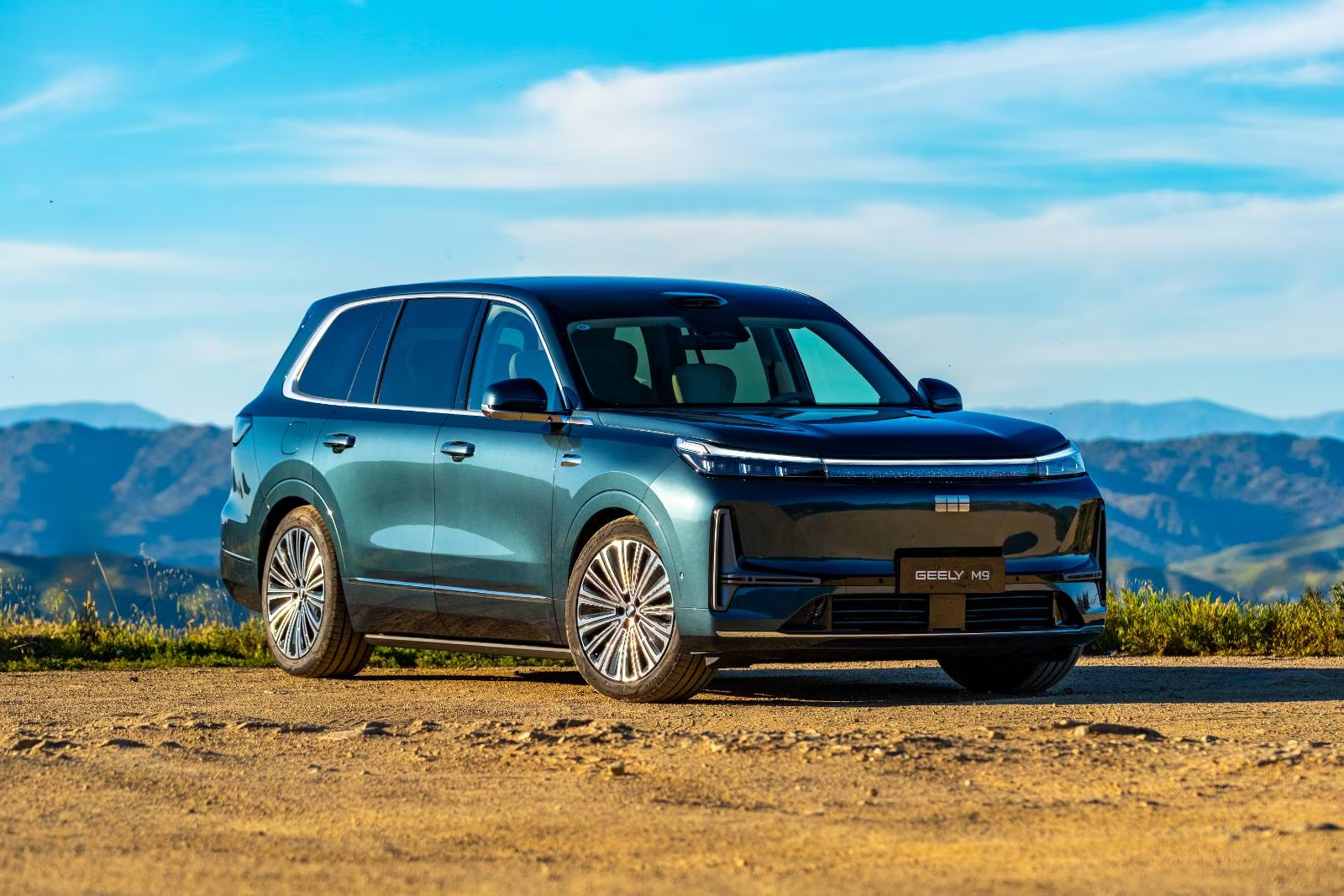

A Chinese SUV costing roughly ₹33 lakh is forcing Washington to confront two uncomfortable questions at once. Can American carmakers compete with China’s rapidly improving vehicles? And what happens when a modern car becomes a moving network of cameras, sensors, microphones and internet-connected computers?
Geely’s Galaxy M9 sits at the centre of that debate. The three-row hybrid SUV combines luxury features, digital controls and driver-assistance technology at a price that would be difficult to match in the US premium-car market.
Its appeal is easy to understand. The vehicle offers massage and heated seats, large entertainment displays, a multi-speaker sound system, a refrigerator and automated parking functions. Its hybrid powertrain also gives it long-distance driving capability.
But in Washington, the conversation has moved far beyond leather seats and touchscreens.
Algoritha Security Launches ‘Make in India’ Cyber Lab for Educational Institutions
Why a Smart Car Is Also a Data Machine
Modern connected cars constantly interact with the world around them.
Navigation systems know where the vehicle is travelling. Cameras watch roads and nearby objects. Sensors measure surroundings. Software communicates with servers for maps, diagnostics, updates and other services.
In simple terms, the modern car increasingly behaves like a smartphone on wheels.
That becomes a security issue when policymakers cannot confidently answer where the information goes, who can access it and whether a foreign company could remotely interact with critical vehicle systems.
US Senator Elissa Slotkin, a former CIA analyst, has been among the most vocal lawmakers raising these concerns. She has argued that connected vehicles could potentially collect location information, video and details about sensitive infrastructure such as military installations.
That does not mean a Geely Galaxy M9 has been proven to be secretly sending American military information to Beijing. No such claim should be made without evidence.
The concern is about capability and control rather than proof of espionage by a particular vehicle.
The US Department of Commerce had already acted on this broader risk before the latest legislative push. A final rule issued in January 2025 restricted certain connected-vehicle hardware and software linked to China and Russia after officials concluded that these technologies could create unacceptable national-security risks.
Washington Wants to Close the Door Further
The political response has intensified in 2026.
Senators Bernie Moreno and Elissa Slotkin introduced the bipartisan Connected Vehicle Security Act of 2026 in April. The proposal targets vehicles, connected software and critical hardware associated with China and other foreign adversaries.
The Senate Commerce Committee advanced the bill unanimously in July, sending it towards consideration by the full Senate.
A separate proposal, the Protecting America from Chinese Cars Act, addresses vehicles entering the US through countries such as Canada and Mexico.
That measure contains an important ownership test. It would cover certain vehicles made by companies in which Chinese firms hold more than a 15% stake.
The threshold could create complications well beyond purely Chinese brands.
Mercedes-Benz, for example, lists China’s BAIC Group as holding 9.98% of its voting rights. Chinese businessman Li Shufu separately holds another 9.69% through an investment company. How such ownership structures would ultimately be treated would depend on the final wording and implementation of any law.
Norway’s Bus Test Showed the Risk Is Not Theoretical
A 2025 cybersecurity test in Norway provides useful context for why governments are worried.
Public transport operator Ruter tested a Chinese-made Yutong electric bus alongside a European bus. Investigators found that the Yutong vehicle allowed remote digital access for software updates and diagnostics.
Ruter said that, in theory, this access could be used to affect the bus’s battery and power systems and potentially make the vehicle inoperable. Importantly, it also found that the bus cameras were not connected to the internet, meaning the test did not show that video footage was being transmitted abroad.
The episode demonstrated an important distinction.
Remote connectivity itself is not evidence of spying. Many modern vehicles rely on remote diagnostics and over-the-air software updates. The security question is whether those systems can be abused, compromised or accessed by an entity a government does not trust.
America’s Problem Is Economic Too
Security concerns are only half of Washington’s problem.
Chinese manufacturers have built huge battery, electronics and vehicle supply chains while developing new models at remarkable speed. They are increasingly able to package expensive-looking technology into comparatively affordable cars.
Blocking those vehicles may reduce one security concern. It does not eliminate the competitive challenge.
American manufacturers still have to answer the underlying question exposed by cars such as the Galaxy M9: why can Chinese companies offer so much technology for so much less?
That is why the battle over Chinese smart cars is becoming bigger than a trade dispute.
It is turning into a debate over industrial competitiveness, software control, data sovereignty and whether the next generation of automobiles should be treated merely as vehicles — or as powerful connected computers travelling through cities, military zones and critical infrastructure.
What this means for you: Before buying any internet-connected vehicle, check what data its cameras, apps and location systems collect and whether remote access can be disabled. A car’s privacy settings may soon matter almost as much as its mileage and safety rating.
https://www.linkedin.com/company/policetechnology/home/
