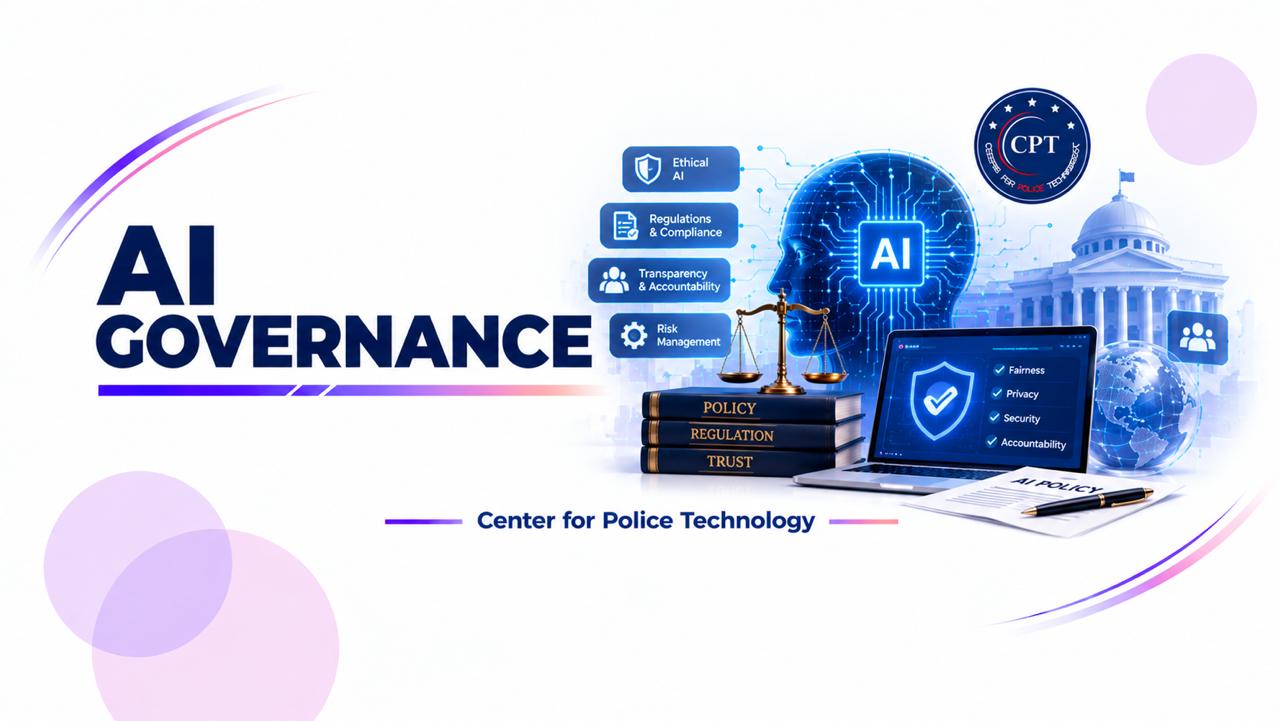

Centre for Police Technology (CPT) presents a 31-Day Cybersecurity Knowledge Series for police personnel, law enforcement agencies (LEAs), corporate investigators, digital forensics professionals and cybersecurity practitioners.
Artificial intelligence (AI) is transforming cybersecurity, financial services, policing and digital investigations. It can analyse large datasets, identify suspicious transactions and automate complex tasks. However, inaccurate outputs, privacy breaches, biased decisions and criminal misuse create serious risks. AI governance ensures that artificial intelligence is used responsibly, securely and accountably.
What Is AI Governance?
AI governance refers to the policies, processes and safeguards that guide how AI systems are developed, deployed and monitored. It establishes who is responsible for a system, what data it can access, how its decisions are reviewed and what happens when something goes wrong.
Effective governance combines technical controls, legal compliance, risk assessment and human oversight. Its objective is to encourage innovation while protecting individuals, organisations and society from avoidable harm.
How Criminals Can Exploit AI
Criminals can use AI to make traditional offences more convincing and scalable.
- Deepfake impersonation: Fake voices and videos can impersonate executives, relatives or government officials to manipulate victims into transferring money.
- AI-assisted phishing: Criminals can generate personalised messages, convincing emails and multilingual scamsdesigned to steal credentials or financial information.
- Identity fraud: AI-generated or manipulated images and documents may support impersonation and fraudulent account creation.
- Cyberattacks: AI tools can assist with reconnaissance, malicious content generation and adapting social-engineering tactics.
- Manipulating AI systems: Prompt injection and data poisoning can influence an AI system’s behaviour or compromise the reliability of its outputs.
Investigators must distinguish suspicion from proof. The presence of AI-generated content does not automatically establish who created it or whether a crime occurred.
https://the420.in/fcrf-certified-chief-ai-officer-second-cohort-november-2026/
How Police and Investigators Can Use AI
AI can assist law enforcement with financial-fraud analysis, suspicious-pattern detection, document examination, transcription, translation and reviewing large volumes of digital evidence.
However, AI outputs should be treated as investigative leads rather than conclusive evidence. Investigators should corroborate findings using independent sources, preserve original records and document the tools and methods used. Digital evidence must be collected lawfully, with its integrity and chain of custody maintained.
Human oversight is essential, especially when decisions affect a person’s liberty, reputation or legal rights. Investigatorsmust understand the limitations of AI tools and remain accountable for their conclusions.
The Core Pillars of AI Governance
Effective AI governance rests on several important principles:
- Accountability: Assign clear responsibility for developing, approving and monitoring AI systems.
- Data protection: Restrict access to sensitive information and establish appropriate data collection, storage and retention practices.
- Risk assessment: Evaluate potential security, privacy, fairness and reliability risks before deployment.
- Transparency: Document system capabilities, limitations and decision-making processes to the extent appropriate.
- Human oversight: Ensure qualified people can review outputs, challenge errors and intervene when necessary.
- Security: Protect models, datasets and connected systems against unauthorised access, manipulation and data leakage.
- Continuous monitoring: Track performance, investigate incidents and update safeguards as threats evolve.
AI Governance in India
India’s AI governance approach includes the IndiaAI Mission and the AI Governance Guidelines released by the Ministry of Electronics and Information Technology (MeitY) in November 2025. The guidelines promote responsible innovation through principles including trust, people-first development, fairness, accountability, transparency and safety. Read the official government overview.
Existing laws, including the Information Technology Act, 2000, and applicable data-protection and sector-specific requirements may also be relevant, depending on the use case. Organisations should distinguish policy guidance from binding legal obligations and verify which requirements apply to their activities.
What Organisations and Individuals Should Do
Organisations should maintain an inventory of AI tools, define approved uses, restrict access to confidential data and assess risks before deployment. Employees need training on AI limitations, data security and verification. High-impact decisions should have appropriate human review, while incidents must be documented and investigated.
Individuals should independently verify urgent requests for money, even when a voice or video appears genuine. Avoid sharing passwords, financial details or confidential documents with unapproved AI tools. Cross-check important AI-generated information against reliable sources.
In India, victims of cyber financial fraud should contact 1930 promptly and report the incident through cybercrime.gov.in.
The Future of AI Governance
As AI systems become more autonomous and gain access to business applications, governance must address theirpermissions, data access, security and actions. Frameworks such as the NIST AI Risk Management Framework and OECD AI Principles can help organisations develop risk-based safeguards.
AI governance must evolve alongside technology. Regular testing, clear accountability and effective oversight will be essential to maintaining public trust.
Conclusion
Artificial intelligence can strengthen investigations and improve security, but weak oversight can amplify fraud, expose sensitive information and produce harmful decisions.
The future of AI will depend not only on what the technology can do, but also on who governs it, how its risks are controlled and who is held accountable when it fails.
Day 28 — AI Governance
31 Days | 31 Key Topics | October 2026
Follow Centre for Police Technology (CPT) for the complete 31-Day Cybersecurity Knowledge Series.