
Follow us on Google News

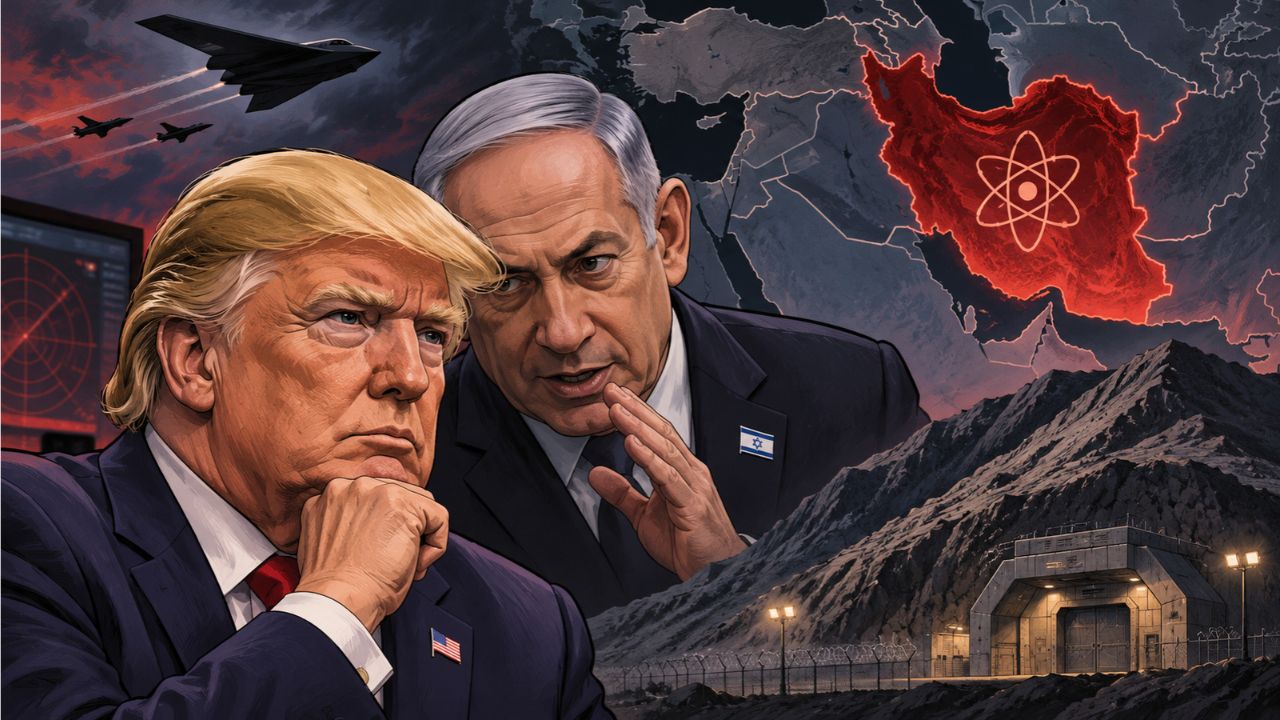
A dramatic claim by US political commentator Tucker Carlson that President Donald Trump could decide within days whether to use a nuclear weapon against Iran has triggered fresh concern over the direction of the eight-month conflict. But while renewed US military action against Iran is clearly under consideration, there is currently no public evidence that Washington has approved or formally prepared a nuclear strike.
In a lengthy social media post on November 2, Carlson alleged that Israeli Prime Minister Benjamin Netanyahu was pressing Trump to use a nuclear weapon against Pickaxe Mountain, a deeply buried Iranian site that has drawn growing attention from Washington and Israel.
Carlson further claimed that Trump could make a decision by November 7 and that Vice President JD Vance and US envoy Steve Witkoff were urging the president to continue pursuing diplomacy instead.
Those claims have not been independently confirmed by the White House, Pentagon or other US authorities.
What is established is that Trump is weighing both diplomatic and military options toward Iran and has publicly identified Pickaxe Mountain as a remaining site of concern.
What Exactly Has Tucker Carlson Claimed?
Carlson alleged that Netanyahu has been repeatedly pressing Trump to authorise an attack on Pickaxe Mountain in central Iran.
According to Carlson, Israeli intelligence believes Iran has restarted nuclear enrichment activity beneath the mountain. He argued that conventional American weapons would not be capable of penetrating the site’s deep granite protection and claimed that this leaves a nuclear strike as the only military option.
He attributed some of his assertions to unnamed informed sources, including the claim that Netanyahu was contacting Trump frequently over the issue.
Carlson also alleged that senior figures inside the Trump administration were divided over the next step, with Vance and Witkoff favouring a negotiated agreement with Tehran.
A report by Anadolu Agency reproduced Carlson’s claims but did not independently establish that a nuclear strike had been approved or scheduled.
The distinction is important. Carlson is describing what he says is happening inside the administration, but the public record does not currently demonstrate that Trump has authorised nuclear use.
Is Pickaxe Mountain a Real US Military Concern?
Yes. The concern surrounding Pickaxe Mountain itself is not based solely on Carlson’s post.
Trump recently identified the site while discussing Iranian nuclear facilities that could still be targeted.
According to reporting on his remarks, Trump said there were one or two remaining nuclear-related sites the US might have to address and specifically referred to Pickaxe Mountain. He said military plans existed for the area and indicated that the United States could act quickly.
However, he did not say that a nuclear weapon would be used. Reporting also noted that Trump had previously explicitly ruled out nuclear use against Iran in an October interview.
That leaves a significant gap between two propositions: Washington may be considering another military strike on an Iranian facility, but that does not establish that it is preparing a nuclear attack.
Is Netanyahu Pushing Trump to Resume Attacks?
There is stronger independent evidence that Netanyahu is pressing Washington for renewed military operations against Iran.
Axios reported that Trump and Netanyahu held a candid telephone conversation about the next stage of the Iran conflict. According to US and Israeli sources cited by the publication, Netanyahu wants military action to resume after the US midterm elections, while Trump has so far preferred to give diplomatic negotiations more time.
That supports the broader claim that Washington and Israel are debating whether to return to major combat.
It does not, however, independently confirm Carlson’s narrower allegation that Netanyahu is specifically demanding a nuclear strike.
Trump’s administration appears to be pursuing parallel tracks: continuing negotiations while maintaining military options if diplomacy fails.
Are US-Iran Negotiations Still Alive?
Diplomacy has not collapsed.
Iran said on November 2 that contacts with the United States were continuing through mediators after talks involving Qatar ended without a breakthrough.
Tehran’s September proposal remains part of the negotiations. Issues under discussion include restrictions on Iranian oil exports, the Strait of Hormuz and the possibility of future nuclear negotiations. Iran has rejected demands to transfer its highly enriched uranium stockpile abroad.
The absence of a breakthrough has kept the possibility of further fighting alive, but financial markets have also responded to hopes that a negotiated settlement could still emerge.
Oil prices fell sharply on November 2 as investors assessed the possibility that diplomacy could reduce disruption across the Middle East.
Trump has said the United States would not attack Iran before the November 3 midterm elections, while leaving open what could happen afterwards.
That makes the immediate situation uncertain, but it still falls short of evidence that nuclear use is imminent.
Could Conventional Weapons Reach the Site?
Carlson’s argument rests heavily on his assertion that conventional weapons cannot destroy Pickaxe Mountain’s underground facilities.
Deeply buried Iranian nuclear-related sites have long presented a military challenge, and the depth and geology surrounding them can limit the effectiveness of conventional bunker-busting weapons.
However, the public information available does not establish that a nuclear weapon is therefore the only possible option.
Military planners could theoretically consider several alternatives, including repeated conventional strikes, attacks on entrances and supporting infrastructure, cyber operations, sabotage or other means of rendering a facility unusable.
Without access to classified US military assessments, claims that nuclear use is the only viable option remain speculative.
What About Carlson’s Wider Warnings?
Carlson also warned that a US nuclear strike could contaminate the Persian Gulf, destabilise energy markets and create a precedent for nuclear escalation elsewhere.
Those are scenarios rather than established outcomes.
Any nuclear detonation in the region would carry exceptionally serious humanitarian, environmental and geopolitical consequences, but the scale and direction of those effects would depend on the weapon, detonation method, location, weather and subsequent actions by other states.
Carlson went further by arguing that nuclear use against Iran could encourage other nuclear-armed countries to employ their own weapons and ultimately lead to a wider global conflict.
Those conclusions are his assessment, not confirmed predictions.
So How Close Is the US to a Nuclear Strike?
Based on publicly available evidence, there is no basis to state that a US nuclear attack on Iran has been approved or is scheduled for November 7.
There is evidence that Trump is considering further military action, that Netanyahu is pressing for renewed attacks and that Pickaxe Mountain is one of the sites under discussion.
There is also evidence that the Trump administration has not abandoned diplomacy. US-Iran contacts continue, and figures including Vance and Witkoff have been associated with efforts to reach a negotiated settlement.
The key unresolved question is therefore not whether military escalation is possible. It clearly is.
The more consequential question raised by Carlson, whether the United States is seriously preparing to cross the nuclear threshold, remains unsupported by independent public confirmation.
Until official evidence or corroborated reporting establishes otherwise, claims of an imminent nuclear strike should be treated as allegations rather than fact.
About the author — Suvedita Nath is a science student with a growing interest in cybercrime and digital safety. She writes on online activity, cyber threats, and technology-driven risks. Her work focuses on clarity, accuracy, and public awareness.