
Follow us on Google News

Three separate developments involving Bihar politics, festive-season airfares and Maharashtra minister Nitesh Rane’s remarks on Diwali shopping have triggered political and public debate in recent days. While social media posts surrounding the issues contain strong political opinions, the underlying events and statements are supported by published reports.
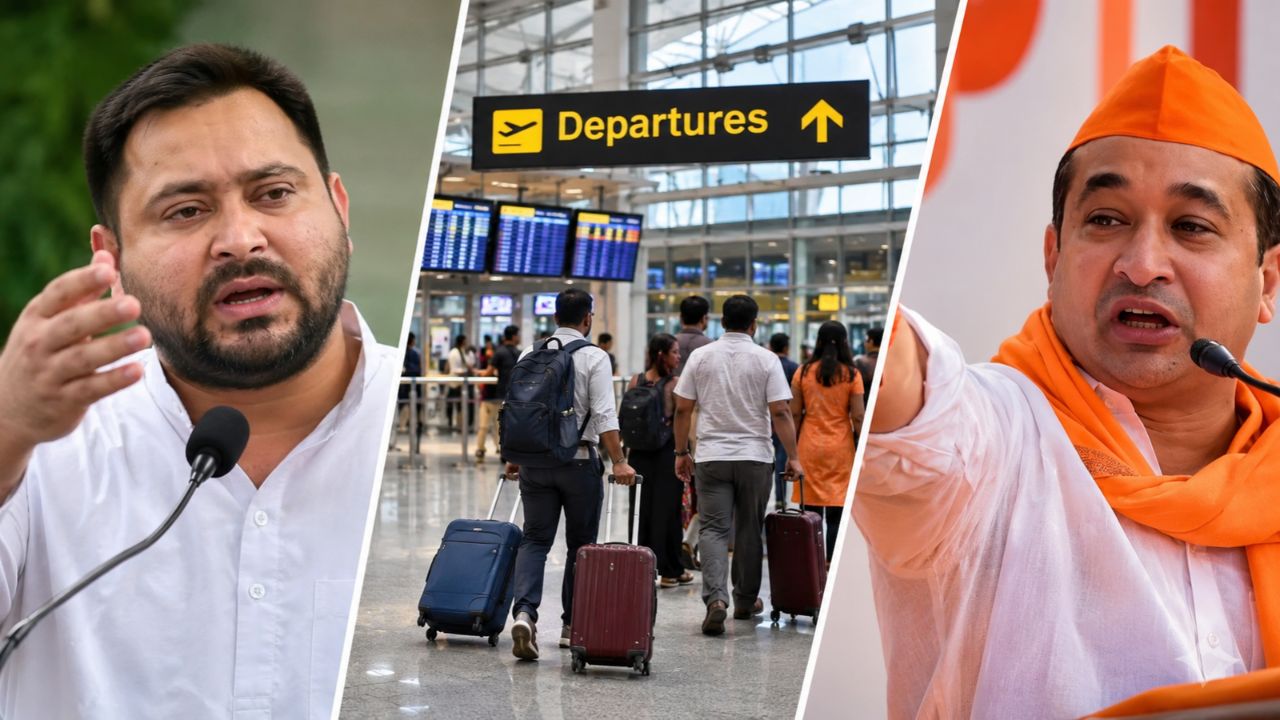
The developments include Rohini Acharya suggesting a possible political understanding between Tejashwi Yadav and Prashant Kishor in Bihar, sharp increases in domestic airfares during the festive travel season, and Rane urging Hindu consumers to consider the religious practices of shopkeepers while making Diwali purchases.
Rohini Acharya Floats Tejashwi-Prashant Kishor Equation
Rohini Acharya, daughter of RJD chief Lalu Prasad Yadav, has suggested that Tejashwi Yadav and Jan Suraaj founder Prashant Kishor could join forces to prevent a division of opposition votes in Bihar.
Her remarks came following elections to eight Bihar Legislative Council constituencies. Acharya argued on social media that combining the votes secured by the RJD and Jan Suraaj showed the potential strength of a united opposition against the NDA.
Results cited in reporting show that the combined first-preference votes of the RJD and Jan Suraaj exceeded the NDA tally in seven of the eight constituencies examined.
In the Saran Teachers’ constituency, for example, the NDA candidate received 2,440 first-preference votes, while the RJD secured 1,708 and Jan Suraaj 1,999. Their combined figure was 3,707.
In the Darbhanga Graduates’ constituency, the NDA candidate secured 14,774 first-preference votes. The RJD received 13,483 and Jan Suraaj 9,230, giving the two opposition parties a combined total of 22,713.
A similar pattern was reported in the Kosi Graduates’, Patna Teachers’, Patna Graduates’, Darbhanga Teachers’ and Tirhut Teachers’ constituencies. Tirhut Graduates’ was the exception, where the NDA tally remained higher than the combined RJD-Jan Suraaj vote.
However, these figures do not establish that an electoral alliance would automatically transfer all votes between the two parties. Voting behaviour can change when parties contest together, and no formal RJD-Jan Suraaj alliance has been announced.
A Jan Suraaj leader quoted in reporting acknowledged that the numbers showed the potential impact of cooperation but said the party was continuing on its own political path. RJD leaders had not publicly committed to such an arrangement in the report.
The stronger claims in social media commentary that the two leaders “must” unite or place political ambition aside therefore represent political opinion rather than an agreed opposition strategy.
Festive Demand Sends Domestic Airfares Higher
Separately, domestic airfares have risen sharply during the 2026 festive travel season as increased passenger demand coincides with higher aviation fuel costs and limited capacity on several routes.
Business Standard reported that average one-way fares for travel between September 1 and November 10 were about 68 per cent higher year-on-year on Delhi-Hyderabad, 51 per cent higher on Mumbai-Kolkata, 39 per cent higher on Delhi-Goa and 37 per cent higher on Mumbai-Bengaluru.
Travel companies have attributed the increases to strong festive demand, fewer flight options on some sectors and higher aviation turbine fuel costs.
Moneycontrol separately reported that return fares during the festive period were hovering around ₹18,000 for Delhi-Hyderabad, ₹17,000 for Delhi-Kolkata and Delhi-Ahmedabad, and about ₹16,000 for Delhi-Bengaluru.
Other reported fare snapshots showed significantly higher last-minute prices on individual flights. Such figures can vary sharply depending on the travel date, time of booking, airline, cabin class and remaining inventory and should not be treated as standard fares for an entire route.
The government had already indicated in September that it did not intend to impose a general airfare cap for the festive season.
Civil Aviation Minister K Rammohan Naidu said airlines would instead be asked to maintain fares at reasonable levels. He also pointed to the impact of higher aviation turbine fuel costs, including pressure linked to the situation in West Asia.
The issue has now also reached the Supreme Court.
On November 2, the court declined to urgently hear a petition alleging increases of nearly 700 per cent in some airfares. The Centre had earlier informed the court that administrative approval had been granted to rules under the Bharatiya Vayuyan Adhiniyam, 2024, aimed at regulating the aviation sector.
The available evidence therefore supports the broader claim that festive airfares have increased substantially. However, descriptions of the increases as “corporate loot” are political or personal characterisations rather than independently established findings.
Nitesh Rane Urges Hindus to Consider Vendors’ Religious Practices
In Maharashtra, minister Nitesh Rane has drawn attention for remarks concerning where Hindus should shop during Diwali.
Speaking in Mumbai, Rane urged members of the Hindu community to buy festive goods from shopkeepers who say “Jai Shri Ram”, wear a tilak and know how to recite Hindu prayers such as the Hanuman Chalisa or Maha Aarti.
The remarks followed another reported statement in which Rane urged people to avoid buying Diwali goods from Muslim shopkeepers. NDTV Marathi reported those comments on October 24.
Rane also called for non-Hindu traders to be barred from doing business at the Kumbh Mela, another statement that generated political criticism and debate.
His remarks on Diwali shopping were therefore part of a broader series of public statements linking commerce at religious events and festivals with religious identity.
The social media post accompanying the screenshot criticised Chief Minister Devendra Fadnavis and described Rane’s position as divisive. That criticism is the opinion of the person who published the post. What can be independently established is that Rane made the reported remarks about choosing vendors based on expressions of Hindu religious identity.
Social Media Posts Mix Facts With Political Interpretation
All three viral posts are based on genuine developments, but each adds its own political interpretation.
Rohini Acharya did raise the possibility of cooperation between Tejashwi Yadav and Prashant Kishor, but there is no confirmed alliance. Festive-season airfares have increased sharply on several routes, but individual screenshots showing extremely high fares represent particular booking conditions rather than permanent route prices. Nitesh Rane did urge Hindu shoppers to favour vendors displaying specific religious practices, while criticism describing those remarks as divisive remains a political assessment.
The distinction is important because political social media posts frequently combine verifiable events, selective statistics and personal conclusions. The underlying claims in these three cases have substantial factual support, but the political judgments attached to them should be presented as opinion rather than established fact.
About the author — Suvedita Nath is a science student with a growing interest in cybercrime and digital safety. She writes on online activity, cyber threats, and technology-driven risks. Her work focuses on clarity, accuracy, and public awareness.