
Follow us on Google News

Victims of online financial scams in India may be able to recover stolen money if they report the transaction quickly enough for banks and police to trace or block the funds.
The first steps to recover money lost in cyber fraud are to contact the bank immediately, call the national cybercrime helpline 1930 and register a complaint through the government’s cybercrime reporting portal. Recovery is possible, but no official process guarantees a refund in every case.
India’s Citizen Financial Cyber Fraud Reporting and Management System (CFCFRMS), operated under the Indian Cyber Crime Coordination Centre (I4C), is designed to interrupt the movement of stolen funds. According to the Ministry of Home Affairs, the system helped save more than ₹11,158 crore across over 32.80 lakh complaints by June 30, 2026. The amount saved must not be confused with money already refunded to victims.
What Should You Do Immediately After Cyber Fraud?
Contact your bank or payment service provider through its official fraud-reporting channel. Report the transaction, request appropriate restrictions on compromised accounts or cards, and obtain a complaint reference number. If the fraud involved UPI, identify the payment application, originating bank, transaction ID and beneficiary details.
Next, call 1930 and report the financial fraud. Keep the transaction date, amount, bank or wallet details and relevant screenshots ready. The government’s reporting instructions identify these details as important for initiating action.
If criminals obtained passwords, PINs or access to your device, secure those accounts using a trusted device. Do not send further payments to supposed investigators or recovery agents. Preserve messages, payment receipts and contact information instead of deleting evidence.
How Does the 1930 Cybercrime Helpline Help Recover Money?
The 1930 helpline connects financial fraud complaints to the CFCFRMS mechanism, which facilitates coordination among police, banks and financial intermediaries. Once a complaint is examined, the relevant institutions may attempt to stop further movement of identifiable fraud proceeds.
The objective is to place a hold or lien on money before it is withdrawn or transferred beyond reach. If funds have already passed through several accounts, tracing them can become more difficult.
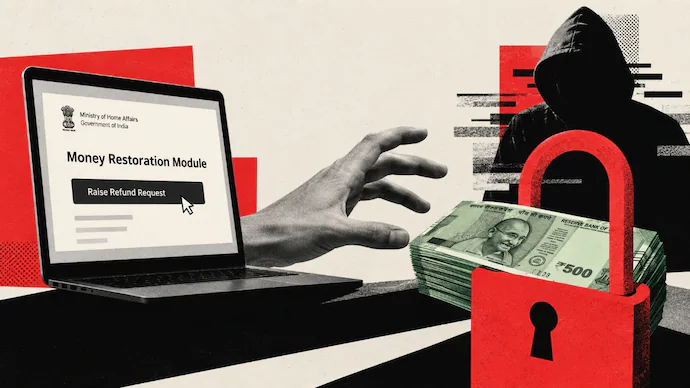
The Ministry of Home Affairs announced an updated operating framework in July 2026 covering complaint processing, bank coordination, lien removal and restoration of money to rightful claimants. Reporting immediately improves the opportunity for intervention, but there is no universally guaranteed recovery window.
How to File a Cybercrime Complaint Online
Visit the official National Cyber Crime Reporting Portal and select the appropriate financial cybercrime reporting option. Enter the transaction details, explain how the fraud occurred and upload supporting evidence where requested.
Keep the acknowledgement number safely. Official reporting instructions direct people who receive a helpline acknowledgement to complete the corresponding online complaint within 24 hours. This is an important follow-up requirement, not a promise that the money will be recovered within 24 hours.
Victims should also preserve the bank’s complaint number and any police or FIR reference. A portal complaint and an FIR are not necessarily the same document.
Can Banks Refund Money Lost Through UPI or Online Banking?
RBI’s customer-protection rules distinguish unauthorised electronic banking transactions from payments a customer makes after being deceived. Under the July 2017 framework, zero liability can apply where a bank is responsible for the breach or where a qualifying third-party breach is reported within three working days of receiving the bank’s transaction communication. Other circumstances attract different liability rules.
Where zero or limited liability applies, the RBI framework requires a provisional credit, known as a shadow reversal, within ten working days. This is not an unconditional refund for every cyber scam.
If a victim personally authorises a transfer to a fraudulent investment scheme or impersonator, reimbursement is not automatically available under these provisions. Such victims should still report the fraud immediately so authorities can attempt to secure the transferred funds.
How Can Victims Get Frozen Cyber Fraud Money Back?
When stolen funds are located in a beneficiary account, banks may place restrictions on the identified amount. However, freezing money and returning it are separate stages. Investigators must establish the relevant transaction trail and determine who is entitled to the funds. The process may involve police verification, banking records and applicable legal procedures.
In October 2026, The420.in covered Rajasthan’s cyber fraud money-restoration initiative, which reported directions to return ₹5.67 crore to victims through an online restoration mechanism. The procedure described was state-specific and should not be assumed to operate identically across India.
What if the Bank Refuses to Help?
Escalate the complaint through the bank’s grievance-redress mechanism and retain all correspondence. If the bank does not respond within the applicable period or its response is unsatisfactory, eligible complaints concerning banking-service deficiencies may be taken to the RBI Ombudsman.
The Reserve Bank Integrated Ombudsman Scheme, 2026, effective July 1, 2026, replaced the 2021 scheme. Complaints can be submitted through RBI’s Complaint Management System. Generally, customers must first approach the regulated entity and observe the scheme’s eligibility and timing requirements.
The Ombudsman addresses qualifying service complaints. It does not replace police investigations or guarantee the recovery of money transferred to criminals.
Frequently Asked Questions About Cyber Fraud Money Recovery
1. Can stolen money be recovered after a UPI scam?
Yes, recovery may be possible if funds can be traced and secured. It is not guaranteed.
2. Is the 1930 cybercrime helpline free?
Yes. It is the government’s toll-free helpline for assistance with cybercrime complaints.
3. Can money be recovered after several days?
Possibly, but delays can make recovery harder. Report the incident even if several days have passed.
4. Does RBI guarantee a refund within ten days?
No. The ten-working-day provisional-credit rule applies to qualifying unauthorised electronic banking transactions, not every scam payment.
5. Does a frozen amount mean the victim has received a refund?
No. Funds may remain restricted while police and banks complete the required verification and restoration process.
6. Can victims report fraud without an FIR?
They can initially report financial cyber fraud through 1930 and the national portal. Police may subsequently register an FIR according to the circumstances and applicable law.
The420 Insight: Report First, Follow Up Until the Money Is Released
The best chance to recover money lost in cyber fraud begins with immediate reporting, not waiting for the scammer to return it. Contact the bank, call 1930, complete the online complaint and preserve every reference number. If funds are frozen, ask the investigating authority about the official restoration process. Never pay anyone promising a guaranteed refund.