
Stay ahead with our breaking stories and exclusive coverage prioritized on Google.
Add The420 on Google →Andhra Pradesh Chief Minister N. Chandrababu Naidu announced on Saturday that the state government will implement a Legal Artificial Intelligence (AI) stack starting in February 2027 to modernize legal administration and case management. Speaking at an event in Rajamahendravaram, the Chief Minister stated that the initiative will create a digital repository of laws, government orders, judicial verdicts, and litigation records. The primary objective of the technology is to identify legal loopholes in government decisions before they are finalized, thereby reducing unnecessary disputes and easing the burden on the judiciary.
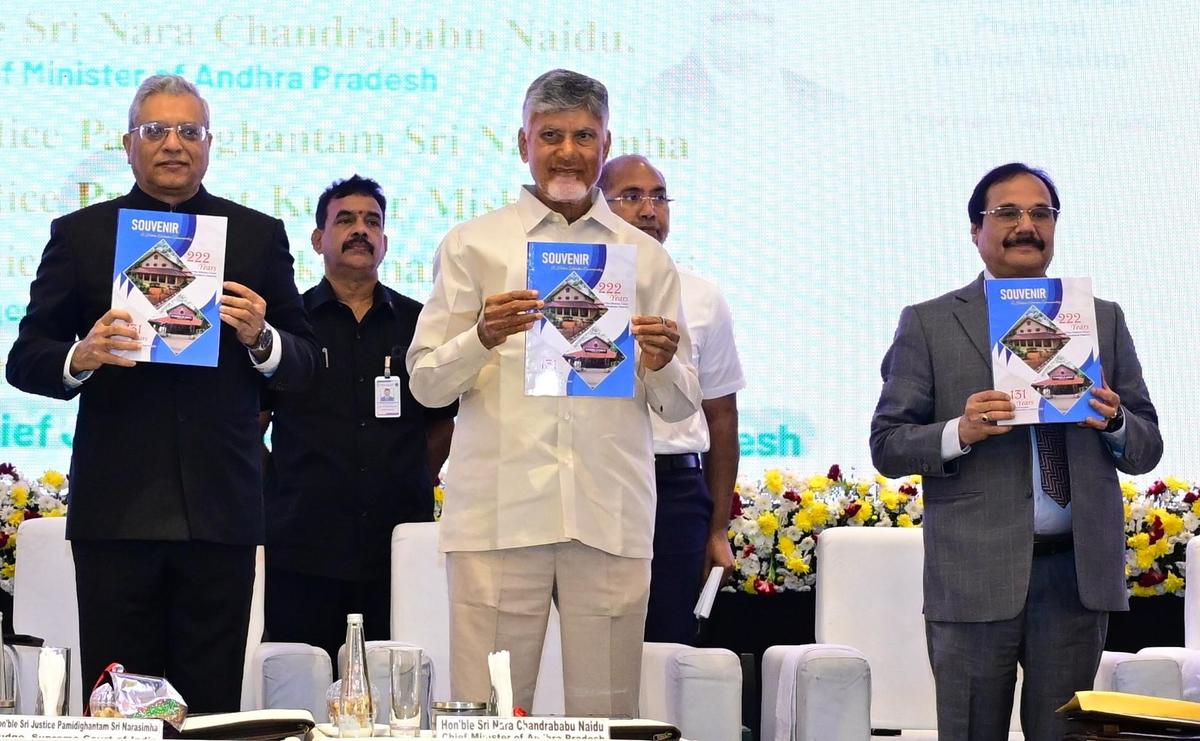
The announcement was made during a ceremony commemorating 222 years of the District Court’s establishment in Rajamahendravaram and the 131st foundation day of the Rajamahendravaram Bar Association. Supreme Court judges Justices Pamidighantam Sri Narasimha, Prashant Kumar Mishra, and Sarasa Venkatanarayana Bhatti, along with Andhra Pradesh High Court Chief Justice Lisa Gill, attended the event. Naidu explained that the proposed Legal AI stack will incorporate AI assistants for legal research, case analysis tools, technical support for drafting counter-affidavits, and technology-driven mediation to help departments manage pending court cases more effectively.
Pre-Release Legal Vetting of Government Orders
A defining feature of the new system will be the mandatory legal review of any Government Order (GO), administrative decision, or agreement prior to its official release. The AI platform will detect potential legal vulnerabilities and disputes within proposed policies, allowing officials to make necessary rectifications before implementation. Naidu noted that the system will also track court directives, compliance status, and stipulated deadlines in real time. This continuous monitoring aims to establish administrative accountability by keeping government departments informed about pending judicial instructions and their compliance timelines.
According to the Chief Minister, the deployment of technology in legal affairs will extend beyond simple document digitization to accelerate dispute resolution and case evaluation. The state government expects these digital tools to bring greater structure and efficiency to overall legal administration.
Curbing State Litigation to Free Judicial Time
Acknowledging that the government is the largest litigant in the country’s judicial system, Naidu pointed out that cases involving state departments and institutions significantly increase the workload of the courts. He emphasized that reducing the volume of government-related litigation would grant courts more time to deliver quality judgments in other pending matters. Early-stage legal scrutiny through the AI stack is designed to prevent disputes that typically reach the courts due to procedural flaws or overlooked legal aspects.
While highlighting the growing role of technology in the judiciary, the Chief Minister stressed that the core purpose of justice must remain rooted in human empathy and needs. Tracing the evolution of the Rajamahendravaram District Court since its inception in 1804, he remarked that judicial records have transitioned from palm leaves to paper, computers, and now artificial intelligence. However, he maintained that regardless of technological advancements, human beings must remain at the center of the justice delivery system.
Honoring 140 Years of Judicial Heritage
Naidu also reflected on the historical significance of the Rajamahendravaram District Court, noting that its current building was constructed in 1886. Over the past 140 years, the institution has witnessed British rule, the freedom struggle, independence, and the establishment of the republic, with generations of judges and advocates serving society. He observed that while physical structures age over time, institutions endure through their values and traditions.
Commending the Rajamahendravaram Bar Association on its 131st anniversary, Naidu recalled that it was founded by a group of 14 lawyers led by noted advocate Nyapathi Subba Rao. The association played a vital role in the independence movement and the agitation for a separate Andhra Pradesh state. Prominent figures associated with the bar include Andhra Pradesh’s first Chief Minister Tanguturi Prakasam Pantulu and Justice Koka Subba Rao, who served as the first Chief Justice of the Andhra Pradesh High Court and the ninth Chief Justice of India. During the ceremony, six advocates with over five decades of practice, including 98-year-old Pothukuchi Suryanarayana Murthy, and eight retired judges who were former members of the bar association were felicitated.