
Follow us on Google News

Nearly 30 Indian investors allege unauthorised US stock trades through Stockal, with estimated losses exceeding ₹100 crore.
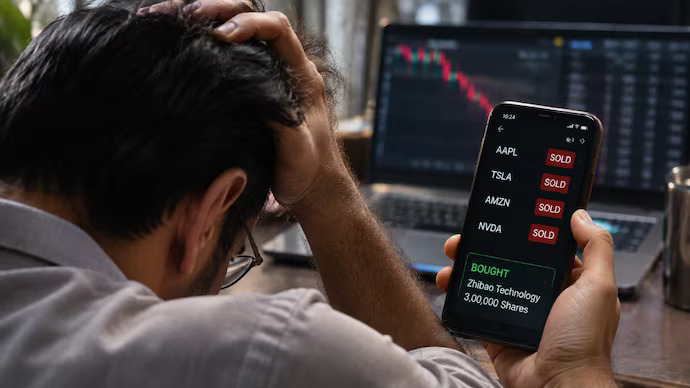
The allegations involve the liquidation of shares in major American technology companies, including Apple, Nvidia, Amazon, Tesla, Alphabet and AMD, on October 15, 2026. Investors claim their holdings were sold without permission and the proceeds redirected into shares of a relatively illiquid Chinese company. Complaints have reached regulators in India and the United States, while the platform and its brokerage partner have disputed responsibility for the incident.
What Happened to Investors’ US Stock Holdings?
The alleged transactions took place through Stockal Securities, a Bengaluru-based fintech platform that enables Indian investors to access American equities and other overseas securities. According to affected investors, their portfolios underwent substantial changes on October 15 without their knowledge or authorisation. Shares accumulated over several years were allegedly liquidated, and the proceeds were used to purchase millions of shares in Zhibao Technology Inc., a Chinese company listed on Nasdaq under the ticker ZBAO.
Investors maintain that they neither placed the orders nor approved the transactions. The purchases involved a comparatively thinly traded stock whose price subsequently declined sharply, leaving affected account holders facing substantial losses.
Zhibao shares reportedly fell from an average purchase price of $1.05 in one investor’s account to $0.42 on October 23, representing a decline of approximately 60%.
https://the420.in/fcrf-certified-chief-ai-officer-second-cohort-november-2026/
How Did Investors Report Losses Exceeding ₹100 Crore?
The preliminary estimate of losses exceeding ₹100 crore is based on information supplied by two investors and has not been independently verified across all affected accounts. One investor, a senior official at a leading beverage company, alleged that 10 major US stock holdings were sold for approximately $335,768. The proceeds were reportedly used to purchase 300,000 Zhibao shares. He estimated his losses at approximately $450,000, equivalent to ₹4.26 crore, and claimed he received neither the usual trade confirmations nor warnings.
Another investor alleged that securities worth approximately $3.1 million, or ₹29 crore, were liquidated within two minutes. The proceeds were allegedly used to purchase 30.5 lakh shares of a thinly traded stock within 15 minutes. The investor said the transactions occurred without verification or notification and that neither the account nor the losses had been restored.
What Has Stockal Said About the Incident?
Stockal’s parent company, Borderless, acknowledged suspicious trading activity but maintained that its investigation had found no evidence of a breach of its internal systems.
According to the company, its US brokerage and custody partner, DriveWealth, notified it on October 16, India time, about unauthorised activity involving 13 customer accounts during US trading hours on October 15. Borderless stated that an unauthorised third party appeared to have accessed 26 customer accounts using valid login credentials. In 13 accounts, existing large-cap US equity holdings were sold and the proceeds redirected into thinly traded microcap securities.
The company said access to affected accounts was restricted shortly afterwards and maintained that no funds had been withdrawn. It also suggested that account holders might have been targeted through social engineering involving information exposed in another company’s data breach. However, the possible connection remains unconfirmed and under investigation.
Independent cybersecurity specialists have been engaged to examine the company’s systems.
Why Are Stockal and DriveWealth Disputing Responsibility?
Stockal works with US-based brokerage and clearing partners, including DriveWealth LLC, to facilitate overseas investments. The arrangement means the platform through which customers access their portfolios may differ from the entity responsible for executing transactions or holding securities.
In a letter dated October 30, DriveWealth reportedly told an affected investor that the unauthorised access occurred through Stockal’s investor interface rather than its own systems. DriveWealth maintained that security lapses associated with Stockal’s platform were Stockal’s responsibility. It also stated that the affected account was frozen after receiving instructions from Stockal.
The brokerage criticised Stockal’s handling of the incident and questioned whether sufficient urgency had been demonstrated. These assertions remain disputed, and investigators have yet to establish how the accounts were accessed or how the transactions were processed.
Why Has HDFC Securities Been Mentioned?
HDFC Securities previously partnered with Stockal in 2019 to introduce a global investing service through globalinvesting.in. Some investors affected by the alleged unauthorised transactions had originally been introduced to Stockal through this arrangement.
However, the operational partnership ended in July 2024, more than two years before the October 2026 incident. HDFC Securities clarified that it was not named among the accused in the FIR connected with the case.
The company said customer trust and regulatory compliance remained central to its operations and indicated that it would cooperate with regulators and authorities as required.
What Action Have Investors and Authorities Taken?
Affected investors have approached the Securities and Exchange Board of India (SEBI) and the US Securities and Exchange Commission (SEC), seeking intervention and compensation. An FIR has also been registered in Bengaluru following a complaint concerning the alleged unauthorised transactions.
The entities named in the FIR include DriveWealth LLC, Stockal Securities, Borderless Softech Private Limited, Borderless Investing Inc. and HDFC Securities. Being named in an FIR does not establish criminal liability.
The investigation must determine whether account credentials were compromised, whether authentication controls were bypassed and how the disputed transactions were authorised or executed. The distinction between unauthorised access and subsequent market losses will also be important. While Zhibao’s share price decline is a market event, investors allege that the original purchases were made without their consent.
The final financial impact will depend on the number of affected accounts, transaction prices, remaining holdings and any subsequent recoveries. For now, the incident has raised significant questions about account security, transaction verification and responsibility across platforms that facilitate international stock investments.